How to Breed Guppies: Pairs, Fry Tank and Raising Strains
Published: 2026-11-19 · FishyKart Blog
To breed guppies on purpose, choose one male to two or three females from the same strain, keep them at 72-82 F (22-28 C) in a planted tank, and give the fry a separate 10 gallon grow-out tank with a sponge filter. Poecilia reticulata is a livebearer: a female gives birth to free-swimming fry roughly every 3-5 weeks and can drop several broods from one mating. Getting fry is easy; the skill is choosing parents, raising fry fast and deciding what happens to dozens of young every month.
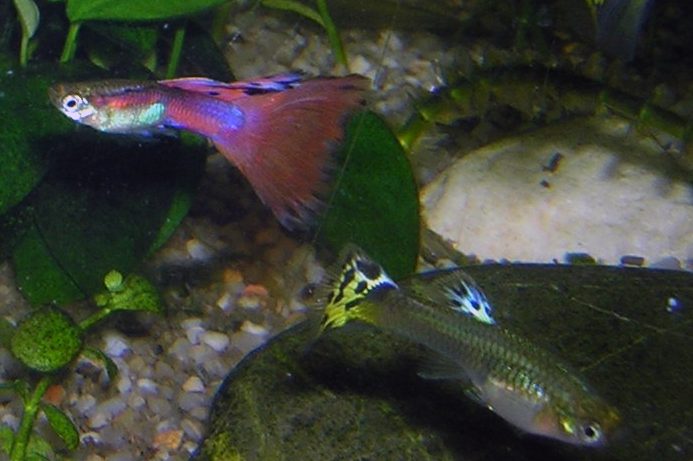
Photo: Federico Cisnetti - Wikimedia Commons, CC BY-SA 3.0
Guppy Breeding at a Glance
| Step | Figure | Source |
| Ratio | 1 male : 2-3 females | PetMD |
| Temperature | 72-82 F (22-28 C) | PetMD |
| Gestation | about 21-35 days | our pregnant guppy guide |
| Brood size | usually 20-40 fry | Tropical Fish Hobbyist |
| First food | newly hatched brine shrimp, twice a day | Tropical Fish Hobbyist |
| Breeding age | as early as 3 months | Tropical Fish Hobbyist |
Sources: PetMD guppy care sheet (reviewed by Maria Zayas, DVM) and Tropical Fish Hobbyist, "Back to the Basics: Breeding Guppies".
Step 1: Choose the Parents
Decide what you want before you buy: long fins, a color such as blue grass or red, or a pattern such as cobra. Tropical Fish Hobbyist advises buying females from the same strain as the chosen male, because females carry the genes even when they look plain. Pick the healthiest, best-shaped fish, not just the brightest. Telling the sexes apart is covered in male vs female guppy. Females bought from a mixed shop tank may already be pregnant by an unknown male, so for a pure line, use virgin females raised apart, or discard the first broods.
Step 2: Set Up Two Tanks
- Breeding tank: the trio or small group, about 10 gallons, heated to 72-82 F, with a sponge filter so fry are not sucked in, and floating plants such as hornwort or water sprite.
- Grow-out tank: another 10-20 gallon tank where fry live away from adults, which eat them.
Move fry daily with a small net or cup, or move a heavily pregnant female into a planted fry tank shortly before birth. Signs of an imminent birth and safe ways to move her are in our pregnant guppy guide.
Step 3: Raise the Fry Fast
Guppy fry are born able to swim and eat. Growth in the first weeks sets their adult size and fin length, so feed small amounts at least twice a day: newly hatched brine shrimp for the best growth, plus finely crushed flakes or powder food. Remove anything uneaten after about five minutes, and change 20-30% of the water often, because fry tanks foul quickly. Brine shrimp hatching is explained in brine shrimp for fish, and adult diets in what to feed a guppy.
Step 4: Separate the Sexes Early
Young males start mating soon after they mature, and Tropical Fish Hobbyist recommends separating the sexes as soon as possible so you control which males father the next generation. Fry can be sexed by the shape and position of the anal fin; males' anal fins begin to point forward and narrow into the gonopodium. Keep the best few males and females as the next breeders, and grow the rest out separately.
The Numbers Problem: Plan for Surplus
A breeding trio does not stay small. Two females each dropping a brood of about 30 every month produce roughly 60 fry a month, or around 180 in three months, by our rough calculation, before those fry start breeding themselves at about three months. Before you start, decide where the young go: a local fish shop that takes trade-ins, other hobbyists, or a larger tank. Never release guppies into ponds or streams; in many places they are an invasive species. If you only want a few fry, keep males alone, see guppy tank size for stocking by gallons.
Common Breeding Mistakes
- Too many males: females get chased constantly and stressed; keep at least two females per male.
- Cold water: below 72 F, broods slow down and fry grow poorly; see guppy water temperature.
- Mixing strains: crossing different colors produces muddled offspring and loses the traits you chose.
- Breeding brothers and sisters for many generations without new stock can weaken a line; bring in an unrelated fish of the same strain now and then.
General care, tank and food for adults are in our guppy care guide.