About & Origin
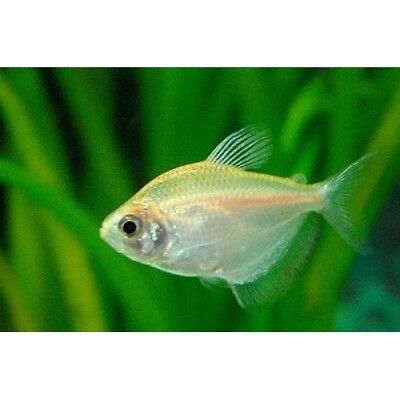
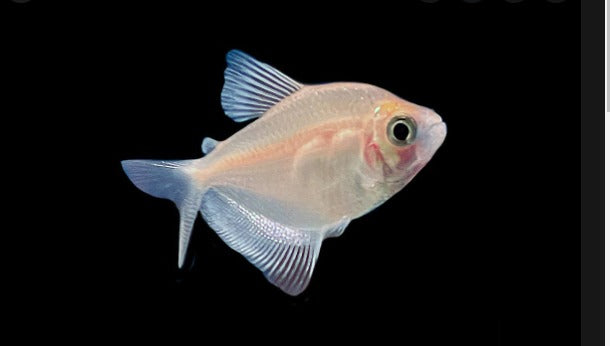
The widow/skirt tetra (Gymnocorymbus ternetzi) is a deep-bodied tetra species native to the Rio Paraguay basin in Brazil, Bolivia, Paraguay, and Argentina, where it shoals in slow-moving, well-vegetated stretches of river. The wild fish is a smoky grey-black, and the white ('albino'/pastel) form seen in this listing is a selectively bred colour variant of the same species.
Its deep, tall body and flowing fins -- particularly pronounced in long-finned strains -- give it a distinctive silhouette that stands apart from most other tetras, and it earned the 'skirt' name from the way those fins trail as it swims.
It's a hardy, adaptable tetra that has been a hobby staple for decades, tolerating a wider swing in water conditions than many of its more delicate soft-water relatives.
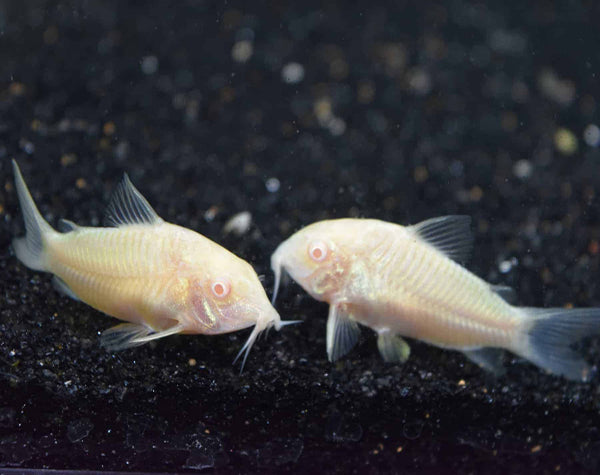
Unlike the vividly dyed or bred colour-morph widow tetras sold elsewhere, this white/pastel form is a genuine, stable selectively-bred colour line rather than an artificially dyed fish — the pale colouring is present from birth and doesn't fade or wash out over the fish's lifetime the way an injected dye can. It reads as a soft, almost pearlescent grey-white rather than a stark, artificial white, which some keepers find a more natural-looking alternative to the brighter dyed variants.
Requirements
A shoal of at least 6 does best in a tank of 60cm (24in) or more, with open swimming space and some planting for cover. Kept in insufficient numbers, skirt tetras can become fin-nippers toward each other and toward slower, long-finned tankmates -- shoaling in proper numbers largely resolves this.
It's an easy, unfussy eater -- flake, micro-pellets, and occasional live or frozen brine shrimp or daphnia are all readily taken.
Because of its fin-nipping tendency in small groups, avoid pairing it with slow-moving, long-finned fish like bettas or fancy guppies unless kept in a properly sized shoal in a spacious tank.
Long-finned strains: if this is a long-finned ("veiltail") skirt tetra rather than the standard fin length, be aware the extended fins are more prone to snagging on sharp or rough décor and take slightly longer to recover from any damage — smooth-edged decor and driftwood are a safer choice than jagged rockwork for this variant specifically.
Sourcing: because pale colour morphs of this species are sometimes confused in shops with dyed stock of the standard grey-black form, buying from a source that can confirm this is a genuine bred colour line (not an injected dye) matters if a stable, non-fading colour specifically is the priority — a quick way to tell is that dye jobs often look unnaturally uniform or slightly too saturated compared to the softer, more variable tone of a genuine bred pastel line.
Compatibility

Water & Care Conditions
One of the hardier, more adaptable tetras in the hobby, tolerating a wider water-chemistry range than most soft-water Amazonian species:
- pH: 6.0–7.5
- Water hardness: soft to moderately hard, 5–20 dGH
- Temperature: 22–28°C (72–82°F)
- Oxygenation: not demanding; standard community filtration is sufficient
Because the pale colouring makes this fish easy to see clearly against most backgrounds, it's also relatively easy to spot early warning signs of illness — clamped fins, faded or blotchy patches, or laboured breathing all stand out more readily here than on a darker-bodied tetra, making it a reasonably forgiving fish for a keeper still learning to read fish body language.
Weekly partial water changes of 20-25% and steady, avoided-sudden-swing water parameters matter more for this species' long-term condition than any single number in the ranges above — it's genuinely tolerant of a range, but not of instability within that range.
Well-kept skirt tetras of this type commonly live 3-5 years, longer than many small tetras, which is worth factoring into stocking decisions as a genuine multi-year commitment rather than a short-lived starter fish.
New arrivals benefit from slow, drip-style acclimation over 20-30 minutes rather than a quick float-and-release, since transport stress combined with a sudden water-chemistry shift is one of the more common preventable causes of early losses in newly purchased tetras.