Customer Reviews
About & Origin
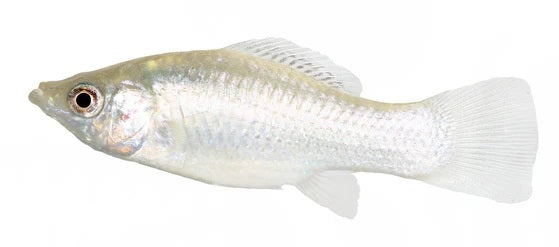
The White Molly is a livebearer fish -- a pale, cream-white colour form of Poecilia sphenops, the short-finned molly, retaining the standard streamlined body shape rather than the "balloon" variant. Its wild ancestors are native to fresh, brackish, and coastal waters across Central America, from Mexico down through parts of Colombia and Venezuela, reaching into the southern United States in places.
As a standard-bodied molly, it's an active swimmer that spends much of its time grazing algae and biofilm from surfaces and décor alongside general omnivorous feeding on flake, pellet, and occasional live/frozen food.
Like all mollies, it's a livebearer -- giving birth to free-swimming fry rather than laying eggs -- and breeds readily in a mixed-sex group, one of the reasons mollies remain such a popular, easy beginner fish.
Poecilia sphenops is also known to hybridise with related molly species, most notably the sailfin molly (Poecilia latipinna), when kept together in a mixed-sex tank — worth knowing if you want to keep this white short-finned strain's line pure rather than crossed with a sailfin variety. Unlike the balloon-bodied molly strains sold alongside it here, this standard-bodied form keeps the natural, streamlined swimming ability of the wild species, with no compressed-spine trade-off.
Requirements
Standard molly husbandry applies (hard/alkaline water preference, tolerates a light dash of aquarium salt, female-heavy groups, 75cm/30in+ tank, grazing omnivore diet with regular vegetable matter, most fry get eaten in a community tank unless you plan for them, standard filtration).
This strain specifically: a standard-body, pale cream-white colour form with no balloon-shape considerations. The pale body makes early stress or water-quality symptoms (reddish streaking, cloudy patches, ragged fins) noticeably easier to spot than on darker molly strains — a genuine practical upside for keeping an eye on health at a glance.
Activity level: as a standard-bodied fish, this strain swims and forages more actively than a balloon-bodied molly, and does best with genuine open swimming space to make use of that — a wider, longer tank footprint suits it better than a tall, narrow one even at the same overall volume.
Fry management: a mixed-sex group will produce fry regularly, often every few weeks, and in a community tank most of these get eaten naturally by adults and tankmates before reaching any size — which is fine if you're not trying to raise them, but worth a plan (dense floating plants, a breeding trap, or a separate rearing tank) if you actually want to grow out fry to adulthood rather than let the population self-regulate.
Compatibility
Water & Care Conditions
- pH: 7.5–8.5 (alkaline)
- Hardness: moderately hard to hard, roughly 15–30 dGH
- Salinity: freshwater to brackish; tolerates a small dose of aquarium salt
- Temperature: 24–28°C (75–82°F)
- Water changes: weekly 20-25% for this bioload-heavy, fast-breeding livebearer
Because the body is pale, this strain shows the classic molly stress sign — "shimmying," a side-to-side sway without forward movement — and any reddish streaking or cloudy patches more clearly and earlier than darker mollies do. Treat those as a cue to check hardness and temperature stability before assuming illness.
Given correct hard/alkaline water, this is a hardy, disease-resistant strain. It doesn't suit a soft, acidic tank set up for tetras or dwarf cichlids — pair it with other hard-water livebearers instead.
A gently sloped, buffered substrate (crushed coral or aragonite sand mixed into a standard substrate) is a common, low-effort way to help maintain the harder, more alkaline water this species prefers over the long term, particularly in regions where tap water runs naturally soft.
Well-kept mollies of this type commonly live 3-5 years, somewhat longer than many small livebearers, provided water hardness and stability are kept consistent rather than allowed to drift toward soft/acidic over time — the single biggest lever for long-term health with this species.