About & Origin
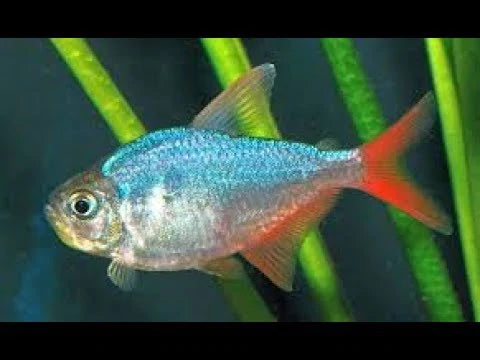
This listing refers to the same species as the Colombian Tetra (Hyphessobrycon columbianus) — a South American tetra — native to the Río Acandí and Río Atrato basins of Colombia in South America — despite "Asian" appearing in the product name, the fish itself is South American, not Asian; the name here most likely reflects how the batch was sourced or supplied rather than the species' natural range. It's a larger, robust tetra reaching around 6 cm, with a silvery-pink body and red fins edged in black.
Its size and bold colour make it a strong centrepiece shoaling fish for medium to large community tanks, and it has a long-standing reputation in the trade for combining hardiness with good looks.
Despite the "Asian" in some trade names, this fish, Hyphessobrycon columbianus, is South American in origin, native to the Atrato River basin in Colombia — the naming is a hobby/trade quirk rather than a reflection of its real geography.
It's one of the larger and more robust tetra species commonly kept, with a deep-bodied silver form flushed with pink-to-red on the fins and lower body, and is prized for good colour that intensifies under good conditions and varied diet.
In the wild it inhabits clear to slightly tannin-stained forest streams with moderate flow, foraging on small invertebrates, fallen fruit, and plant material.
Despite the "Asian" in some trade listings, this fish is South American in origin, not Asian — Hyphessobrycon columbianus comes from fast-flowing tributaries in Colombia, and the naming is a long-standing quirk of the ornamental fish trade rather than a taxonomic fact. Adults develop a striking two-tone body, rosy-orange toward the head shading into a darker rear half, with the dorsal, anal, and caudal fins trimmed in black and white.
Requirements
As a larger tetra, it needs a correspondingly roomy tank and should be kept in a shoal of 6 or more for confidence and natural shoaling behaviour.
Generally peaceful, though its size means very small fish or fry could be seen as food, so it's best matched with other medium-sized, robust community species rather than tiny nano fish.
An easy eater, taking flake, pellets, and live or frozen foods without fuss.
Being larger-bodied than most tetras (adults can approach 6-7cm), it needs a bit more swimming room than the smaller nano tetras, and does best in a group of 6 or more in a tank of at least moderate size.
Generally peaceful but can be a boisterous, active midwater swimmer — fine with similarly sized, non-nippy community fish rather than tiny nano species that could be intimidated by its size and activity level.
An easy omnivore: takes flakes and pellets readily, with frozen and live foods boosting colour and conditioning for breeding.
Because of its larger adult size, a tank of at least 80-100 litres is a more realistic long-term home than a small nano setup.
This is a notably larger and more boisterous tetra than most community staples, reaching close to 6cm and displaying real swimming power that benefits from a longer tank footprint rather than a tall, narrow one. Kept in groups of six or more it settles into a stable, mostly peaceful shoal, but singles or very small groups can become nippy toward slower tankmates.
It is a mid-water swimmer that appreciates open space and some current, and does well on a varied diet of flake, pellets, and occasional live or frozen foods to support its larger size and active metabolism.
Compatibility


Water & Care Conditions
Hardy and adaptable within a fairly typical tropical community range:
- pH: 6.0–7.5
- Salinity / hardness: freshwater only, soft to moderately hard water
- Temperature: 22–27°C (72–81°F)
- Light: moderate; not especially light-sensitive
- Oxygenation: standard filtration and flow are sufficient for this hardy species
- Growth rate: reaches near-adult size relatively quickly on a varied diet, faster than many smaller tetra species
- Water flow: appreciates moderate current reflecting its native fast-water origin, unlike many still-water blackwater tetras
- Diet: benefits from a varied diet including some live/frozen foods to support its larger size and activity level
- Longevity: can live 5+ years in stable, well-maintained conditions
- Tank position: a mid-water swimmer that appreciates open space and a longer tank footprint given its larger, active build
- Filtration: a well-maintained filter and regular partial water changes keep this larger, more active species in top condition
- Substrate: a dark substrate helps show off its colouring, though it is not particular about substrate type
As a larger, more robust tetra it's somewhat more tolerant of parameter swings than delicate nano species, though it still appreciates the soft, slightly acidic water typical of its South American forest-stream origin for best long-term colour and condition.
Good filtration and a varied diet do more for this species' vivid colouration than water chemistry alone.
Weekly partial water changes of 20-30% help keep this species colourful and active, since like most small characins and rasboras it's sensitive to accumulating nitrates and organic waste over time even though it isn't considered a delicate species.
A mature, cycled tank with established biological filtration is a much safer home for a new shoal than a freshly set-up system, since ammonia and nitrite spikes during cycling are a common cause of losses in small schooling fish.