About & Origin
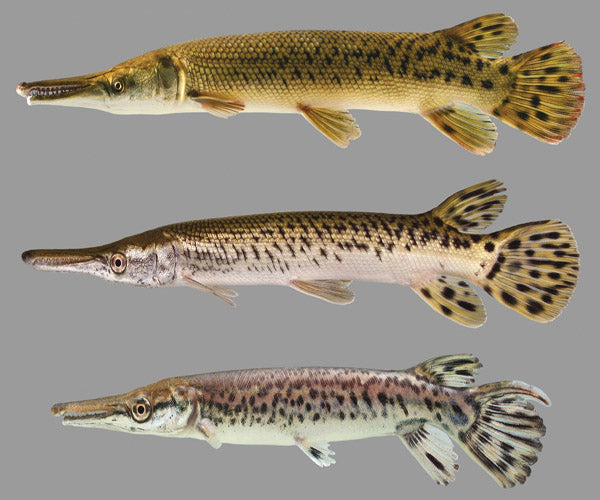
Gars (family Lepisosteidae) are an ancient lineage of freshwater predatory fish native to North and Central America, largely unchanged for tens of millions of years. Their bodies are long, cylindrical, and armoured with hard, diamond-shaped ganoid scales rather than the overlapping scales most fish have, fronted by elongated, tooth-lined jaws built for snatching prey.
They're ambush predators, hanging motionless near the surface or in cover before striking, and they have a vascularised swim bladder that lets them gulp air at the surface -- an adaptation for the low-oxygen, weedy backwaters and swamps they favour in the wild.
Species commonly seen small in the aquarium trade (such as spotted gar, Lepisosteus oculatus) are sold as juveniles only a few centimetres long, which gives a misleading impression of the fish this will become.
Gars are living fossils in a very literal sense -- the family's basic body plan is recognisable in fossils from the Cretaceous period, over 100 million years old, and their armoured ganoid scales (which don't overlap the way scales on most modern fish do, and historically were tough enough that some Indigenous American cultures used gar skin as a cutting tool) are a direct holdover from that ancient lineage. Their swim bladder doubles as a rudimentary lung: gars regularly rise to gulp air at the surface even in well-oxygenated water, a behaviour that's normal and expected, not a sign of distress.
Despite the intimidating jaws and teeth, gars are not aggressive toward anything too large to eat, and in the wild coexist peacefully alongside similarly sized fish that simply aren't potential prey -- their aggression is purely predatory and size-driven rather than territorial in the way a cichlid's is.
Requirements
This is the single most important thing to know before buying a gar: it does not stay small. Even the more modestly-sized species reach 45-90cm (18-36 inches) as adults, and some considerably more, so a juvenile bought at 8-10cm needs a firm plan for a very large long-term home -- commonly 500+ litres (130+ gallons) for a single adult, with a wide footprint since gars are poor at turning in tight spaces.
A gar is a strict carnivore and will eat any tankmate small enough to fit in its mouth, which in practice means almost everything else in a typical community tank once it's grown. It needs a tight-fitting, heavy lid with a small surface-air gap, since gars do jump and are also air-breathers that need access to the surface.
Feeding is simple but heavy: whole fish, shrimp, and other meaty protein, offered every day or two for a young, growing fish. Filtration needs to be sized generously for the waste a large predatory fish produces.
Feeder fish are best avoided or used sparingly and only from a trusted, disease-free source -- a diet built entirely around live feeder fish carries a real risk of introducing parasites and disease, and pre-killed or frozen whole fish/prawns are both safer and, with a little training, just as readily accepted once a gar settles in.
Décor should be minimal and secure: open swimming space matters more than aquascaping detail, since a long, torpedo-shaped fish this size needs room to turn without colliding with rock or driftwork, and any decor present should be too heavy or well-anchored for a large fish to dislodge while cruising past it.
Growth is fast in the first year or two on a good diet, so the jump from a manageable juvenile setup to the eventual 500+ litre adult tank tends to arrive sooner than new keepers expect -- planning and budgeting for the adult housing from day one avoids an unwelcome, rushed upgrade later.
Compatibility
Water & Care Conditions
Gars are unusually tolerant of water chemistry compared to most tropical fish, which is part of why they survive in oxygen-poor swamps in the wild -- but that tolerance doesn't extend to tank size or tankmates:
- pH: 6.5–8.0 (tolerant of a wide range)
- Water hardness: soft to hard, adaptable
- Temperature: 21–27°C (70–80°F)
- Oxygenation: naturally tolerant of low-oxygen water thanks to its air-breathing ability, but a large predator's waste load still demands strong filtration
- Air access: needs regular access to the water's surface to gulp air -- a lid with a modest gap or vent is necessary, not just a nice-to-have, alongside its jump-prevention role
- Water changes: larger, more frequent partial water changes than a small community tank needs, given the substantial bioload of a single large predatory fish; ammonia and nitrite should always read zero
- Substrate & decor: smooth, open layouts suit this species far better than dense aquascaping -- it needs room to turn and cruise, not obstacles to navigate around
- Longevity: gars are notably long-lived, with some species documented living well over 20 years in captivity, so this is a multi-decade commitment for the right keeper, not a short-term fish
- Lighting: not a significant factor for this species -- moderate, standard aquarium lighting is fine, and it isn't especially sensitive to light intensity one way or another
- Common issues: generally hardy and disease-resistant; the main real risks come from undersized housing (stress, stunted growth, injury from repeated collisions with tank walls) and disease introduced via untreated feeder fish, both avoidable with adequate space and a varied, mostly non-live diet
- Handling: avoid netting an adult gar if at all possible -- its long, toothy jaws and thrashing strength make both the fish and the handler vulnerable to injury; a large, soft container is much safer for any necessary moves