About & Origin
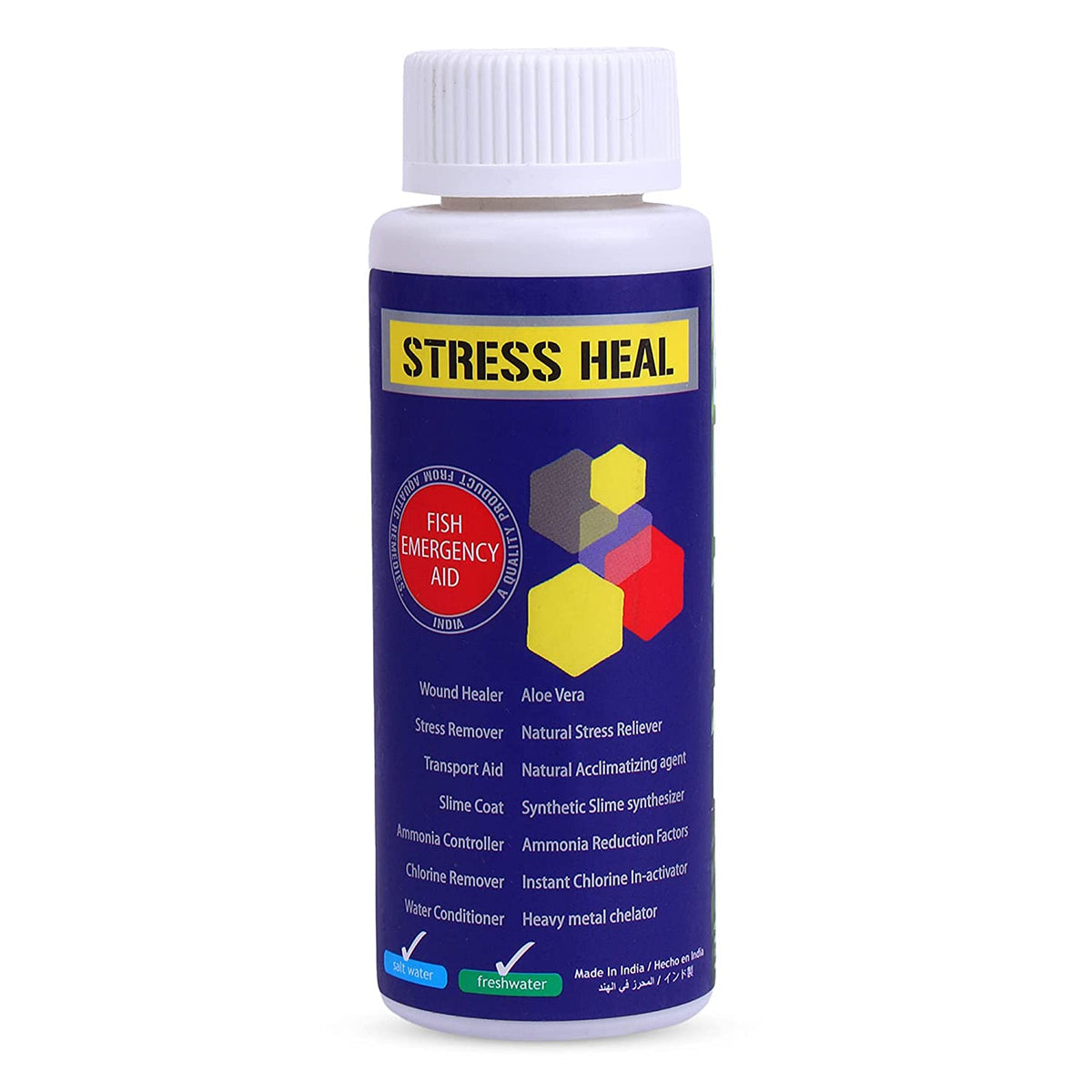
Stress Heal is an aloe-vera-based conditioner built to support fish through the moments that stress them most — being netted and moved, a big water change, transport home from the shop, or acclimating to a new tank.
Aloe vera acts as a natural wound healer and mild antibacterial, helping to reinforce a fish's slime coat — the protective mucus layer on its skin that guards against infection and physical damage, and that's easily disrupted by netting, bagging, or rough handling.
Beyond the aloe vera component, products like this typically also condition tap water at the same time: removing chlorine/chloramine and binding some harmful trace metals, so it doubles as a general water conditioner as well as a stress aid. This 50ml bottle is sized for regular use during routine water changes and the occasional stressful event.
The slime coat a fish's skin produces is its first line of defence against infection and physical injury -- comparable in some ways to human skin's role -- and it's disrupted surprisingly easily by handling, even a single careful netting. A conditioner built around reinforcing that layer is one of the most broadly useful, low-risk products a fishkeeper can keep on hand, since almost every routine tank task involves some amount of handling or water disturbance.
Visible stress in fish shows up as clamped fins, faded or blotchy colour, hiding more than usual, rapid gilling, or a general loss of appetite -- these are the situations this kind of product is meant to soften, whether the trigger was a rough netting, an aggressive tankmate, a sudden parameter swing, or simply the disorientation of arriving somewhere new. None of that is a substitute for fixing the underlying cause (poor water quality, overstocking, an incompatible tankmate), but it buys the fish some physiological breathing room while the real issue gets addressed.
It's a mild, buffering product rather than a targeted drug, which is part of why it's safe to use frequently -- there's very little risk of overdosing it the way there is with a true medication, so many keepers simply fold it into their standard water-change routine rather than reaching for it only in emergencies.
Requirements
Routine dosing: add at every water change, treating the fresh tap water going in, the same way you'd use any dechlorinator — it doesn't need a separate special occasion to be useful.
Transport/high-stress dosing: for moving fish, a heavier dose (a smaller volume of water, more concentrated) is typically used than for routine water changes — check your bottle for the specific transport-strength ratio.
New arrivals: dosing the bag or acclimation container when introducing new fish can meaningfully reduce the shock of the move, especially after a long trip home.
It's a supportive product, not a cure for an active infection — for a fish showing genuine disease symptoms rather than just stress, pair it with a targeted treatment rather than relying on it alone.
Bagging fish for transport: dosing the water a fish will be bagged in before a move (whether bringing new fish home or moving existing fish between tanks) meaningfully reduces the stress and slime-coat damage of the trip itself, not just the arrival.
After netting or handling: a light dose to the main tank after any session that involved chasing/netting fish (rescaping, moving decor, catching one fish out of a group) helps the whole tank recover faster, not just the individual that was handled.
Compatibility with other treatments: because it's a conditioner rather than an antibiotic or antiparasitic, it's generally safe to dose alongside most other aquarium medications rather than needing to be used in isolation -- but always check your specific product's label, since formulations vary between brands.
Shrimp and scaleless fish: aloe-vera-based conditioners are typically gentle enough for shrimp, snails, and scaleless fish like loaches, unlike copper-based medications -- but it's worth confirming against the specific bottle's ingredient list if you're keeping sensitive invertebrates.
Compatibility

Dosage & Usage Guidelines
Two common dosing rates apply depending on the situation — check your bottle for the exact ratios:
- Routine water changes: a light standard dose added to new water
- Transport/acclimation: a stronger, more concentrated dose for the bag or transport container
- Also functions as: a chlorine/chloramine conditioner for tap water
- Storage: cool, dark place, tightly sealed between uses, away from direct sunlight which can degrade the active aloe vera component over time
- Shelf life: like most liquid conditioners, check the bottle for an expiry date -- an older bottle that's changed colour or developed an odour is best replaced rather than relied on
- Not a substitute for: a targeted medication if a fish is showing actual disease symptoms rather than just stress
- Especially useful: dose the water before bagging fish for any kind of transport, not just after arrival
- After tank maintenance: a light dose after any session involving significant netting, rescaping, or handling helps the whole tank settle faster
- Dosing tools: use the cap or a dedicated measuring device rather than eyeballing it, especially for the stronger transport-strength dose where accuracy matters more
- Planted tanks: aloe-vera-based conditioners are generally plant-safe and don't interfere with fertilisation or CO2 dosing, unlike some medicated treatments that can affect sensitive plant species
- Low-risk, broadly useful -- reasonable to use more liberally than a targeted medication
Because it's low-risk at recommended doses, it's reasonable to use a little more liberally than a targeted medication -- when in doubt during a stressful event, dosing is rarely the wrong call. That said, more concentrated is not automatically better: stick to the labelled ratios rather than assuming a heavier dose speeds recovery, since some conditioning agents can themselves stress fish at high enough concentrations.