300 Gallon Fish Tank: Dimensions, Weight, Floor Load and Cost
Published: 2026-11-14 · FishyKart Blog
A 300 gallon fish tank is usually 96 x 24 x 30 inches: 8 feet long, 2 feet front to back and 2.5 feet tall (about 244 x 61 x 76 cm). Set up with water, sand and rock it weighs roughly 3,000 lb before the stand, which spread over its 16 square foot footprint is about five times the floor load that US homes are designed for. In November 2026 the tank alone cost about $4,400, glass or acrylic.
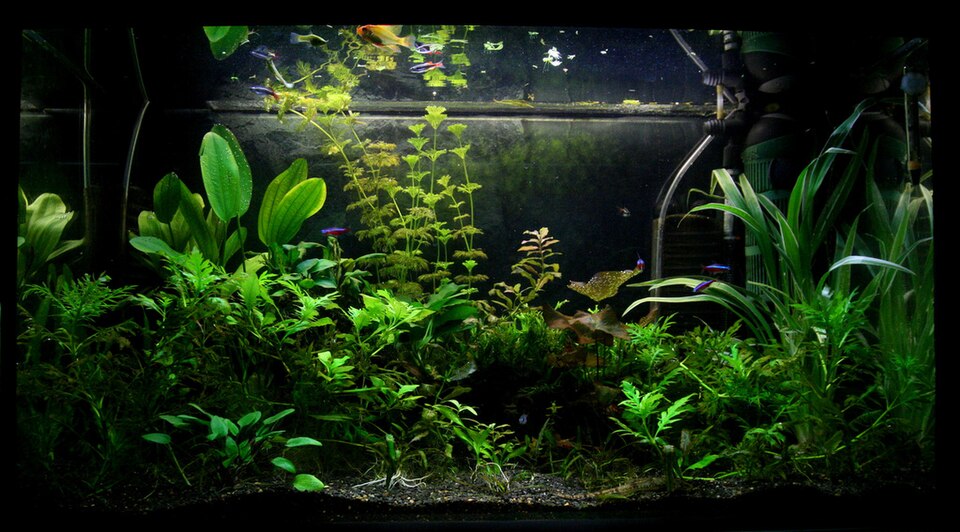
Photo: úlfhams_víkingur - Wikimedia Commons, CC BY 2.0
300 Gallon Tank Specs
| Spec | Glass (Custom Aquariums) | Acrylic (Clear-For-Life) |
| Size (L x D x H) | 96 x 24 x 30 in glass, plus about 3/4 in frame | 96 x 24 x 30 in |
| Centimetres | about 244 x 61 x 76 | about 244 x 61 x 76 |
| Actual capacity | 280 gallons (rated 300) | sold as 300 gallons |
| Panels | 5/8 in front, back and bottom; 1/2 in sides | acrylic |
| Price (Nov 2026) | $4,443.80-$7,150.64 by package | $4,399.99 tank only |
| Warranty | lifetime leak warranty with their stand and pad | limited lifetime (leaks) |
Specs from the Custom Aquariums 300 gallon page and the Clear-For-Life 300 listing at PetSmart, checked November 13, 2026. For scale, the biggest tank in Aqueon's standard range is the 210 gallon at 72 1/2 x 24 1/2 x 29 5/8 inches, 2,450 lb full; a 300 is a custom or specialist size.
How Much Does a 300 Gallon Tank Weigh?
Our estimate for the 96 x 24 x 30 glass tank, set up for freshwater:
| Part | Weight | How we got it |
| Water | about 2,335 lb | 280 gallons x 8.34 lb per gallon (USGS) |
| Glass | about 520 lb | 5,760 cubic inches of glass at about 2.5 g/cm3 |
| Sand, 2 in layer | about 250-300 lb | 96 x 24 x 2 in of sand |
| Total, before stand and rock | about 3,100 lb |
An acrylic tank of the same size is lighter than glass, but the water is the same 2,300-2,500 lb, so the total barely changes. Rock work, a sump with another 60-80 gallons and the stand add hundreds of pounds more. Water density from the USGS.
Floor Load: The Real Question
The tank's footprint is 96 x 24 inches, or 16 square feet. About 3,100 lb over 16 square feet is roughly 190 lb per square foot. US residential codes design living-area floors for a live load of 40 lb per square foot (IRC Table R301.5), so a 300 gallon tank concentrates almost five times that on one spot. In practice this means:
- Ground floors on a concrete slab are the safe choice.
- On a wooden floor, place the tank across the joists and close to a load-bearing wall, never in the middle of a span.
- Upper floors and apartments need a structural engineer's check before purchase.
- Use a stand built for the tank: it spreads the weight evenly and is often required for the warranty.
A smaller tank with the same footprint logic: 125 gallon tank dimensions covers floor load at 1,400 lb.
Glass or Acrylic?
- Glass: scratch resistant and cheaper to keep looking new, but heavy and usually framed. Custom Aquariums' 300 uses 5/8 inch panels.
- Acrylic: lighter, clearer, insulates better and allows curved corners, but scratches easily; clean it only with acrylic-safe pads.
Both cost about the same as a tank alone at this size. Delivery is its own project: an 8-foot tank needs several people, a clear path through doors and stairs, and often professional delivery.
Which Fish Need a 300 Gallon Tank
A tank this size is built for fish that outgrow everything else:
- Red tail catfish, but only as a stage tank: they grow to 120 cm in the wild, and our red tail catfish tank size guide puts adults over 60 cm at about 1,000 gallons.
- Large cichlid groups such as several oscars or big South American cichlids.
- Bichirs and other large predators kept as a group: see bichir care.
- Big community displays with large schools of mid-size fish.
Check how big the adult fish gets before choosing a tank; it is much easier to buy the right tank once than to upgrade twice.