Aquarium Volume Calculator: Gallons, Liters and Tank Size Chart
Published: 2026-10-30 · FishyKart Blog
To find how many gallons a fish tank holds, multiply length x width x height in inches and divide by 231: one US gallon is exactly 231 cubic inches. For liters, multiply the dimensions in centimeters and divide by 1,000. The calculator below does both for rectangular, cylinder and bow front tanks, and also shows the real water volume after gravel and the gap under the rim, plus the weight of that water.
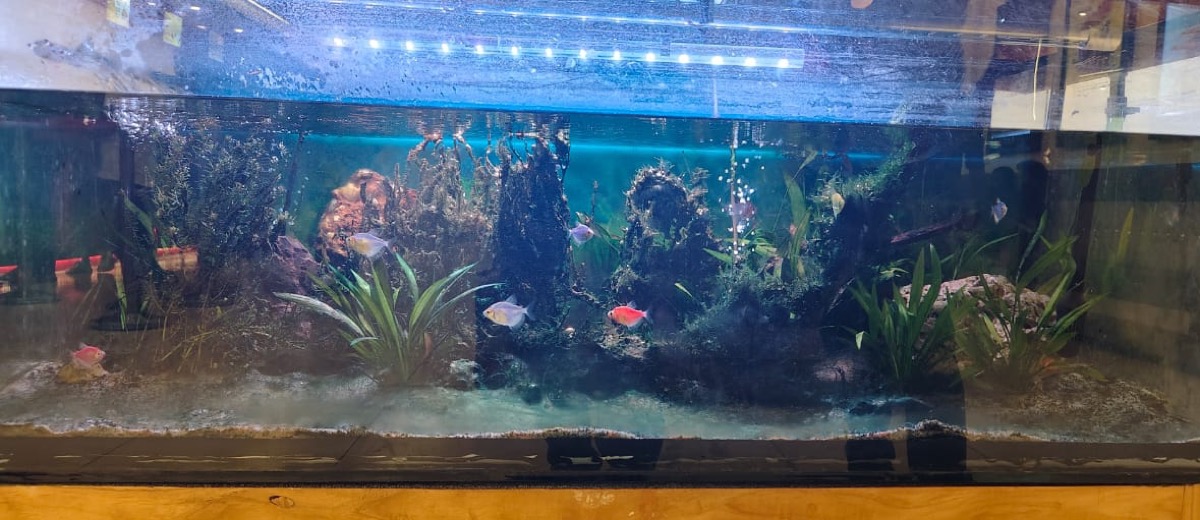
Photo: Sandhiya Rangasami - Wikimedia Commons, CC BY 4.0
Fish Tank Volume Calculator
Bow front volume is an estimate: the curved front is treated as a smooth arc. Measurements taken outside the glass give the gross volume; use inside measurements for the most accurate water volume.
Gallons to Liters Converter
The Formulas Behind the Numbers
Every result above comes from three fixed definitions. The US gallon is 231 cubic inches (NIST Handbook 44, Appendix C), which is 3.785411784 liters. The UK, or imperial, gallon is 4.54609 liters (UK Weights and Measures Act 1985, Schedule 1), about 20% larger, which is why a British "50 gallon" tank is bigger than an American one.
| Tank shape | US gallons (measure in inches) |
|---|---|
| Rectangle or cube | length x width x height / 231 |
| Measured in feet | length x width x height x 7.48 (1,728 in³ per ft³ / 231) |
| Cylinder | 3.1416 x (diameter / 2)² x height / 231 |
| Bow front (estimate) | [length x end depth + 2/3 x length x (center depth - end depth)] x height / 231 |
| Liters (measure in cm) | length x width x height / 1,000 |
Why Your Tank Holds Less Than the Label Says
The gallon number on a tank is a size class, not a measured amount of water. Run the manufacturer's outside dimensions through the formula and you get more than the label: Aqueon's 10 gallon tank comes out at 11.6 gallons, its 55 at 55.9 and its 75 at 82.1. Then three things take water away:
- Glass and trim. Outside dimensions include the glass walls and the plastic frame.
- The gap under the rim. Most tanks are filled to just below the trim, so the top inch or so stays empty.
- Substrate, rock and wood. A 2 inch gravel bed in a 20 x 10 inch tank fills about 400 cubic inches, nearly 2 gallons, even though water fills the spaces between the stones.
Enter your substrate depth and water line in the calculator to see the difference. For a 10 gallon tank with 2 inches of gravel and the water 1 inch below the rim, the water volume drops to about 8.8 gallons. That smaller figure is the one to use when you dose water conditioner or medication: dosing by the label slightly overdoses, which matters with sensitive fish and with medications.
Standard Aquarium Sizes Chart
These are Aqueon's published outside dimensions and weights for its standard glass tanks, the most common rectangular sizes sold in US pet stores. Other brands of the same gallon size can differ by a fraction of an inch, so measure the actual tank before you buy a stand, lid or background.
| Tank | L x W x H (inches) | L x W x H (cm) | Empty / filled (lb) |
|---|---|---|---|
| 5.5 gallon | 16 3/16 x 8 3/8 x 10 1/2 | 41.1 x 21.3 x 26.7 | 7 / 62 |
| 10 gallon | 20 1/4 x 10 1/2 x 12 9/16 | 51.4 x 26.7 x 31.9 | 11 / 111 |
| 15 gallon | 24 1/4 x 12 1/2 x 12 3/4 | 61.6 x 31.8 x 32.4 | 21 / 170 |
| 20 gallon high | 24 1/4 x 12 1/2 x 16 3/4 | 61.6 x 31.8 x 42.5 | 25 / 225 |
| 20 gallon long | 30 1/4 x 12 1/2 x 12 3/4 | 76.8 x 31.8 x 32.4 | 25 / 225 |
| 29 gallon | 30 1/4 x 12 1/2 x 18 3/4 | 76.8 x 31.8 x 47.6 | 40 / 330 |
| 30 gallon | 36 1/4 x 12 5/8 x 16 3/4 | 92.1 x 32.1 x 42.5 | 43 / 343 |
| 40 gallon breeder | 36 3/16 x 18 1/4 x 16 15/16 | 91.9 x 46.4 x 43.0 | 58 / 458 |
| 55 gallon | 48 1/4 x 12 3/4 x 21 | 122.6 x 32.4 x 53.3 | 78 / 625 |
| 75 gallon | 48 1/2 x 18 1/2 x 21 1/8 | 123.2 x 47.0 x 53.7 | 98 / 785 |
| 90 gallon | 48 1/2 x 18 1/2 x 25 1/8 | 123.2 x 47.0 x 63.8 | 135 / 1,050 |
| 125 gallon | 72 1/2 x 18 1/2 x 23 1/8 | 184.2 x 47.0 x 58.7 | 177 / 1,400 |
| 150 gallon | 72 1/2 x 18 1/2 x 29 1/2 | 184.2 x 47.0 x 74.9 | 281 / 1,800 |
| 210 gallon | 72 1/2 x 24 1/2 x 29 5/8 | 184.2 x 62.2 x 75.2 | 343 / 2,450 |
Source: Aqueon product catalog, "Critical dimensions for all aquariums" (standard glass rectangle aquariums), checked November 2026: aqueon.com. Centimeters converted by FishyKart. Aqueon notes that filled weights vary with substrate and decor.
Two patterns in the chart help when you plan an upgrade. Several sizes share a footprint and differ only in height: the 15 and 20 high (24 1/4 x 12 1/2 inches), the 20 long and 29 (30 1/4 x 12 1/2), and the 75 and 90 (48 1/2 x 18 1/2). A taller tank on the same stand adds gallons but not swimming length or surface area, which is what active fish and gas exchange depend on. The 40 breeder, by contrast, gives an 18 inch front-to-back depth in a 3 foot tank, which is why it is a popular choice for territorial fish and aquascapes.
How Heavy Is Your Tank?
Fresh water weighs about 8.3 pounds per US gallon at aquarium temperatures. That figure is derived from the USGS water density table: 0.99802 g/cm³ at 70°F (21°C) gives 8.33 lb per gallon, and 0.99669 g/cm³ at 80°F (27°C) gives 8.32 lb. The calculator uses 0.997 kg per liter. Add the empty glass, the gravel and rock and the stand itself, and a filled tank is far heavier than most people expect: Aqueon lists 625 lb for a filled 55 gallon and 1,050 lb for a 90. Put anything above about 20 gallons on a stand made for aquariums, not on ordinary furniture. Source: USGS Water Science School, Water Density.
What to Do With the Number
- Stocking. Gallons alone do not decide how many fish fit; adult size, waste and footprint matter more. See how many fish in a 10 gallon tank for how bioload works.
- Dosing. Use the water volume, not the label, for conditioner, fertilizer and medication.
- Water changes. A 25% change on a 55 gallon tank with real water volume of about 48 gallons is 12 gallons, not 14.
- Choosing a size. Start from the fish: species pages such as goldfish tank size and oscar tank setup give minimum dimensions, then check the chart above for a tank that matches.
When the Calculator Is Not Enough
The formulas assume straight sides. Hexagon, corner (pentagon) and custom tanks with curved glass need the manufacturer's stated volume or a fill test: count how many measured gallon jugs it takes to reach your normal water line. The bow front result is an estimate because the curve of the front glass differs between brands. And if you measure outside the glass, the gross volume will always be higher than the water you can actually put in.