How to Cycle a Fish Tank: Fishless Cycle Steps and Test Numbers
Published: 2026-10-29 · FishyKart Blog
To cycle a fish tank without fish, run the filter, add a source of ammonia to about 2 ppm, and test every day or two until the tank turns that ammonia into nitrate. The tank is ready when ammonia and nitrite both read 0 ppm within 24 hours of a fresh 2 ppm dose. In a new setup this usually takes about 4-8 weeks, and it is the single most important step before buying fish.
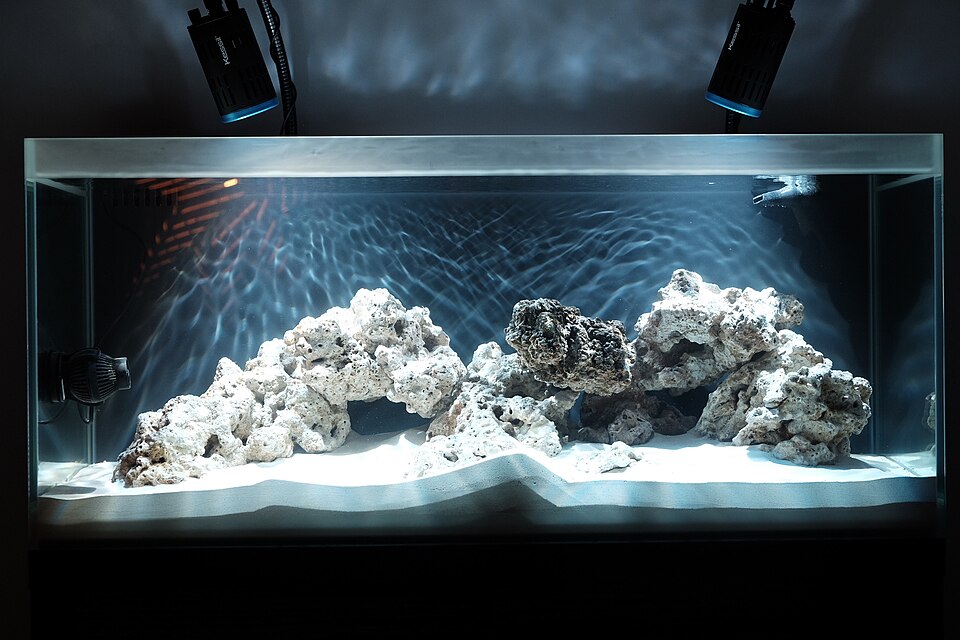
Photo: kerinin - Wikimedia Commons, CC BY-SA 2.0
What Cycling Means
Fish produce ammonia through their gills and waste, and rotting food adds more. Ammonia is toxic even in small amounts. In a cycled tank, one group of bacteria turns ammonia into nitrite, which is also toxic, and a second group turns nitrite into nitrate, which is far less harmful and is removed with water changes. These bacteria live mostly in the filter media and on gravel, rocks and plants, not in the water itself. Cycling simply means growing enough of them before fish arrive.
Fishless Cycle Step by Step
- Set up the tank fully: substrate, decor, heater and filter running 24 hours a day. Treat all tap water with a dechlorinator.
- Warm the water: about 77-86 F (25-30 C) helps the bacteria grow faster than room temperature.
- Add ammonia: use pure ammonia sold for fishless cycling, with no surfactants, dyes or perfumes. A pinch of fish food left to rot also works but is slower and harder to control. Aim for about 2 ppm on the test.
- Test every 1-2 days: record ammonia, nitrite and nitrate. When ammonia drops close to 0, dose it back to about 2 ppm.
- Wait for nitrite to fall: nitrite usually rises after the first week or two and then drops to 0 as nitrate climbs.
- Do the 24-hour test: dose 2 ppm ammonia. If ammonia and nitrite are both 0 the next day, the tank is cycled.
- Water change, then fish: do a large water change to bring nitrate down and add a few fish at a time.
Typical Timeline and Test Numbers
| Stage | What the tests show |
| Week 1-2 | Ammonia stays high, nitrite starts to appear |
| Week 2-4 | Ammonia falls faster, nitrite rises high |
| Week 3-6 | Nitrite starts to fall, nitrate rises |
| Week 4-8 | 2 ppm ammonia becomes 0 ammonia and 0 nitrite in 24 hours |
| Ready for fish | Ammonia 0 ppm, nitrite 0 ppm, nitrate present; keep it below about 40 ppm with a water change |
Every tank is different, so trust your test results, not the calendar. A liquid test kit is usually more accurate than paper strips.
How to Speed It Up
The fastest boost is seeded media: a piece of sponge or a handful of gravel from a healthy, disease-free tank. Live aquarium plants also help, and fast growers such as hornwort take up some ammonia. Bottled bacteria can help start the process, but always confirm the result with a test.
Mistakes to Avoid
- Adding a full stock of fish on day one. Ammonia spikes quickly in a new tank. Add fish slowly, especially in small tanks such as those in our guide to how many fish in a 10 gallon tank.
- Cleaning the filter in tap water. Chlorine and chloramine in tap water can kill the bacteria. Rinse media in old tank water.
- Overdosing ammonia. Very high ammonia or nitrite can slow the bacteria down.
- Leaving the tank empty after cycling. Without fish or ammonia, the bacteria colony starts to shrink, so add fish soon after the final test.
- Ignoring cloudy water. A white haze in a new tank is common and usually harmless. See cloudy aquarium water.
Once the tank is cycled, choose fish that fit its size, for example from our list of the best fish for a 10 gallon tank.