
Customer Reviews
About & Origin
Ambulia (Limnophila sessiliflora, sometimes sold under the older synonym Limnophila sessilis) is a fast-growing stem plant native to the shallow ponds, ditches, and rice paddies of South and Southeast Asia, from India through to China and Japan. In the wild it grows both fully submersed and emersed along muddy banks, which is part of why it adapts so readily to aquarium life — few aquatic plants make the jump from "wetland weed" to "aquascaping staple" quite this smoothly.
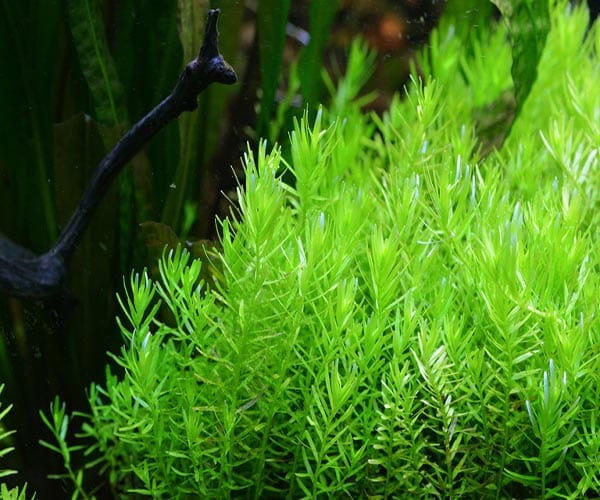
Underwater it forms dense, feathery whorls of finely divided, needle-like leaves along an upright stem — a classic "background jungle" plant that softens hardscape and gives smaller fish somewhere to dart in and out of. Given strong light, the whorls sit close together and the plant stays bushy; in weaker light the stems stretch out and the whorls space apart, giving a leggier look. Like many Limnophila species it shows real heterophylly: leaves grown underwater are finely feathered for capturing dissolved CO2 and nutrients, while any growth that reaches the surface and pokes into the air develops broader, simpler leaves better suited to photosynthesising in open air — a visible reminder of its amphibious rice-paddy origins.
It's a genuinely fast grower once established, and stem cuttings root easily, so a single starter bunch can be propagated into a full background hedge within a few weeks. In its native range it's actually considered a minor agricultural weed in flooded rice fields, which says a lot about how little encouragement it needs to spread once conditions suit it — the same trait that makes it such a forgiving, rewarding plant in a home aquarium.
The genus name Limnophila translates roughly to "marsh-loving," and the whole group is closely related to other popular aquarium stem plants in the figwort family, sharing the same general whorled-leaf growth pattern and easy propagation by cutting. Ambulia has been a fixture of the planted-tank hobby for decades precisely because it combines a lush, jungly look with a tolerance for a wide range of setups, from dedicated high-tech CO2-injected aquascapes down to fairly casual community tanks.
Requirements
Ambulia rewards a bit of investment in lighting and nutrients — it is not a true low-tech "set and forget" plant, though it will survive in less demanding setups with slower, leggier growth and less impressive foliage density.
Light: moderate to high lighting brings out its best, most compact form. Under weak light the whorls thin out, internode spacing stretches, and the lower stem tends to shed leaves as the plant channels its energy toward reaching brighter water near the surface instead of staying full and bushy.
CO2 and nutrients: not strictly required, but supplemental CO2 and a nutrient-rich substrate or regular liquid fertiliser noticeably improve density and growth rate, and reduce the risk of the stem bases going bare. As a heavy feeder, it responds well to root tabs pushed near the base in addition to water-column dosing, and a shortage of iron or other micronutrients tends to show up first as pale new growth at the stem tips.
Substrate: a nutrient-rich planted substrate helps, though Ambulia is primarily a water-column feeder and can do reasonably well in plain inert gravel or sand as long as liquid fertiliser is dosed consistently.
Planting: plant stems a couple of centimetres apart in the background or midground, in small clusters of 3-5 stems for a fuller look sooner; trim the tops and replant the cut tops to keep a full hedge rather than a few tall, sparse stems with bare lower sections.
Maintenance: regular trimming is the main task — left alone it will happily grow to the surface, break through, and start putting out the broader emersed leaf form described above, so plan on topping it back every few weeks in a well-lit, well-fed tank. Old, thinning lower stems are usually best replaced with fresh cuttings rather than nursed back to fullness.
Compatibility
Water & Care Conditions
Ambulia is adaptable across a fairly wide range of freshwater conditions, but grows fullest and most compact within these ranges:
- pH: 6.0–7.5
- Hardness: soft to moderately hard water, roughly 3–15 dGH
- Light: moderate to high; low light causes leggy, sparse growth and long bare stretches of stem
- Temperature: 22–28°C (72–82°F)
- Nitrate/phosphate tolerance: genuinely useful in a lightly overstocked or heavily fed tank, since it's a fast enough grower to help mop up excess nutrients that would otherwise feed algae
- Oxygenation: as with most fast-growing stem plants, healthy Ambulia is itself a good oxygenator during daylight hours; it does best with normal water movement rather than stagnant corners, which also helps keep fine debris from settling in the dense whorls
Outside these ranges it won't die off outright, but expect thinner whorls, slower growth, and a greater tendency to shed lower leaves. Worth noting for anyone who keeps outdoor tubs or ponds alongside an indoor tank: in several warm-climate regions outside its native range, Limnophila sessiliflora has escaped cultivation and become a genuinely invasive waterway weed, so trimmed cuttings and old plants should be disposed of in household waste or composted rather than released into local ponds, ditches, or waterways.
A weekly partial water change alongside routine fertiliser dosing is the simplest way to keep parameters stable for Ambulia and any tankmates sharing the aquarium, since sudden swings in hardness or pH are more likely to stress the plant than any single value within the ranges above.
Because it's such an efficient grower, Ambulia is also a reasonable early warning sign for a tank's overall nutrient balance: if it starts looking pale, thin, or slow to put out new whorls even under decent light, that's usually a cue to check dosing or substrate nutrient levels before assuming something is wrong with the water itself.