About & Origin
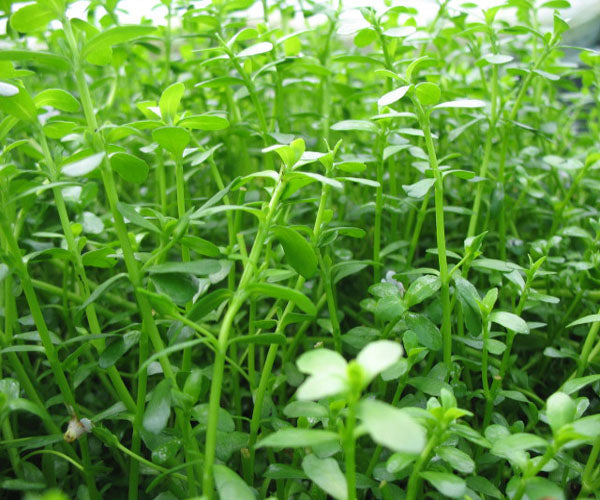
Bacopa monnieri (water hyssop) is a creeping perennial herb and popular aquarium stem plant, found growing wild in wetlands, marshes, and muddy shorelines across much of the world's warmer regions, including India, Africa, Australia, and the Americas. Outside the aquarium hobby it's also a long-used medicinal herb in traditional Ayurvedic practice, though that's a separate use from its role as an aquascaping plant.
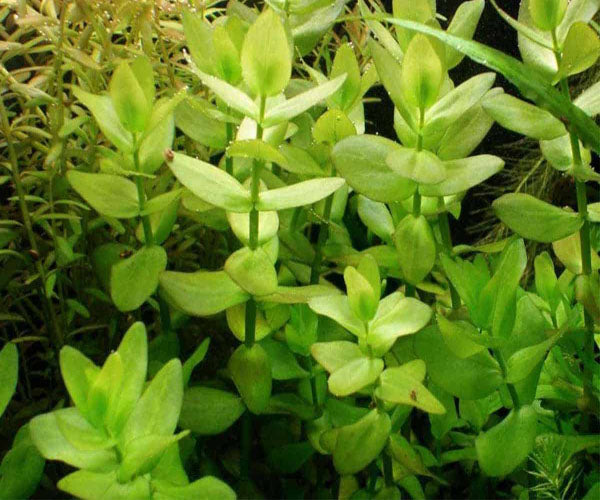
Underwater it grows as a soft, succulent stem plant with small, rounded, bright green leaves arranged in opposite pairs. It has a classic bushy, upright growth habit that's been a staple of the aquarium hobby for decades — one of the plants many aquascapers cut their teeth on.
It grows both emersed (above the waterline, where it can flower) and fully submersed, and adapts to either form without much fuss. In its emersed form, growing along a muddy bank or in a paludarium, it produces small pale blue-to-white flowers with four or five petals — something submersed aquarium specimens never show, since flowering is triggered by growing in open air rather than underwater.
The plant's other common names — brahmi, water hyssop, herb of grace — reflect just how widely it's used and recognised outside the fishkeeping world; in Ayurvedic tradition it's one of the most studied "medhya rasayana" (cognition-supporting) herbs, extracted and sold as a supplement in health-food shops quite separately from the aquarium trade. In the tank, though, none of that matters — it's grown purely for its soft, bright-green bushy foliage and its reputation as one of the easiest true stem plants to keep alive.
The succulent, slightly fleshy texture of the leaves is also a giveaway of its wetland origin: like many amphibious marsh plants, Bacopa monnieri stores a bit of extra water in its tissue, which is part of why the stems feel noticeably softer and more brittle to handle than tougher hardscape plants like Anubias or Java Fern.
Requirements
Bacopa monnieri is one of the more forgiving stem plants and a good choice for a first planted tank.
Light: moderate light gives the best compact, bushy growth; in low light the stems stretch out with more space between leaf pairs.
CO2: not required, though supplemental CO2 speeds up growth and gives a fuller look. It's genuinely usable in a non-CO2, low-tech setup.
Substrate: not a heavy root feeder — it takes up most of its nutrients through its leaves and stem, so it does fine in plain gravel with regular liquid fertilising as much as in a nutrient-rich substrate.
Trimming: as with most stem plants, regular topping keeps it dense; left alone the stems will reach the surface and can even grow emersed along the edge of an open-top tank. Cut just below a leaf node and replant the top portion — Bacopa roots readily from cuttings, so a single bunch can be multiplied into several stems within a matter of weeks.
Handling care: the succulent stems are a bit more fragile and brittle than tougher stem plants, so they're prone to snapping if handled roughly during planting or trimming — planting with tweezers rather than fingers, and pushing the stem base gently into the substrate rather than forcing it, reduces breakage.
Setup flexibility: genuinely one of the few stem plants that performs almost as well in a bare, low-tech tank with just a liquid fertiliser dosed occasionally as it does in a fully kitted-out CO2 aquascape, which is a big part of why it's such a common recommendation for someone's first planted setup.
Placement: works well in the midground to background, planted in loose small groups rather than a single dense wall, which lets light reach the lower leaves and keeps the whole stem fuller rather than just the top few centimetres.
Companion role: because it tolerates shade reasonably well, Bacopa is often used to soften the base of taller background plants or fill gaps behind hardscape where a fussier plant might struggle with the lower light levels found there.
Compatibility
Water & Care Conditions
Bacopa monnieri tolerates a broad range of freshwater conditions, and grows fullest within these ranges:
- pH: 6.0–7.5
- Hardness: soft to moderately hard water, roughly 3–15 dGH
- Light: low to moderate; higher light with matching nutrients gives denser growth but isn't required
- Temperature: 20–28°C (68–82°F)
- Oxygenation: undemanding; normal community-tank circulation is sufficient
Outside these ranges it doesn't tend to die outright, just grows more slowly and leggier, with wider gaps between leaf pairs.
Its genuinely wide native distribution — across wetland habitats on nearly every warm continent — is exactly why it tolerates such a broad range of water chemistry in captivity: unlike a plant restricted to one specific river system, Bacopa monnieri has evolved to cope with whatever local conditions a given wetland throws at it, from soft blackwater-style acidic pools to harder, more mineral-rich water.
New plantings sometimes shed a few lower leaves in the first week or two after introduction as they adjust to a new tank's water chemistry and lighting — this is a normal settling-in response rather than a sign of a parameter problem, and fresh growth from the stem tips typically resumes within a couple of weeks once the plant has acclimated.
Weekly partial water changes help keep it looking its best, mainly by preventing the slow build-up of algae on its soft, slightly fuzzy-textured leaves rather than because the plant itself is sensitive to stable-but-imperfect water — in practice, most healthy community tanks already sit comfortably within the ranges this plant needs without any special adjustment.
Because it draws most of its nutrition from the water column rather than the substrate, a general liquid fertiliser dosed weekly or twice-weekly is usually enough to keep growth steady; root tabs aren't necessary unless the tank is otherwise very lean on nutrients.