About & Origin
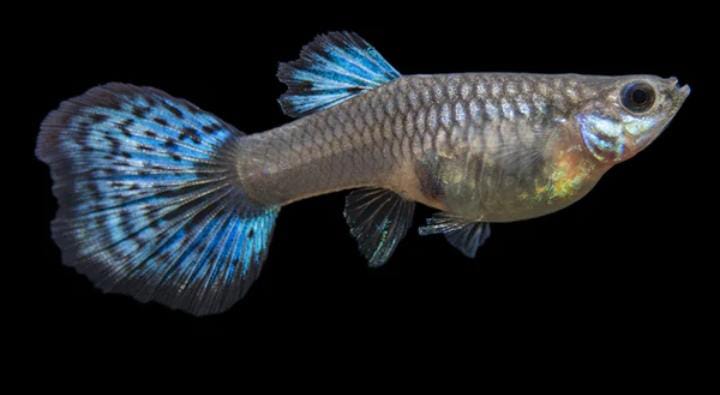
The guppy (Poecilia reticulata) is a small livebearer fish native to freshwater streams, ponds, and coastal waters of northeastern South America and some Caribbean islands, where wild fish are comparatively plain. Nearly all the color and finnage variety seen in the hobby today -- including this blue grass-tail strain -- comes from generations of selective breeding, not from different wild species.
Guppies are livebearers: females give birth to free-swimming fry rather than laying eggs, and a healthy female can produce a new brood roughly every 4-6 weeks without any special intervention, which is part of why they've remained one of the most popular beginner fish for well over a century.
They're constantly active, inquisitive swimmers that spend their time in the middle and upper water column, and males in particular will spend much of their day displaying their fins and colour to females.
The "grass tail" pattern refers to a fine, speckled scattering of colour across the tail fin -- resembling scattered blades of grass rather than a solid block of colour or a bold stripe -- bred through many generations of selecting parents whose own speckling was densest and most evenly spread. Blue grass-tail lines specifically select for a cool blue-to-turquoise iridescence across the body and tail base, which shows best under moderate lighting and against a darker substrate.
Guppies are short-lived but fast-maturing: females can begin breeding at around 3 months old, and a typical lifespan is 2-3 years in good conditions. Colour and pattern strains like this one can vary noticeably between individual fish and even between broods, since patterning genetics in guppies are complex and polygenic -- two grass-tail parents won't always produce offspring with identically dense or evenly distributed speckling, which is part of why selective guppy breeding remains an active, ongoing hobby in its own right.
Requirements
Blue and other cool-toned guppy strains show their colour best against contrast -- a darker substrate and moderate rather than harsh lighting makes the turquoise speckling read clearly, while pale gravel and bright light tends to wash it out visually even though the fish itself hasn't changed. Worth factoring into tank decor choices if colour intensity matters to you.
Standard guppy stocking applies: 40-60 litres for a small group, with more females than males (2-3 to 1) to spread out the near-constant courting pressure males put on females in an uneven group.
Breeding happens without any effort on the keeper's part -- guppies breed continuously once mixed-sex, so plan ahead if an expanding population isn't wanted, and know that a single female can keep producing broods for months even after being separated from any male, since she stores sperm from prior matings.
Diet is simple: quality flake or micro-pellet as a staple, with occasional live or frozen brine shrimp/daphnia both for variety and to help support colour intensity over time.
A secure lid is worth having regardless of breeding plans -- guppies jump, particularly when startled or when water quality has quietly declined without any other obvious warning sign yet.
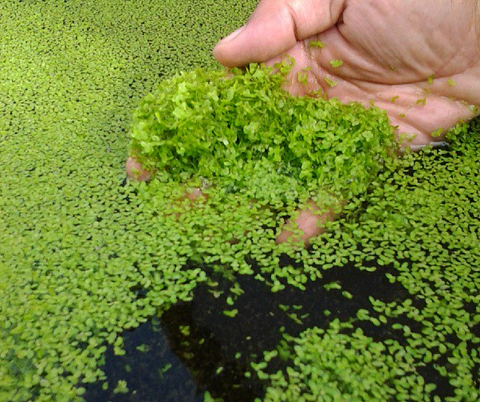
If fry are wanted to survive to adulthood, they need real separation from adults or genuinely dense cover (a breeding box, thick planting, floating duckweed) -- otherwise adults, including their own parents, will simply eat them; surviving fry grow quickly on crushed flake and can usually rejoin the main tank around 3-4 weeks old.
Compatibility
Water & Care Conditions
Nothing about the blue grass-tail pattern changes this fish's underlying water needs -- it's the same easygoing Poecilia reticulata biology as any other guppy strain:
- pH: 7.0–8.0, tending toward slightly alkaline, harder water
- Water hardness: moderately hard, 10–20 dGH
- Temperature: 22–28°C (72–82°F)
- Oxygenation: not demanding, but decent circulation is appreciated as with most livebearers
- Water changes: weekly 20-25% keeps nitrate down, which matters more for finnier strains prone to fin damage in poor water than for plain wild-type fish
Fin rot and columnaris ("guppy disease") are the two issues to watch for if water quality slips -- both are usually a downstream symptom of overstocking or skipped water changes rather than a sign the fish is inherently fragile.
New arrivals do better with a slow drip acclimation (20-30 minutes) than being tipped straight in -- guppies are sensitive to a sudden mismatch between shipping water and tank water, more so than to the destination parameters themselves being slightly outside the ideal range.
If maintaining strong, even speckling across future generations matters to you, selective pairing across several generations is genuinely how grass-tail lines are kept sharp -- letting a mixed tank breed at random tends to soften and blur the pattern over a few generations, since guppy colour/pattern genetics are polygenic and don't breed uniformly true by default.
Otherwise this is a low-fuss, hardy species well suited to a beginner planted community tank -- live plants genuinely help by buffering minor water-quality swings between changes and giving fry and any stressed fish somewhere to retreat.