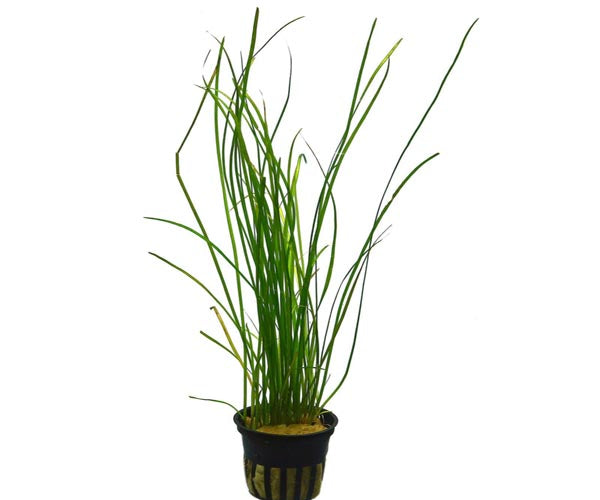
About & Origin
Vallisneria is a genus of freshwater grass-like plants found across warm temperate and tropical regions worldwide, growing rooted in the muddy or sandy bottoms of slow rivers, lakes, canals, and ditches, often in dense underwater meadows that provide shelter, grazing, and spawning cover for fish and invertebrates. Vallisneria nana — the "narrow-leaf" or dwarf form commonly grown in the hobby — is native to Australia and is prized for its finer, more delicate blades compared to the broader, coarser leaves of Vallisneria americana and other larger species in the genus.
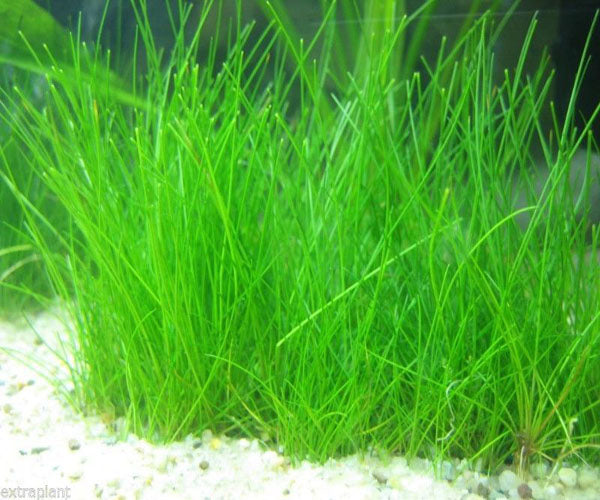
It grows as long, ribbon-like leaves rising directly from a central crown at the base, with no true stem to speak of — new leaves simply emerge from the crown as the plant grows. It spreads readily by sending out thin horizontal runners just beneath or along the substrate surface, each producing a new plantlet a short distance from the parent; over time a single specimen can fill an entire background strip of substrate with a dense stand of grass-like foliage, all genetically identical clones connected by their runners.
In the aquarium, Vallisneria nana is one of the classic background plants for a natural-looking planted tank or biotope-style setup: tall enough to provide a green backdrop and cover for shy or skittish fish, but with a soft, swaying texture in even mild water movement that's quite different from stiffer, broader-leaved background plants. Its narrow blades also let light through to plants growing behind or beside it more readily than a thick screen of broad leaves would.
fishykart.com supplies live Vallisneria nana rooted plantlets rather than dried or artificial material, ready to establish directly in substrate.
Requirements
Vallisneria nana is one of the easiest true aquarium plants to grow, tolerant of a wide range of setups from low-tech, unfertilised tanks through to fully CO2-injected, high-light aquascapes.
Substrate: roots in ordinary aquarium gravel or sand and doesn't demand a nutrient-rich substrate to survive, though it responds well to root tabs or a richer substrate with visibly faster, denser growth and broader leaf blades.
Light: grows under low to moderate light without issue, and in dimmer tanks it simply grows taller and reaches further for the surface rather than failing outright — a useful trait in tanks where light is limited by depth or stocking of light-hungry fish.
CO2: not required — one of the more forgiving background plants for a tank without CO2 injection, though it will grow noticeably faster and fuller with supplemental CO2 in a higher-light setup.
Trimming: leaves that reach the surface and trail along it are normal for this plant and are often left alone for a natural look; if a tidier appearance is wanted they can be trimmed back, and damaged or browning tips can simply be cut off without harming the plant, since new growth continues from the crown regardless.
Propagation and spread: spreads on its own via runners, gradually forming a dense meadow along the background — plan its footprint accordingly and give it room, since a thriving patch will expand well beyond where it was first planted and can be thinned out and replanted elsewhere once established.
Compatibility
Water & Care Conditions
Vallisneria nana adapts to a wide range of freshwater conditions, and in fact often does best in harder, more mineral-rich water than many other popular aquarium plants:
- pH: 6.5–8.0 — tolerant of alkaline water, unusually so for a common aquarium plant, which makes it a good background choice for hard-water setups (including African cichlid tanks) where many other plants struggle
- Water hardness: soft to hard water (roughly 3–20 dGH); often grows especially well in harder, more mineral-rich tanks where softer-water plants can look pale or stunted
- Temperature: 18–28°C (64–82°F), a comfortable span across unheated and heated tropical setups alike
- Light: low to moderate is enough for steady, healthy growth; higher light with CO2 speeds things up and can deepen leaf colour but isn't necessary for the plant to thrive
One notable sensitivity worth flagging: some copper-based fertilizers and fish medications can harm Vallisneria even at doses safe for fish, so it's worth checking product labels before dosing a tank that includes it. Sudden large swings in water hardness, or trimming into the crown itself rather than just the leaf blades, can also trigger "Vallisneria melt," where leaves die back and dissolve before the plant recovers from its crown and resumes normal growth — unsettling to see, but rarely fatal to an otherwise healthy plant as long as the underlying water conditions are stable and suitable. New growers sometimes mistake early melt for the plant dying outright and remove it too soon; if the crown itself looks firm and pale rather than mushy and brown, it's usually still alive and worth leaving in place to recover.
Beyond water chemistry, the other main "care" consideration is simply space and light competition — because it spreads via runners into a dense meadow, it will eventually compete with slower neighbouring plants for light and substrate if left unchecked, so periodic thinning is a normal part of long-term maintenance rather than a sign of a problem.