About & Origin
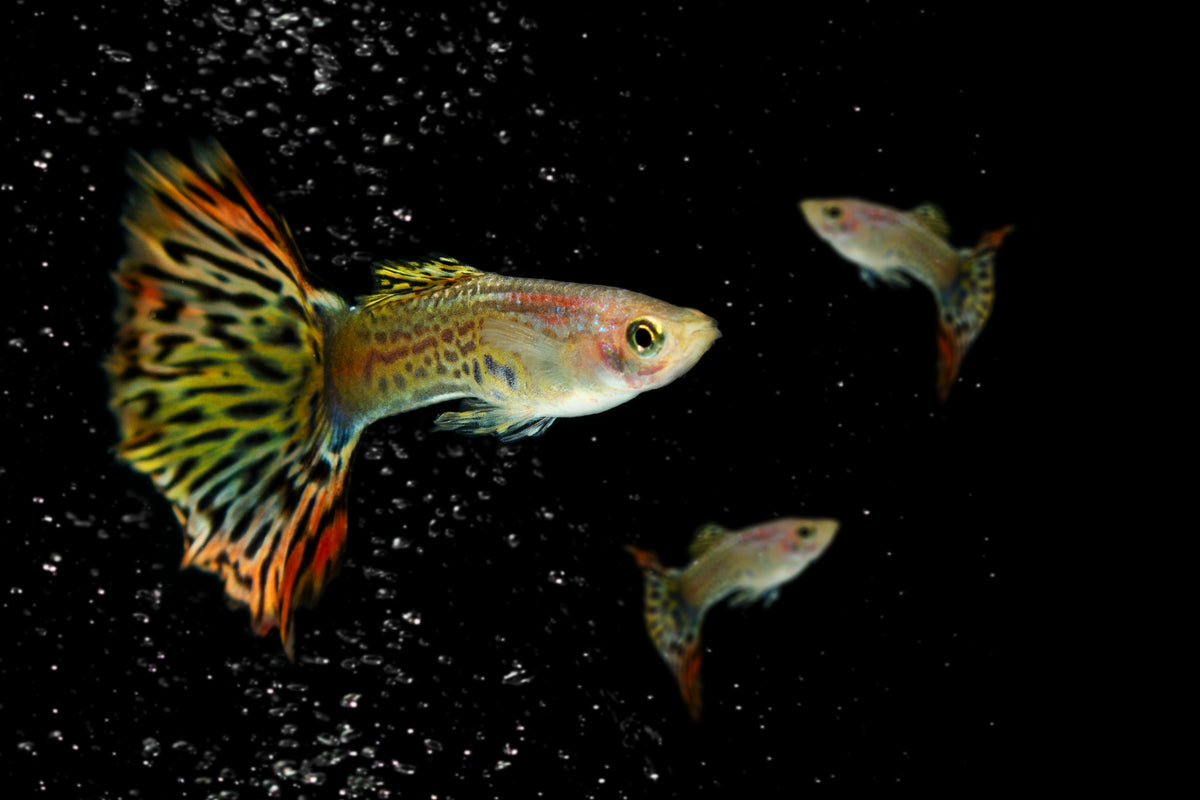
The guppy (Poecilia reticulata) is a small livebearer fish native to freshwater streams, ponds, and coastal waters of northeastern South America and some Caribbean islands, where wild fish are comparatively plain. Nearly all the color and finnage variety seen in the hobby today -- including this large-eared 'dumbo ear' mosaic-tail strain -- comes from generations of selective breeding, not from different wild species.
Guppies are livebearers: females give birth to free-swimming fry rather than laying eggs, and a healthy female can produce a new brood roughly every 4-6 weeks without any special intervention, which is part of why they've remained one of the most popular beginner fish for well over a century.
They're constantly active, inquisitive swimmers that spend their time in the middle and upper water column, and males in particular will spend much of their day displaying their fins and colour to females.
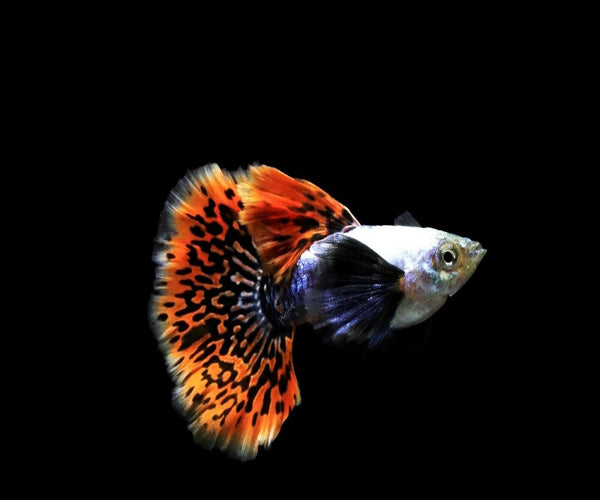
"Dumbo ear" guppies carry a genetic trait that enlarges the pectoral fins into broad, wing-like structures behind the gills, resembling the ears of the fin's namesake -- a purely ornamental trait bred for over many generations, distinct from the tail patterning. Combined here with a "chilli" red-orange body colour and a mosaic tail pattern (an irregular, marbled scattering of colour rather than a solid block or single stripe), this is one of the more elaborate and sought-after fancy guppy combinations, and correspondingly one of the pricier ones in the hobby.
Guppies are short-lived but fast-maturing: females can begin breeding at around 3 months old, and a typical lifespan is 2-3 years in good conditions -- fancier, more heavily selected strains like this one can be marginally shorter-lived than robust wild-type stock. Colour and finnage genetics in guppies are complex and polygenic, so individual fish and even siblings from the same brood can vary in exactly how large the "ears" grow or how densely the mosaic pattern fills in, which is part of why show-quality dumbo-ear lines remain a specialised, actively developed area of the hobby rather than a fixed, uniform strain.
Requirements
A small group does well in as little as 40-60 litres (10-15 gallons), though more space and more females than males (a ratio of at least 2-3 females per male) reduces the constant mating pressure that can stress and exhaust females in a male-heavy group.
Guppies breed prolifically and without any encouragement needed -- if you don't want a rapidly growing population, keep males and females separate or expect regular fry. Dense planting or floating plants give fry somewhere to hide from adults, who will otherwise eat them. A female can store sperm and continue producing broods for several months after being separated from a male.
They're easy omnivorous eaters, doing well on quality flake or micro-pellets with occasional live or frozen brine shrimp and daphnia for extra colour and conditioning.
The enlarged pectoral fins on a dumbo-ear guppy create noticeably more drag than a wild-type fish's, so gentle to moderate filter flow suits this strain much better than a strong current -- both for swimming ease and to avoid fraying the delicate fin edges. Smooth rockwork and silk rather than sharp plastic plants further reduce tear risk.
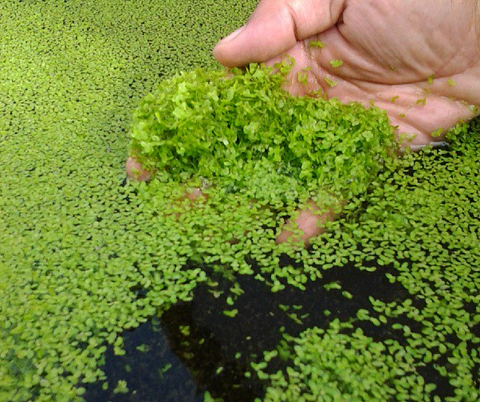
Fry, once born, need to be separated or given very dense cover to survive alongside adults -- a breeding box or floating plants like duckweed work well. Fry grow quickly on crushed flake and can usually join the main tank after 3-4 weeks, though the large "dumbo" pectoral fins and full mosaic pattern typically don't develop their final adult size and colour density until several months in, so juveniles look noticeably plainer than the adults they'll grow into.
A tightly fitted lid is also worth having: guppies are small, capable jumpers, particularly when startled or when water quality has quietly slipped without any other obvious warning sign yet.
Compatibility
Water & Care Conditions
Guppies are forgiving of a range of conditions, which is part of their beginner-friendly reputation, but stay healthiest and breed most reliably within these ranges:
- pH: 7.0–8.0 (guppies tolerate and often do best in slightly alkaline, harder water)
- Water hardness: moderately hard, 10–20 dGH
- Temperature: 22–28°C (72–82°F)
- Oxygenation: not demanding, but appreciates good circulation like most livebearers
- Water changes: weekly 20-25% changes keep nitrate low, especially important for a large-finned strain prone to fin damage/rot in poor water
- Common issues: fin rot and columnaris ("guppy disease") if water quality slips or the tank is overstocked -- more a management issue than an inherent fragility
Sudden temperature drops are a common preventable stressor for this species; guppies tolerate a fairly wide range but do poorly with rapid swings, so a stable heater matters more than an exact number. New arrivals benefit from slow drip-acclimation over 20-30 minutes rather than being tipped straight in, since they can be sensitive to abrupt pH or hardness changes.
Once settled, this is a hardy species for a beginner planted or community tank, though the elaborate finnage of a dumbo-ear mosaic strain does mean paying closer attention to fin condition than with a plain wild-type guppy -- catching early fraying before it develops into fin rot is far easier to treat than an established infection.
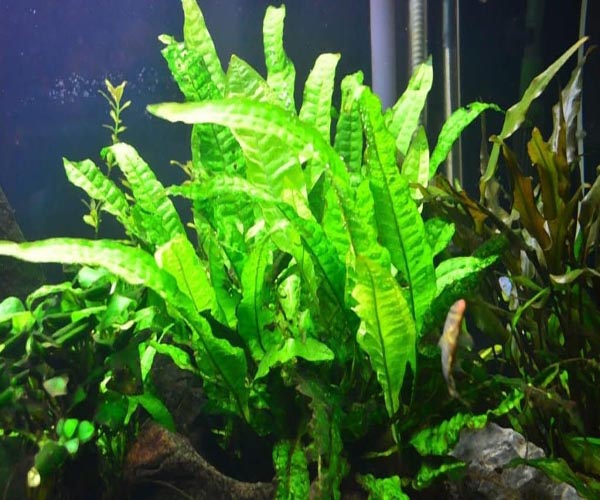
Live plants are a genuine benefit rather than just decoration: they help buffer minor water-quality swings between changes, give fry and stressed fish somewhere to retreat, and undemanding low-light species like java fern or java moss don't add much extra care burden on top of the fish themselves. Chilli-red colouration in particular tends to look most vivid against a darker substrate under moderate rather than very bright lighting.