About & Origin
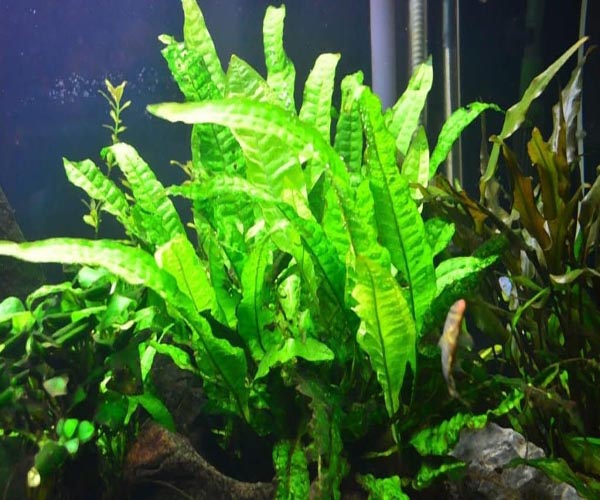
Java fern is one of the most widely grown aquarium ferns, prized for how little it asks of the keeper. It's native to Southeast Asia (Microsorum pteropus), where it grows attached to rocks and driftwood along the banks of shaded, slow-moving streams and rivers, often partly emersed. Narrow leaf is a naturally occurring form with slimmer, more upright leaves than the standard broad-leafed variety, growing to roughly 10–20cm.
Unlike almost every other plant on this site, Java fern isn't a substrate rooter at all — it's a rhizome epiphyte. In the wild and in the aquarium it anchors itself to hard surfaces with fine root threads, never growing in soil or gravel the way a true rooted plant does.
It's one of the most widely recommended aquarium plants there is, precisely because it tolerates neglect, low light, and beginner mistakes better than almost anything else in the hobby.
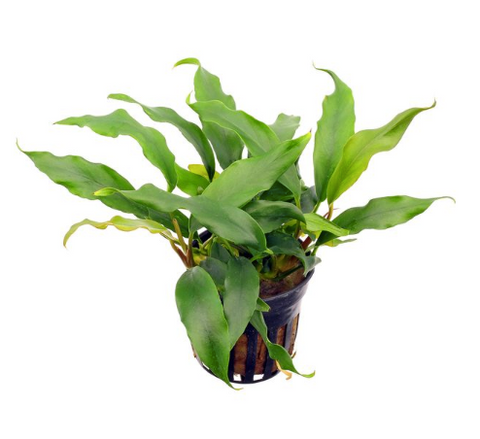
This particular listing ships attached to a 5cm mesh disc rather than loose -- a common, convenient nursery format that lets the rhizome start gripping a hard surface immediately rather than needing to be tied down by the buyer, though the mesh itself is typically removed or left to be grown over once the plant has anchored on its own.
Requirements
The single most important rule with Java fern: never bury the rhizome (the thicker horizontal stem the leaves and roots grow from) in the substrate. A buried rhizome will rot over time, even though the plant may look fine for weeks first. Instead, tie or glue it to a piece of driftwood or rock with the rhizome exposed — the roots will grip the surface on their own within a few weeks, after which the tie can be removed.
Light: low to moderate light is ideal; it's genuinely one of the best plants for low-tech, low-light tanks and can actually bleach or grow algae-covered leaves under very intense light.
CO2 and nutrients: not required — it grows perfectly well without CO2 injection or heavy fertilising, drawing much of what it needs from the water column.
Growth: slow and steady; new leaves and, over time, small plantlets can form along mature leaf edges, which can be separated and attached elsewhere once they've grown a few small leaves and roots of their own.
Placement: works well attached to driftwood or rock in the midground or as a foreground accent given the narrow leaf form's more compact, upright habit compared to the broader standard variety.
Compatibility
Water & Care Conditions
Java fern is genuinely tolerant of a wide range of conditions:
- pH: 6.0–7.5
- Hardness: soft to moderately hard, roughly 2–15 dGH
- Temperature: 20–28°C (68–82°F)
- Light: low to moderate — this is one of the very few plants that does better in dimmer tanks than under intense lighting
Poor growth or blackened, melting leaves are far more often caused by a buried rhizome or algae smothering the leaves than by water chemistry — it's a genuinely forgiving plant on parameters. Small black dots that appear on mature leaves are not disease but new plantlets forming -- a normal and, for many keepers, desirable reproduction method rather than something to remove. Growth is slow, so patience matters more than intervention; a healthy Java fern that looks unchanged for weeks is very likely doing fine, not stalled. Algae growth on the leaves is the most common real complaint keepers have with this plant, usually a sign of too much light or too little water flow around the leaves rather than anything wrong with the fern itself -- reducing photoperiod or intensity slightly, and improving circulation, generally clears it up over a few weeks without needing to treat the plant directly. Otherwise, this is about as low-effort as aquarium plants get.