
About & Origin
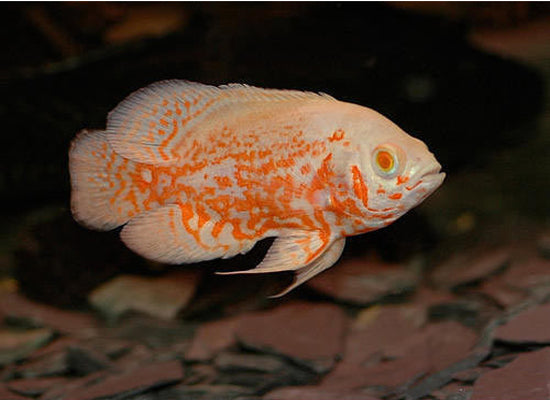
The Oscar (Astronotus ocellatus) is a large, genuinely intelligent freshwater cichlid native to the Amazon and Orinoco river basins of South America, where it inhabits slow-moving, often turbid tributaries, floodplains, and quiet backwaters. The Copper Oscar is a selectively bred colour variety showing a warm coppery-orange base, distinct from the wild-type's mottled brown-and-orange pattern.
Oscars are large, intelligent cichlids often nicknamed "water dogs" for how strongly they recognise and interact with their keeper — learning to anticipate feeding time, following movement outside the glass, and even accepting hand-feeding once settled.
Important to know before buying: Oscars sold small will grow into a genuinely large fish — commonly 30–35cm (12–14in) — and are messy, heavy-waste-producing eaters. This is a long-term, large-tank commitment, not a fish that stays small.
The copper colouring deepens and becomes noticeably more even as the fish matures over its first couple of years, with juveniles typically showing a duller, more mottled version of the adult's richer tone. Oscars are also long-lived for a freshwater fish, commonly reaching 10-15 years or more in a well-kept tank -- a genuine long-term commitment on top of the space they need, well beyond what many other commonly-kept aquarium fish require.
Requirements
Oscars need real space and strong filtration to thrive long-term.
Tank size: a single adult Oscar needs a minimum of roughly 75 gallons (285L), with 125+ gallons better for a pair or for keeping it with other large tankmates. A tank that's fine for a juvenile will be badly undersized within a year or two.
Filtration: Oscars are messy, heavy eaters that produce a lot of waste — strong, well-maintained filtration is essential, not optional.
Décor: Oscars dig and rearrange substrate, and can be clumsy around delicate decor — use sand or smooth gravel and secure, sturdy decorations rather than anything sharp or easily toppled.
Diet: omnivorous and food-motivated — quality cichlid pellets as a staple, with occasional treats; avoid a diet of feeder fish, which carries a real disease risk.
Growth rate: Oscars grow quickly when young, often reaching half their adult size within the first year given adequate feeding and space -- plan the eventual tank size around the adult from the start rather than upgrading repeatedly as the fish outgrows each setup.
Tankmates: best kept with other large, robust South American cichlids or similarly sized catfish -- anything small enough to fit in an adult Oscar's mouth is at real risk of being eaten.
Compatibility


Water & Care Conditions
Oscars are fairly adaptable on water chemistry but sensitive to poor water quality given how much waste they produce:
- pH: 6.0–8.0, ideally 6.5–7.5
- Water hardness: soft to moderately hard, roughly 5–20 dGH
- Temperature: 23–27°C (74–81°F)
- Oxygenation: needs strong filtration and good water movement to keep pace with a heavy bioload
Ammonia and nitrite control matter more for Oscars than for almost any community fish on this site — their size and appetite mean water quality can deteriorate quickly and noticeably in an under-filtered or overstocked tank.
Large weekly water changes (25-30%) are standard practice for a healthy Oscar tank, alongside canister or sump filtration rated well above the tank's nominal stated capacity -- undersized filtration is one of the most common, entirely preventable causes of Oscar health problems seen in the hobby.
Watch for the classic warning signs of illness -- clamped fins, loss of appetite, pale colour, or "hole in the head" pitting around the face and lateral line, which is strongly linked to poor water quality and nutrition in this species specifically and is largely preventable with consistent maintenance and a varied, quality diet rather than requiring anything exotic once the issue is caught early and properly addressed.