
About & Origin
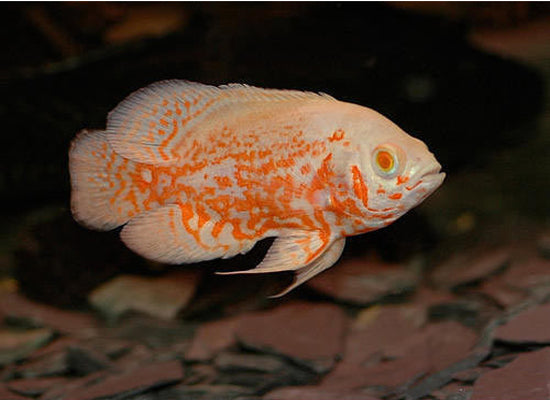
The Oscar (Astronotus ocellatus) is a large South American cichlid native to the Amazon and Orinoco river basins, inhabiting slow-moving, often turbid tributaries and floodplain waters. The Tiger Oscar is the classic wild-type-style colour form: a dark base marked with bold orange-red mottling and blotches, the pattern most people picture when they think of an Oscar.
Oscars are large, intelligent cichlids often nicknamed "water dogs" for how strongly they bond with their keeper, recognising feeding routines and reacting to activity outside the tank.
Important to know before buying: Oscars sold small will grow into a genuinely large fish — commonly 30–35cm (12–14in) — and produce substantial waste. This is a long-term, large-tank commitment, not a fish that stays small.
The "tiger" name refers specifically to the irregular dark mottling and blotching pattern rather than true tiger-style parallel stripes -- the same broad pattern-naming convention used across a lot of ornamental fish and reptile trade names. This wild-type-style pattern is also the form most closely resembling how the species actually looks in the Amazon basin, unlike some of the more heavily selectively-bred Oscar colour strains.
Colour and pattern intensity naturally deepen with age and good conditioning, so a young tiger Oscar's markings will typically become richer and more defined over its first year or two rather than staying static from the size it's purchased at.
Requirements
The Tiger Oscar is the classic wild-type colour form, but needs the same serious commitment as any Oscar: 75 gallons (285L) minimum for one adult, 125+ for a pair, strong filtration for a heavy eater, and secure, blunt decorations since this fish digs and bumps into things. Feed quality cichlid pellets as a staple and skip feeder fish, which carry real disease risk.
Behaviour and personality: individual Oscars have distinct, recognisable personalities in a way most aquarium fish don't -- some are bold and constantly at the glass looking for interaction, others more reserved, and this variation is genuinely part of the appeal for long-term keepers. They readily learn to associate a keeper's presence with feeding and will often follow movement around the room from inside the tank.
Aquascaping realities: Oscars rearrange their tank as a matter of course -- loose gravel gets shifted, unanchored plants get uprooted, and lightweight decor gets knocked over. Heavy, half-buried rock and securely potted or fake plants hold up far better than a delicately arranged aquascape, and it's worth planning décor with this behaviour in mind from the start rather than fighting it.
Tankmates: beyond size, look for species that share this fish's slow-moving, murky-water temperament -- other large South American cichlids, robust catfish, and similarly sized armoured fish generally cope well, while fast, nervous, or small fish either get bullied or eaten outright.
Compatibility


Water & Care Conditions
pH 6.0-8.0 (ideally 6.5-7.5), hardness 5-20 dGH, 23-27C, with strong filtration and circulation to handle a heavy bioload. Water-quality discipline matters more for this species than almost any other on this site -- an underfiltered tank shows ammonia/nitrite problems fast with a fish this size and this messy an eater.
Common health issues: Hole-in-the-head disease (a set of lesions typically around the head and lateral line) and ich are the two conditions most associated with Oscars, and both are largely preventable rather than inevitable -- consistently clean water and a varied, high-quality diet are the real prevention, far more than any single medication or supplement.
Growth rate: a young Oscar bought at a few centimetres can reach a substantial adult size within a year or two under good conditions, so tank size should be planned around the adult the fish will become, not the juvenile it's sold as -- upgrading tanks partway through a fast-growing Oscar's first year is common among keepers who underestimated this.
Feeding discipline: Oscars beg persistently and will act hungry regardless of how recently they've eaten, which makes overfeeding a genuinely common problem -- stick to a measured portion once or twice daily rather than feeding on demand, and favour a varied diet over a single food type to avoid nutritional gaps that show up as dull colour or poor condition over time.