
About & Origin
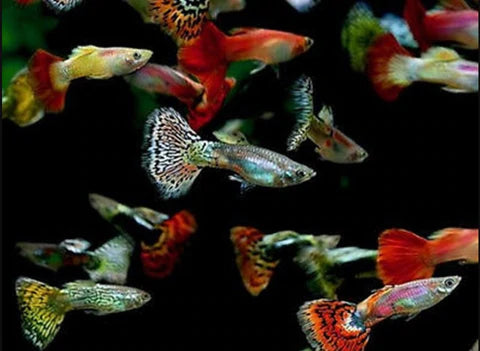
These are standard, unselected guppies (Poecilia reticulata) sold as a bulk pack -- typically used either to stock a community tank inexpensively or as live food for larger predatory fish (e.g. bigger cichlids, oscars, puffers) that benefit from live prey for enrichment and conditioning. Biologically they are the same species as every fancy-finned guppy strain: a small, hardy South American livebearing freshwater fish.
If you're keeping them as pets rather than feeders, they behave exactly like any other guppy: peaceful, active, and easy to breed, with females giving birth to free-swimming fry every 4-6 weeks.
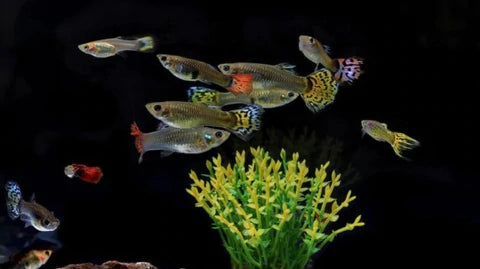
Unlike the fancy-finned or colour-strain guppies sold elsewhere on this site, "feeder" guppies are deliberately unselected stock -- ordinary mixed colouring and standard fin length, bred purely for hardiness and low cost rather than any particular look. This is the same basic approach used for common feeder fish worldwide: prioritise a robust, disease-resistant, easily-bred fish over ornamental traits, since the primary use case doesn't call for either.
Live feeding is a genuinely debated practice among fishkeepers -- some predatory-fish owners use live guppies specifically for enrichment (encouraging natural hunting behaviour in species like larger cichlids or puffers) or as an occasional supplement rather than a staple diet, while others avoid live feeding altogether over disease-transmission risk or welfare concerns about the feeder fish itself. Either use case is entirely up to the buyer -- these are sold as live, healthy guppies, not specifically marketed or guaranteed as feed animals. A pack this size is equally suitable as a cheap, low-fuss way to start a first community tank, since the underlying fish is exactly the same hardy, easy-breeding species prized throughout the hobby, just without the selective colour or fin breeding that adds cost to fancier strains.
Requirements
Guppies are famously easy but do have a few things worth knowing before stocking a group.
Sex ratio and breeding: males constantly court females, which can stress females kept 1:1 -- a ratio of roughly 2-3 females per male (or an all-male or all-female group) makes for a calmer tank. If you keep both sexes together, expect regular fry unless you specifically plan not to breed them.
Tank size and cover: a 40-60cm tank suits a small group comfortably; floating plants or dense planting give fry (and stressed females) somewhere to hide from adults, which will otherwise eat newborn fry given the chance.
Diet is easy -- a good flake or micro-pellet staple, with occasional live/frozen foods (brine shrimp, daphnia) for conditioning and colour. They are unfussy eaters and one of the most beginner-friendly fish available.
If used as feeders: a genuine quarantine period (2 weeks minimum) before feeding to display predatory fish is strongly advised, since feeder fish can carry parasites or bacterial infections that transfer to whatever eats them. "Gut-loading" -- feeding the feeders a nutritious diet for a few days before use -- also improves the nutritional value passed on, since a starved feeder fish offers far less benefit than a well-fed one.
If kept as pets instead: treat this pack exactly like any other guppy purchase -- same tank size, sex ratio, and breeding considerations as described for any guppy strain on this site, with the only real difference being appearance rather than care.
Batch stocking: with 10 fish arriving together, plan filtration and tank size for the full group rather than assuming a few will be used immediately as feed -- unused guppies breed and thrive under normal community conditions just like any other line.
Compatibility
Water & Care Conditions
Guppies are adaptable, but genuinely do best -- with the strongest colour, fullest fins, and best breeding success -- in water on the harder, more alkaline side, unlike many soft-water tetras:
- pH: 7.0–8.0
- Hardness: moderately hard to hard, roughly 8–25 dGH; a small pinch of aquarium salt is tolerated well and sometimes used to support fin health, though it isn't required
- Temperature: 22–28°C (72–82°F)
- Oxygenation: not demanding; comfortable in gentle to moderate flow
They tolerate a wider range than the ideal above, but colour, fin condition, and fry survival rates are noticeably better in clean, moderately hard, well-cycled water.
Even as unselected feeder-line stock, these are living animals and benefit from the same basic care as any other fish while in your possession -- a properly cycled tank or holding container, clean water, and adequate feeding, rather than a bare, unfiltered container, will keep them healthier and reduce disease risk whether they're destined to be pets or feed.
If holding a batch temporarily before feeding out, a simple sponge-filtered container with weekly partial water changes is enough; overcrowding a holding tank is the most common way feeder stock develops water-quality problems and associated illness.
Signs of stress or illness to watch for in a newly arrived batch include clamped fins, gasping at the surface, listlessness, or visible spots/fuzz on the body -- any of these in multiple fish at once usually points to water quality or a transit-related stress issue rather than something wrong with an individual fish, and is worth addressing with a partial water change and parameter check before anything else, the same as it would be for any purchased fish regardless of its intended purpose or eventual use.