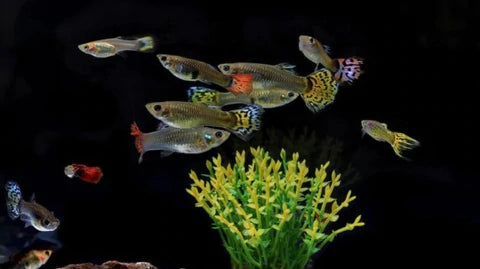
About & Origin
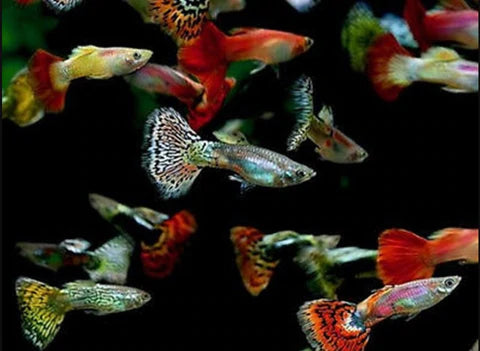
The guppy (Poecilia reticulata) is a small livebearing fish native to freshwater streams, ponds, and coastal drainages across Venezuela, Trinidad, Guyana, and parts of Brazil, from where it has been introduced (sometimes deliberately, for mosquito control) to warm-climate waterways worldwide. Wild guppies are modestly coloured; virtually every ornamental strain sold today, including this one, is the product of over a century of selective breeding for fin shape and colour, not a different species.
Guppies are livebearers: females are fertilised internally and give birth to free-swimming fry rather than laying eggs, and a single mature, previously-mated female can produce a new batch of fry roughly every 4-6 weeks without a male present, since she can store sperm. This is exactly why guppies remain one of the most widely bred and easily available fish in the hobby.
This listing is a pack of 10 female guppies specifically -- noticeably larger-bodied and more rounded than males, with plainer, less flamboyant colouring and shorter fins, since virtually all of the ornamental colour and finnage breeding in this species has historically focused on males. Females are also easy to sex with confidence: look for the dark "gravid spot" near the base of the anal fin, which darkens further as a pregnancy progresses, and the clear absence of a modified, rod-like gonopodium fin that males use to fertilise females internally.
Buying females as a dedicated group, rather than a mixed-sex batch, is a common way to either avoid unplanned breeding altogether or to deliberately pair a specific male-only strain with chosen females later -- giving noticeably more control over which colour lines end up crossed than letting an unmanaged mixed-sex group breed freely and unpredictably.
Requirements
Guppies are famously easy but do have a few things worth knowing before stocking a group.
Sex ratio and breeding: males constantly court females, which can stress females kept 1:1 -- a ratio of roughly 2-3 females per male (or an all-male or all-female group) makes for a calmer tank. If you keep both sexes together, expect regular fry unless you specifically plan not to breed them.
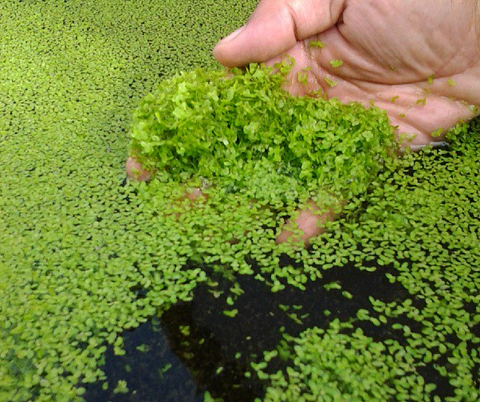
Tank size and cover: a 40-60cm tank suits a small group comfortably; floating plants or dense planting give fry (and stressed females) somewhere to hide from adults, which will otherwise eat newborn fry given the chance.
Diet is easy -- a good flake or micro-pellet staple, with occasional live/frozen foods (brine shrimp, daphnia) for conditioning and colour. They are unfussy eaters and one of the most beginner-friendly fish available.
Important sperm-storage caveat: a female bought from a mixed-sex tank at the supplier may already be carrying stored sperm from a prior mating, even if no male is present in your own tank -- meaning a genuinely all-female group can still unexpectedly produce fry once or even a few times after purchase. This is normal guppy biology, not a sorting error, and usually tapers off within a couple of broods as stored sperm is used up.
Group dynamics: an all-female group is generally calmer than a mixed-sex tank, since there's no constant male courtship chasing to stress individuals -- this often makes a female-only pack a better choice for a display tank focused on watching relaxed, natural behaviour rather than breeding.
Tank size for 10 females: given their larger adult size compared to males, a group of 10 females is comfortable in a 15-20 gallon (55-75 litre) tank alongside other peaceful community stock, with room to spare compared to housing the same number of males.
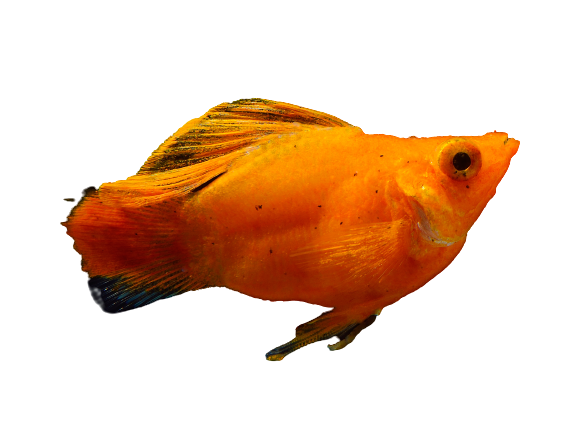
Compatibility
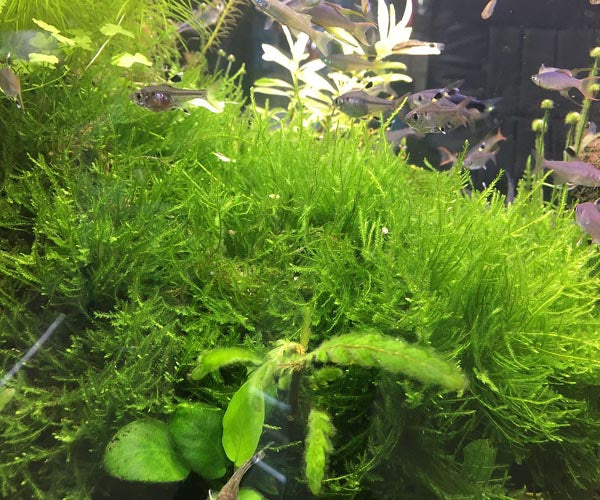
Water & Care Conditions
Guppies are adaptable, but genuinely do best -- with the strongest colour, fullest fins, and best breeding success -- in water on the harder, more alkaline side, unlike many soft-water tetras:
- pH: 7.0–8.0
- Hardness: moderately hard to hard, roughly 8–25 dGH; a small pinch of aquarium salt is tolerated well and sometimes used to support fin health, though it isn't required
- Temperature: 22–28°C (72–82°F)
- Oxygenation: not demanding; comfortable in gentle to moderate flow
They tolerate a wider range than the ideal above, but colour, fin condition, and fry survival rates are noticeably better in clean, moderately hard, well-cycled water.
Pregnant or heavily gravid females benefit from extra cover -- dense planting or a breeding box -- as birth approaches, since even in an all-female tank a stressed or exposed female giving birth is more vulnerable than one with somewhere to retreat. Watch body shape as a general health indicator: a healthy female should look evenly rounded, not lopsided, sunken on one side, or dramatically swollen beyond what pregnancy alone would explain, which can indicate internal illness (such as dropsy) rather than normal gestation. A female nearing birth will also often seek out a quiet corner or dense plant cover on her own, a natural behaviour worth accommodating rather than a sign of distress.
As with any batch purchase, water quality during the first few weeks after arrival matters most -- test ammonia and nitrite regularly while the group settles in, and do a partial water change at the first sign of any fish looking off rather than waiting to see if it resolves on its own. Established, well-cycled water is far more forgiving than a brand-new setup, so if possible avoid stocking a large group like this into a tank that hasn't finished cycling yet.