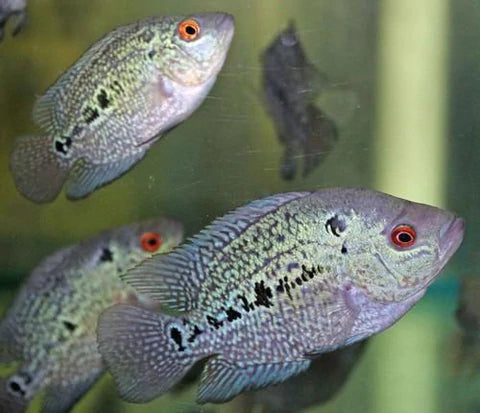
- IMAGE FOR THE REFERENCE
- MAKE ORDER AND CHECK WITH CUSTOMER CARE AND SELECT THE FISH BY CHECKING THE READY STOCK
- ONCE AFTER YOUR SELECTION ONLY ORDER WIL GET PROCESSED
About & Origin
The Flowerhorn is not a wild species but a man-made hybrid cichlid, developed from crosses between several Central American cichlids (including Trimac and Red Devil-type parentage) originating in Malaysia and Taiwan in the 1990s, prized for its bold coloring and the distinctive "kok" nuchal hump that develops on the forehead of mature males. Because it's a hybrid rather than a wild-type species, no two Flowerhorns are genetically identical, and how large a nuchal hump or how vivid the coloring becomes varies fish to fish. Over the years breeders have developed numerous named strains (Kamfa, Zhen Zhu, Golden Monkey, and others), each selected for different combinations of hump size, pearling/spotting pattern, and body shape, though a specific strain isn't always identifiable at this young, unformed stage.
This listing is for a young Flowerhorn — small, active, and not yet showing full adult coloring or hump development, both of which emerge with age and good care. The nuchal hump itself is thought to be linked to a swim-bladder-adjacent structure and is influenced by genetics, diet, hormones, and even stress levels, which is why hump size can vary enormously between individual fish raised in similar conditions and why no breeder or seller can guarantee a particular hump size in advance.
Flowerhorns became a genuine cultural phenomenon in parts of Southeast Asia in the early 2000s, prized in some traditions for supposedly bringing luck or prosperity to their owner (partly tied to the fish's vivid red coloring and the markings some strains show that resemble Chinese characters) — a belief that drove exceptional prices for prized specimens and helped establish the fish firmly in the aquarium trade well beyond that initial craze.
fishykart.com sources healthy, actively-feeding juveniles, not stressed stock straight off a long shipping chain.
Requirements
Flowerhorns are a serious commitment, and it's worth knowing what a baby Flowerhorn grows into before buying one.
Adult size and tank size: Flowerhorns commonly reach 25–30cm (10–12") and need a minimum 75-gallon tank as a single adult, with considerably more for a breeding pair. A juvenile can start smaller, but budgeting for the eventual upgrade in advance avoids a rushed, stressful move later.
Temperament: among the most aggressive commonly kept cichlids. Adult Flowerhorns are highly territorial and are usually kept alone rather than with other fish — this isn't a fish chosen for a peaceful community tank.
Diet: omnivorous and a hearty eater — high-quality cichlid pellets formulated to enhance color, supplemented with occasional live or frozen protein. Overfeeding is a real risk with a fish this enthusiastic about food; portion control matters more than most keepers expect for a species this size.
Filtration: Flowerhorns are messy, large-bodied fish; strong filtration rated well above the tank's actual volume is standard practice to keep water quality stable.
Enrichment and personality: Flowerhorns are widely considered among the most interactive, "doglike" cichlids in the hobby — many recognize their keeper, follow movement around the room, and can be trained to take food from the hand. This intelligence is part of the appeal, but it also means a Flowerhorn kept in a bare, understimulating tank can become visibly stressed or listless over time; some rearranging of decor and regular interaction genuinely benefits this species.
Growth rate: Flowerhorns grow quickly when well fed, often reaching several inches within the first year, so the "grow into it" tank-size planning mentioned above is not a distant, theoretical concern — upgrades tend to come sooner than new keepers expect.
Compatibility

Water & Care Conditions
Flowerhorns are hardy and adaptable to a range of parameters, but do best and color up best within these ranges:
- pH: 6.5–7.5
- Salinity / hardness: freshwater, moderately hard
- Temperature: 26–30°C (79–86°F) — on the warmer side for a freshwater fish, and sensitive to sudden temperature swings
- Oxygenation: benefits from strong filtration and good water movement, both for oxygenation and to manage the bioload of a large, messy fish
Stability matters as much as hitting exact numbers — sudden parameter swings stress Flowerhorns and can trigger color loss or illness.
Weekly partial water changes of around 25–30% are typical for this species given how much waste a large, heavily-fed cichlid produces; skipping maintenance is one of the fastest ways to see color dull and a previously vivid Flowerhorn start to look washed out. Some keepers also add a small amount of aquarium salt or a color-enhancing mineral supplement, though this isn't strictly necessary if water quality and diet are already good — a high-quality color-formula pellet as the diet base does most of the real work. A sponge or canister filter rated for at least double the tank's actual volume is a common recommendation given how much this species eats and excretes relative to its size.
Because Flowerhorns are usually kept alone, water testing is the main early-warning system for problems, since there's no tankmate behavior to cross-check against — a sudden loss of appetite, clamped fins, or faded color in an otherwise-settled fish is worth investigating with a water test before assuming it's just a mood. A well-cycled, well-filtered tank with a consistent maintenance schedule is the single biggest factor separating a Flowerhorn that colors up beautifully from one that stays dull despite good food.