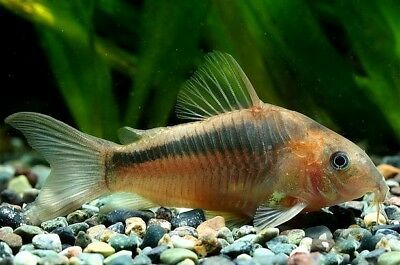
About & Origin
The Green Cory is a small armoured catfish, the natural "bronze/green" colour form of Corydoras aeneus, arguably the single most widely distributed and commonly kept corydoras species in the aquarium trade. Its natural range spans a remarkable stretch of South America -- from Colombia and Trinidad through the Amazon basin down to the Río de la Plata drainage in Argentina -- living in slow streams, ditches, and floodplain pools with soft, silty bottoms.
The metallic olive-green sheen across the body (most visible under good lighting) is the source of the common name, and it's this same wild-type fish that most "bronze cory" stock in the trade descends from. Like all corydoras, it's an armoured catfish -- rows of bony plates take the place of scales -- and it forages constantly along the substrate using three pairs of barbels to locate food by touch and smell.
Green Corys are shoaling fish in nature, moving and feeding in loose groups, and they're known for a distinctive habit of periodically darting to the surface for a gulp of air, a trait tied to their ability to use their gut as an accessory breathing organ in oxygen-poor water.
Because C. aeneus breeds so readily in captivity, the vast majority of Green Corys sold today are tank-raised across several generations rather than wild-caught, which generally means hardier, better-acclimated stock than a wild import. This species is also notably long-lived for its size -- a well-kept specimen commonly reaches 5 years and can push past 10, longer than many of the small tetras typically kept alongside it, so it's worth planning a community around them with that lifespan in mind.
In a well-decorated tank with some open sandy patches, Green Corys spend much of the day in near-constant motion, sifting through the top layer of substrate -- genuinely active, engaging fish rather than a static "cleanup crew," which is part of what makes them one of the most consistently popular bottom-dwelling fish in the hobby.
Requirements
As one of the hardiest corydoras species, Green Corys are an excellent beginner-friendly bottom dweller, but they still have real requirements worth getting right.
Substrate: fine sand or smooth, rounded gravel is important -- sharp-edged substrate abrades their sensitive barbels over time.
Group size: keep at least 6 together; this is a genuinely social species and a lone cory is a stressed cory.
Tank size: comfortable from around 60cm/24 inches upward for a group, with open floor space to forage across.
Diet: sinking wafers or catfish pellets as a staple, with occasional bloodworm or daphnia. Don't rely on them purely to "clean up" -- they need their own dedicated feeding.
Tankmates: peaceful only -- avoid boisterous or nippy fish that will out-compete them at the bottom or stress them.
Filtration: moderate flow suits them better than a strong powerhead current, matching the calm water they inhabit in the wild -- what matters far more than flow rate is a fully cycled tank with zero measurable ammonia and nitrite, since bottom-dwellers are usually the first fish to show stress when water quality slips.
Breeding: Green Corys are one of the easier catfish to breed at home. A well-conditioned group given a cooler, oxygen-rich partial water change (mimicking a rain event) will often trigger spawning, with the classic "T-position" mating posture and sticky eggs deposited on glass or plant leaves. It's a rewarding beginner breeding project, though eggs and fry need separating from adult tankmates to survive.
Acclimation: slow drip-acclimating new stock over 30-60 minutes reduces the shock-related stress that abrupt water-parameter changes can cause in catfish, which are generally more sensitive to sudden shifts than the hardier community fish often kept alongside them.
Compatibility
Water & Care Conditions
Green Corys are one of the more chemistry-tolerant corydoras, which is a big part of why they're so beginner-friendly.
- pH: 6.0–8.0
- Hardness: soft to moderately hard, roughly 2–20 dGH
- Temperature: 22–26°C (72–79°F) -- avoid running them long-term in a warm, high-70s°F+ tank meant for tropical centrepiece fish, as heat noticeably shortens their lifespan
- Oxygenation: appreciates good flow and surface movement; their ability to breathe air at the surface gives useful headroom if oxygen dips
Consistency matters more than precision here -- stable parameters within these ranges will keep a group healthy for years.
The most common issue keepers see isn't disease but physical barbel damage from sharp substrate -- shortened, frayed, or missing whiskers, which can develop secondary bacterial or fungal infection if the underlying substrate problem isn't fixed. Checking barbel condition is a quick, useful health check when selecting stock at a shop. Nitrate is also worth monitoring specifically: this species tolerates a wide pH and hardness range but is comparatively sensitive to nitrate buildup, and consistently elevated nitrate is a common hidden cause of unexplained lethargy in a group that otherwise looks fine.
A weekly 20-30% water change with light gravel vacuuming (without fully disturbing the sand layer they forage through) is a solid baseline routine, and it matters more for keeping this species thriving than fine-tuning pH or hardness to an exact figure.
New stock should always be quarantined for a couple of weeks where practical, since corys can carry parasites or mild bacterial issues that don't show visibly until the stress of transport and a new environment brings them out -- catching that in a separate tank protects an established display tank's existing residents. A dim, heavily planted or driftwood-furnished tank also tends to bring out their best colour and most natural, confident behaviour.