About & Origin
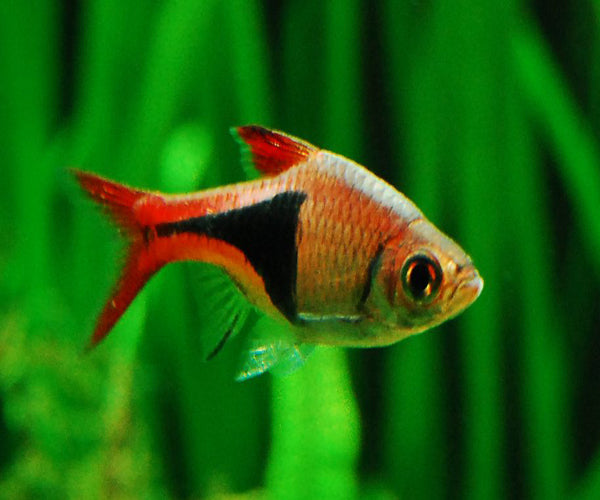
The Harlequin Rasbora (Trigonostigma heteromorpha) is a small shoaling freshwater fish native to the Malay Peninsula, Sumatra, and parts of Thailand and Singapore, where it inhabits slow-moving, densely vegetated blackwater streams and swamps. It's easily identified by its copper-orange body and the distinctive black triangular "wedge" patch toward the tail.
It has been one of the most popular community fish since it was first introduced to the hobby in the early 20th century — hardy, peaceful, and strikingly patterned without being fragile or demanding, which has made it a long-standing beginner and expert favourite alike.
In the wild it shoals in large numbers through the leaf-litter-stained waters of Southeast Asian peat swamp forests, and its calm, cohesive shoaling behaviour translates well into the aquarium.
The Harlequin Rasbora (Trigonostigma heteromorpha) is one of the most recognisable rasboras, identified by its bold black triangular "wedge" marking against a pinkish-copper body, and is native to Malaysia, Singapore, Sumatra, and Thailand.
In the wild it inhabits slow, blackwater streams and peat swamps thick with leaf litter and overhanging vegetation, giving the water its characteristic tea-brown tannin stain and soft, acidic chemistry.
It has an unusual breeding behaviour among common aquarium fish: females lay eggs on the underside of broad-leaved plants rather than scattering them, a trait shared with its close relatives.
The Harlequin Rasbora (Trigonostigma heteromorpha) is one of the most recognisable Southeast Asian schooling fish, instantly identified by the black triangular patch angled across the rear half of its copper-orange body. It comes from blackwater streams and peat swamp forest across Malaysia, Singapore, Thailand, and Sumatra, and has been a community-tank staple since the early 20th century.
It remains one of the most widely available and consistently popular rasboras in the trade, largely because it combines easy care with striking, reliable colour.
Requirements
Harlequin Rasboras should be kept in groups of 8 or more; they're a genuinely social shoaling fish and settle noticeably better, showing more natural behaviour and colour, in a proper group than in a small one.
They're an easy, adaptable, and peaceful community fish that does well in a planted tank with some open swimming space. Unlike some of the softer-water tetras, they're relatively tolerant of a range of water conditions, which is part of why they're such a reliable beginner-friendly choice.
Feeding is simple — a good quality flake or micro pellet, with occasional live or frozen foods appreciated but not essential.
A classic community shoaler — keep in groups of 8-10 or more for natural schooling behaviour and best colour; in smaller numbers it tends to be noticeably shyer.
Does well in a planted tank with some open swimming space, ideally with broad-leaved plants if breeding is of interest, plus subdued lighting reflecting its shaded native habitat.
An easy omnivore — takes flake and micro pellets, with small live/frozen foods appreciated for conditioning and colour.
It shoals tightly and confidently in groups of eight or more, showing far better colour and less skittish behaviour than smaller groups. It is one of the easier blackwater species to keep in ordinary tap water once acclimated, though it still shows its richest colour in soft, tannin-tinted conditions closer to its wild habitat.
It accepts standard flake and pellet foods without issue, though colour and condition improve further with occasional small live or frozen foods, and it does well in almost any peaceful, established community setup.
It is a hardy, adaptable species once past initial acclimation, tolerating a broader range of established tank conditions than some of its more delicate blackwater relatives.
Compatibility



Water & Care Conditions
More tolerant of a range of conditions than many of its softwater tankmates, though it still does best within these ranges:
- pH: 6.0–7.8
- Salinity / hardness: freshwater only, soft to moderately hard water
- Temperature: 22–27°C (72–81°F)
- Light: moderate; comfortable in both open and planted setups
- Oxygenation: standard community filtration and flow; a hardy, forgiving species with no special oxygenation demands
- Breeding note: uniquely among common rasboras, it lays eggs on the underside of broad leaves rather than scattering them, a behaviour worth knowing if attempting to breed it
- Colour display: tannin-tinted, softer water and dark substrate bring out noticeably richer copper and black tones than harder, brightly lit setups
- Feeding: unfussy, takes flake and pellets readily; occasional live/frozen foods boost colour
- Longevity: commonly lives 5-8 years, longer-lived than many small schooling fish
- Tank position: stays mainly in the lower-to-middle water column, especially around planting
- Filtration: gentle to moderate filtration suits this species well, matching its slow-water native habitat
Soft, acidic, tannin-stained water most closely matches its native blackwater habitat and tends to bring out its best colour, though well-acclimated stock adapts reasonably well to moderate hardness.
Gentle to moderate filtration suits this species well, since it comes from calm, slow-moving swamp and stream habitats rather than fast-flowing water.
Weekly partial water changes of 20-30% help keep Harlequins colourful and active, since like most small characins and rasboras it's sensitive to accumulating nitrates and organic waste over time even though it isn't considered a delicate species.
A mature, cycled tank with established biological filtration is a much safer home for a new shoal than a freshly set-up system, since ammonia and nitrite spikes during cycling are a common cause of losses in small schooling fish.