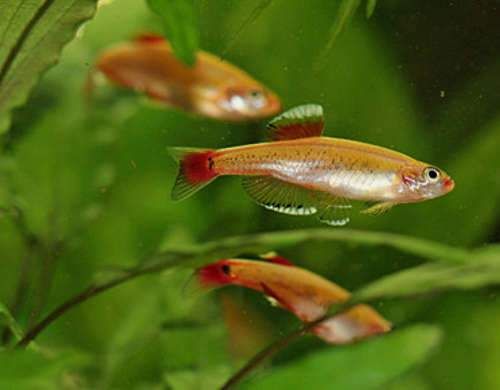
About & Origin
The White Cloud Mountain Minnow is a small, cold-tolerant freshwater fish popular with beginners. This listing refers to it (Tanichthys albonubes) in its standard wild-type colouring — an olive-green bodied fish with a shimmering metallic stripe and red-and-white tipped fins, native to cool mountain streams near Guangzhou in southern China.
It's one of the very few widely available "tropical fish shop" species that isn't actually tropical: it evolved in cool, fast-flowing water and, as a result, doesn't need a heater to thrive, unlike almost everything else typically sold alongside it. Wild populations were once considered nearly extinct before recovering, and virtually all fish in the trade today are captive-bred.
It has long been recommended as a first fish for beginners and as a hardy companion species for unheated or coldwater tanks.
This refers to the standard wild-type White Cloud Mountain Minnow (Tanichthys albonubes), an olive-green-bodied fish with a red-and-gold horizontal stripe and red-tipped fins, native to Baiyun (White Cloud) Mountain near Guangzhou, China.
It comes from cool, fast-flowing hill streams, making it unusually tolerant of cooler temperatures compared to most popular tropical aquarium fish — historically it was even nicknamed the "poor man's neon tetra" for its similarly bright colouring at a much lower price and easier care.
In the wild it's now considered rare to extinct in its original habitat due to habitat loss and pollution, so nearly all stock available today is captive-bred.
The White Cloud Mountain Minnow (Tanichthys albonubes) is native to cool hill streams near Guangzhou in southern China, historically thought extinct in the wild before being rediscovered in small surviving populations. Its slender silvery-green body with a metallic stripe and red-tipped fins has earned it the nickname "poor man's neon tetra," though its cool-water needs set it apart from true tropical tetras.
Requirements
A hardy, easy shoaling fish — keep in groups of 6 or more. Its standout practical feature is not needing a heater, making it one of the easiest fish to keep at genuinely cool room temperature.
Peaceful and adaptable, it does equally well in a dedicated coldwater setup or a cooler-running community tank, provided it isn't paired with fish that need consistently warm water.
Feeding is easy — takes flake and micro pellets without fuss.
A very active, hardy shoaler — keep in groups of 6 or more in the upper-to-middle water column, where it spends most of its time.
Its cool-water tolerance means it can be kept in an unheated tank at normal room temperature as well as a standard heated tropical setup, giving real flexibility in stocking a mixed-temperature system.
Feeding is simple: quality flake or micro pellet as a staple, with small live or frozen foods appreciated for conditioning and colour.
Uniquely among widely sold schooling aquarium fish, it thrives at genuinely cool, unheated room temperatures and can even struggle in consistently warm tropical tank conditions over the long term — this makes it one of the very few community schooling fish suited to an unheated tank, a cool porch setup, or a temperate outdoor pond in mild climates.
It accepts flake, micro pellets, and small live/frozen foods without fuss, and does especially well in a cooler, well-planted tank alongside other small, peaceful, similarly cold-tolerant fish rather than being limited to strictly tropical tankmates.
Its tolerance for a wide temperature range gives real flexibility in stocking plans, and it does equally well in a simple bare setup or a heavily planted cool-water aquascape.
Overall a genuinely low-maintenance, forgiving species for a cool-water community tank.
Compatibility


Water & Care Conditions
Genuinely cold-tolerant compared to almost any typical community fish:
- pH: 6.0–8.0
- Salinity / hardness: freshwater only, tolerates a wide hardness range
- Temperature: 18–22°C (64–72°F) ideally, tolerating up to around 24°C — no heater required in most rooms
- Light: not light-sensitive
- Oxygenation: appreciates a bit more current/oxygenation, reflecting its native fast-flowing mountain-stream habitat
- Temperature range: genuinely coldwater-tolerant, comfortable well below standard tropical tank temperatures — avoid keeping it warm long-term
- Breeding: one of the easier egg-scattering fish to breed in a community planted tank without special intervention
- Feeding: unfussy, accepts flake, micro pellets, and small live/frozen foods readily
- Longevity: with cool, stable conditions can live 5+ years, longer than many warm-water tetras
- Tank position: an active upper/mid-water swimmer that appreciates some open space
- Filtration: standard filtration suits this hardy, adaptable species well
- Substrate: not particular about substrate type; does well in a simple or planted setup alike
- Substrate: not particular about substrate type or colour
- Note: a genuinely low-maintenance, hardy choice for a cool-water community
One of the most cold-tolerant common aquarium fish, genuinely comfortable at room temperature without a heater in many climates.
Reasonably tolerant of a range of water chemistry, though it originates from clean, well-oxygenated flowing water, so good filtration and some current are appreciated.
Weekly partial water changes of 20-30% help keep this species colourful and active, since like most small characins and rasboras it's sensitive to accumulating nitrates and organic waste over time even though it isn't considered a delicate species.
A mature, cycled tank with established biological filtration is a much safer home for a new shoal than a freshly set-up system, since ammonia and nitrite spikes during cycling are a common cause of losses in small schooling fish.