About & Origin
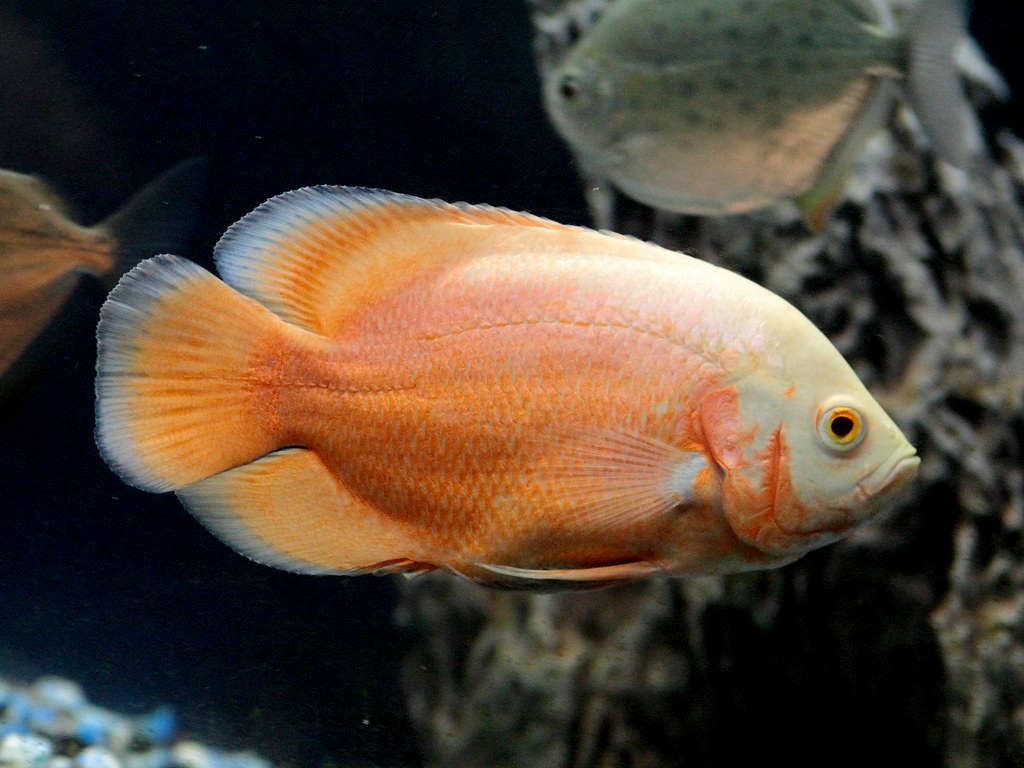
The oscar (Astronotus ocellatus) is a large South American cichlid from the slow-moving, often turbid waters of the Amazon, Rio Negro, and Paraná river basins. The red albino seen in this listing is a selectively bred colour form of the same wild species, not a different fish.
Oscars are famous in the hobby for their intelligence and personality -- they recognise their owner, learn to anticipate feeding time, and are often described as 'the dog of the aquarium world' for how interactive they become once settled in.
In the wild they're ambush predators, hanging in cover near submerged wood and vegetation before lunging at passing prey, a hunting style that carries straight over into tank behaviour: an established oscar will often "case" a new tankmate for days before deciding it's food, rather than attacking on sight.
They're also long-lived for an aquarium fish, commonly reaching 10-15 years or more with good care, and continue growing for the first few years of life -- a young oscar bought small will still need the full-size adult setup within a year or two, so it's worth planning tank space around the fish it will become rather than the size it's sold at.
Colour and pattern in oscars vary widely even within a single wild population, and decades of aquarium breeding have produced additional named forms -- tiger (mottled orange-and-black), red, albino, and long-fin variants among them -- all still the same species and sharing identical size, temperament, and water requirements regardless of colour. This variety, combined with the fish's outsized personality, is part of why oscars have stayed one of the most consistently popular large cichlids in the hobby for decades, despite the serious space commitment they demand.
The red albino form specifically combines the standard reddish-orange oscar pattern with the albino gene (a recessive trait affecting melanin production), giving pink eyes and a paler base tone than a normally pigmented red oscar. Like other albino fish, it's somewhat more light-sensitive than standard-coloured individuals and appreciates some shaded cover in the tank rather than intense, shadow-free lighting all day.
Requirements
Standard oscar space and stocking rules apply regardless of colour form: a single adult needs at least 250-300 litres (65-75 gallons) since they commonly reach 30-35cm, secured hardscape and minimal or potted planting since they dig and uproot enthusiastically, and only large, robust tankmates -- anything small enough to fit in an oscar's mouth is treated as food, not a companion.
Albino stock specifically comes from selective breeding for reduced pigmentation, the same general principle as albino strains in other fish, and this has a couple of real practical knock-on effects worth planning around: reduced pigment generally means somewhat more light-sensitive eyes and skin, so shaded retreat areas or floating cover in the tank are worth including rather than uniformly bright lighting all day. Diet and feeding rules are otherwise identical to any oscar -- a quality cichlid pellet staple over feeder fish, with prawn or earthworm for conditioning, and genuine care not to overfeed a species that begs persistently regardless of how full it already is.
Décor and space: oscars dig with real enthusiasm and will uproot loose plants or topple unsecured rockwork, so décor needs to be anchored directly to the tank base rather than balanced on substrate. A single adult needs the full 250–300 litres minimum regardless of colour form — this isn't a fish that can be kept smaller because it looks juvenile-sized on arrival, since it will outgrow that impression within the first year or two. Many keepers eventually move toward a single-species tank once the fish reaches adult size, simply because compatible tankmates get harder to find at that scale. A quality cichlid pellet works well as the staple diet, occasionally supplemented with prawn or earthworm for conditioning.
Compatibility
Water & Care Conditions
Same water chemistry range as any oscar -- pH 6.0-8.0, hardness 5-20 dGH, 23-27°C -- since colour form doesn't change what the fish needs beyond the lighting note below. Filtration and bioload are the real limiting factor for this species regardless of colour: canister or sump filtration rated well above the tank's nominal volume is the norm, not the exception, and 25-30% weekly water changes are typical given how much waste a fish this size produces.
The one genuine difference for albino stock: reduced pigmentation generally means somewhat greater light sensitivity, so shaded retreat areas or floating cover are worth including rather than bright, uniformly-lit water all day -- a small setup adjustment, not a different care regime. "Hole in the head" disease (linked to poor diet and water quality) and ich remain the two most common health issues in oscars generally, largely preventable with a varied diet and consistent water quality.
Because reduced pigmentation is part of what defines this colour form, watch for skin health specifically — albino fish can show sunburn-like irritation under very intense, unfiltered lighting over time, another reason shaded cover in the tank is worth including rather than treating it as purely cosmetic. Canister or sump filtration rated well above the tank's stated volume is standard practice for oscars generally, and 25–30% weekly water changes keep pace with a bioload that scales up fast as the fish matures toward its adult size. "Hole in the head" disease and ich remain the most common issues seen in oscars of any colour form, and both are largely avoidable with a varied diet and consistently maintained water quality rather than requiring anything specific to the albino trait.