About & Origin
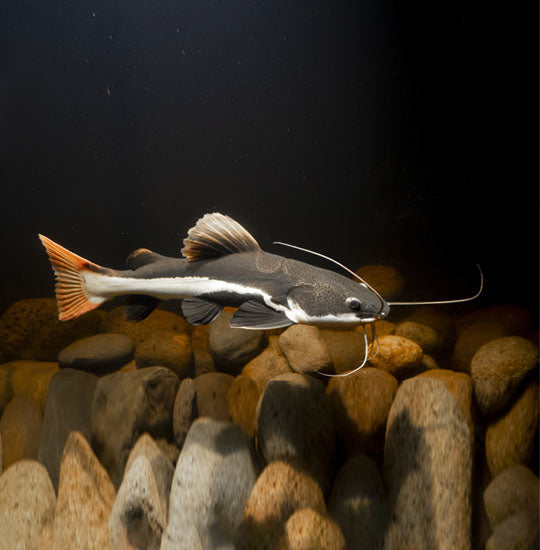
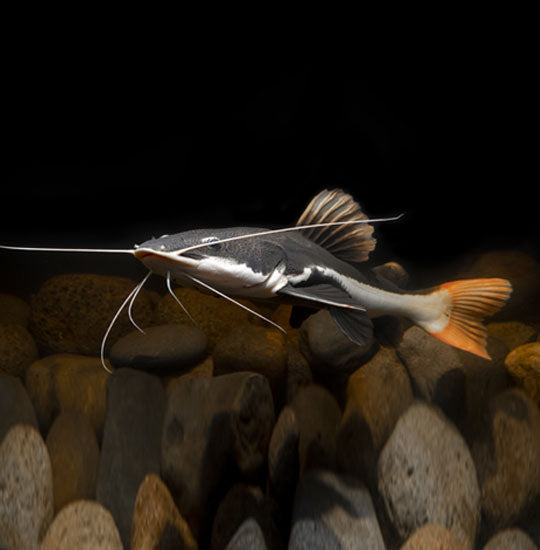
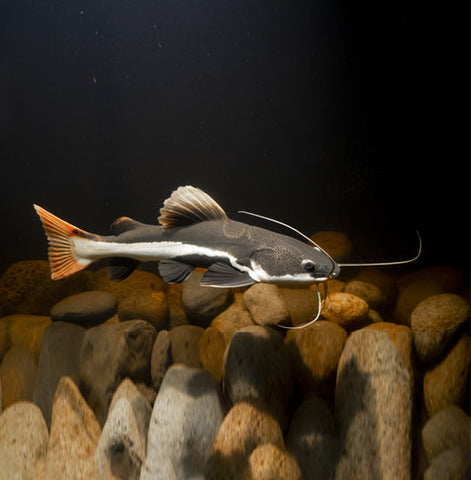
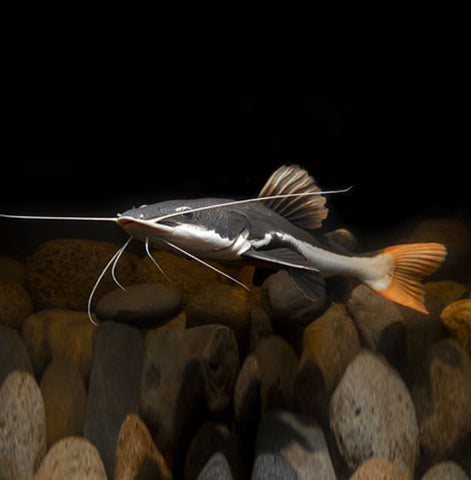
The Red-Tail Catfish (Phractocephalus hemioliopterus) is a large, powerful predatory catfish native to major river systems across the Amazon and Orinoco basins of South America. In the wild, it's an apex bottom-dwelling predator, eating fish, crustaceans, and virtually anything else it can fit in its very large mouth, and it grows into one of the biggest freshwater catfish species kept anywhere in the aquarium trade.
Juveniles sold in shops are small, strikingly patterned, and inexpensive, which is exactly why this species has a long-standing reputation as an "impulse buy that outgrows everything" -- in the wild and in large public aquaria, it regularly exceeds 100cm (over 3 feet) in length and can weigh many kilograms.
We're including this honestly rather than glossing over it: this is not a realistic long-term community or even standard single-species home aquarium fish for the vast majority of keepers.
In its native rivers, this species uses its enormous mouth to swallow prey whole rather than chewing, and its powerful, muscular body lets it hunt effectively even against strong current -- traits that make it a genuinely impressive predator in the wild but a poor fit for the vast majority of home setups once it reaches anywhere close to its real adult size.
Requirements
Please read this before buying: a Red-Tail Catfish is one of the most commonly rehomed/outgrown fish in the hobby, precisely because its adult requirements are wildly different from what a juvenile needs.
Eventual tank size: a full-grown adult needs an enormous system -- realistically a many-thousand-litre pond or a public-aquarium-scale tank, not a standard home aquarium, even a large one.
Growth rate: this species grows fast and will quickly outgrow any typical starter or even large "big fish" tank within one to two years.
Predatory diet: as it grows it will eat any tankmate small enough to fit in its mouth -- it cannot be safely kept with most other fish long-term.
Plan before buying: only suitable for keepers with a genuine, realistic long-term plan for pond-scale or public-aquarium housing. If in doubt, a smaller catfish species (bristlenose, corydoras) is a far more practical choice for a home tank.
Filtration: even as a juvenile, this species produces substantial waste, so strong filtration well beyond the tank's nominal rating is needed from day one, not just once the fish is fully grown. Growth is fast under good feeding -- a juvenile can add many centimetres per year, regularly catching keepers off guard at how quickly the "manageable" starter fish stops being manageable.
Compatibility
Water & Care Conditions
Red-Tail Catfish are hardy on water chemistry -- the real constraint on keeping this species is tank size and growth rate, not water parameters.
- pH: 6.5–7.5
- Hardness: soft to moderately hard, roughly 2–15 dGH
- Temperature: 23–28°C (73–82°F)
- Oxygenation: as a large, heavy waste producer, it demands strong filtration and oxygenation regardless of tank size
Water chemistry is genuinely the easy part with this species -- the real, non-negotiable requirement is having a realistic plan for an adult fish over a metre long before purchase. Well-kept individuals are also exceptionally long-lived, commonly reaching 15-20 years or more, which means the space and filtration commitment isn't a phase the fish will outgrow into a stable arrangement -- it only ever gets bigger. Ammonia and nitrite should read zero once cycled, and given the species' predatory nature, feeding appropriately sized whole or chunked food rather than pellets alone better matches its natural diet as it matures. As with the Hi-Fin Albino Pleco and other large catfish on this site, the honest summary is that water chemistry is genuinely the easy part -- the real, ongoing challenge is having enough physical space, filtration capacity, and a firm long-term plan before this fish is ever brought home.