About & Origin
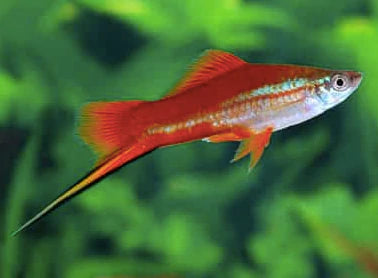
The Sword-Tail Platy is a small livebearer fish that carries the elongated, blade-like extension at the base of the tail fin characteristic of the genus Xiphophorus, the same genus that includes both platies and true swordtails (X. hellerii) -- two closely related livebearer groups that interbreed readily and share very similar care needs. Wild Xiphophorus populations are native to slow rivers, streams, and coastal waters across Mexico and Central America.
The sword extension is purely ornamental and doesn't affect the fish's swimming or behaviour -- it remains an active, peaceful, mid-water swimmer that feeds on algae, small invertebrates, and general aquarium foods, just like standard platies.
As with other Xiphophorus livebearers, it gives birth to free-swimming fry and breeds readily in a mixed-sex group, so keepers should expect regular fry if keeping both sexes together.
Only males develop the namesake sword; females have a plain, fan-shaped tail identical in shape to a standard female platy, which makes sexing this strain visually straightforward from the moment the sword starts coming in during a young male's growth. The genus Xiphophorus itself is named from the Greek for "sword-bearer," a nod to the true swordtail's more pronounced version of the same tail feature that this strain shares in a smaller, platy-proportioned form.
Requirements
Core livebearer husbandry carries over from standard platy care (female-heavy sex ratio, omnivorous flake/pellet diet plus vegetable matter, more cold-tolerant than most tropicals) but the sword extension changes a few specifics.
Tank size: a little more generous than a plain platy — 75cm/30in rather than 60cm/24in — since the sword adds visible length and this strain is closer in size to true swordtails than a compact standard platy.
Male-only aggression: as with true swordtails, males can spar over the sword and over females — keep either one male per group of females, or enough space and cover for multiple males to establish territory without constant conflict.
Fin care: the sword extension is more fragile than a standard platy's rounded tail — smooth decor and calm tankmates matter more here.
Breeding: because Xiphophorus platies and swordtails interbreed readily, avoid keeping this strain alongside true swordtails if you want to preserve either line's traits.
Fry appearance: newborn fry of this strain hatch (are born) without a visible sword — the tail extension only develops as young males mature, so it's not possible to tell which fry will eventually show the trait until they're partway grown; this is normal and not a sign that the sword trait has been lost from the line.
Compatibility

Water & Care Conditions
- pH: 7.0–8.2
- Hardness: moderately hard to hard, roughly 10–28 dGH
- Temperature: 18–26°C (64–79°F)
Xiphophorus species as a group are forgiving on exact water chemistry as long as it's stable. For this strain specifically, check the sword extension for fraying or clamping as an early sign of stress or poor water quality, in addition to normal platy health checks.
Standard community filtration is sufficient; consistency and cleanliness matter more than hitting a precise number.
Tap water that's naturally soft or acidic can be nudged toward this species' preferred harder, more alkaline range with a small addition of aquarium salt, a remineralizing product, or crushed coral/limestone worked into the filter or substrate — precise dosing matters less here than simply moving in the right direction, since the acceptable range is fairly wide.
Beyond the sword itself, general health checks apply as with any livebearer: active swimming, a healthy appetite, and steady colour are better indicators of wellbeing day to day than any single water parameter reading in isolation.
Weekly partial water changes of around 20-25% are the simplest lever for keeping both water quality and colour consistent — this species tolerates a fairly wide chemistry range, but it doesn't tolerate stale, nitrate-heavy water well, and a neglected tank shows up first as duller colour and a shorter, less impressive sword before any more serious symptoms appear.