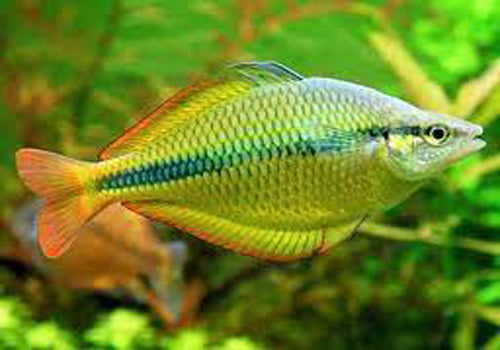
About & Origin
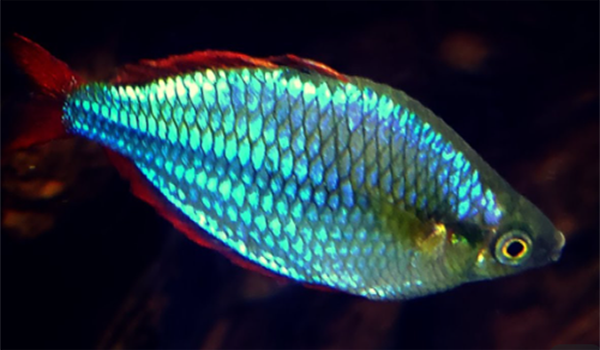
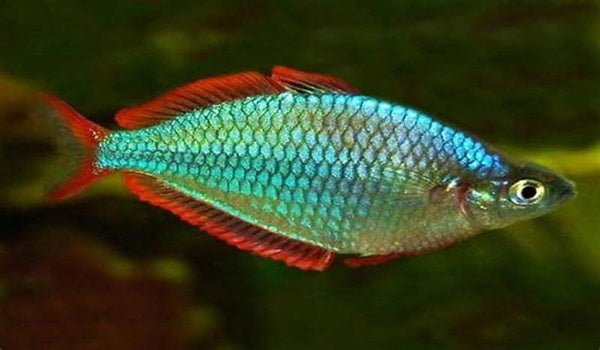
"Yellow Rainbow" is a small rainbowfish -- the name trades on the yellow-tinged finnage that dwarf neon rainbowfish (Melanotaenia praecox) females and younger fish naturally show, rather than describing a separate colour strain — this species' colour shifts noticeably by sex and age, from silvery-yellow juveniles to the iridescent blue-purple of a fully mature male.
Wild populations come from fast-flowing forest streams in the Mamberamo River system of New Guinea. The colour is natural pigment shimmer, not dye or genetic engineering, and develops fully with age, diet, and a settled, confident environment.
They are active, fast-swimming schooling fish that spend most of their time in the middle and upper water column, and males display and flare their fins at each other and at females in a way that's part of their normal, harmless shoaling behaviour rather than real aggression.
Because the yellow tone is closely tied to sex and youth rather than being a fixed adult trait, a group sold under this name will naturally diversify in appearance over its first several months -- males colouring up toward blue-purple while females and any late-maturing individuals retain more of the yellow tone longer, giving a mixed-sex group genuine visual variety rather than a single uniform look.
Requirements
Standard dwarf neon rainbowfish care applies (shoal of 6+, 60cm/24in tank with open mid/upper swimming space, secure lid, easy omnivore diet, breeds over fine-leaved plants).
Sexing note: since this trade name describes the yellow tone typical of females and juveniles, buyers should know that as this fish matures — especially a male — the yellow will likely shift toward the fuller iridescent blue-purple adult colouring rather than staying yellow permanently. That's a normal part of growing up, not a sign the fish was mis-sold.
Group dynamics: keeping a proper mixed-sex shoal (ideally more females than males) both suits the species' natural social behaviour and produces the best display, since males show off their developing colour most actively when competing gently for female attention within a group -- a lone male or a very small group tends to display less and colour up more slowly than one kept in a proper shoal.
Swimming space: as a genuinely active, fast-swimming species from flowing water, this fish makes noticeably better use of a longer, wider tank footprint than a tall, narrow one at the same overall volume -- horizontal swimming room matters more here than vertical height.
Startle response: as a naturally alert, fast-moving species, this fish can be prone to sudden darting if startled -- a securely fitted lid is worth having regardless of jumping risk specifically, since a spooked rainbowfish can collide with tank edges hard enough to injure itself.
Compatibility
Water & Care Conditions
- pH: 6.5–7.5
- Hardness: soft to moderately hard, roughly 5–15 dGH
- Temperature: 24–28°C (75–82°F)
- Oxygenation: strong water movement matters, reflecting this species' fast-stream origin
Colour and activity level track health closely in this species — a fish that stays dull well past the usual settling-in period, rather than developing its adult colour, is worth checking against diet, group size, and water flow rather than assumed to just be a naturally paler individual.
Diet plays a genuine role in how fully colour develops: a varied diet including small live or frozen foods (daphnia, brine shrimp, bloodworm) alongside a quality flake or micro-pellet tends to produce noticeably better colour and condition than a flake-only diet over the same time period.
Well-kept individuals of this species commonly live 4-5 years, a longer lifespan than many small community fish, worth factoring into stocking plans as a genuine multi-year fixture rather than a short-lived addition.
New arrivals benefit from slow, drip-style acclimation over 20-30 minutes rather than a quick float-and-release, since this species is somewhat more sensitive to sudden chemistry shifts than some hardier community fish, and transport stress compounds that sensitivity.
Strong, moving water and open swimming space aren't just about matching the species' native habitat cosmetically -- genuinely poor circulation in a still, stagnant tank measurably reduces activity level and colour development in this species over time.