90 Gallon Tank Dimensions: Size, 1,050 lb Weight, 90 vs 75
Published: 2026-11-20 · FishyKart Blog
A standard 90 gallon tank measures 48 1/2 x 18 1/2 x 25 1/8 inches (about 123 x 47 x 64 cm), weighs 135 lb empty and 1,050 lb full, according to Aqueon's aquarium dimension chart. It is effectively a taller 75 gallon: the same 4-foot by 18-inch footprint, but 4 inches more height. That extra height adds about 15 gallons, 265 lb of weight and a deeper reach to the bottom, which is the real decision between the two.
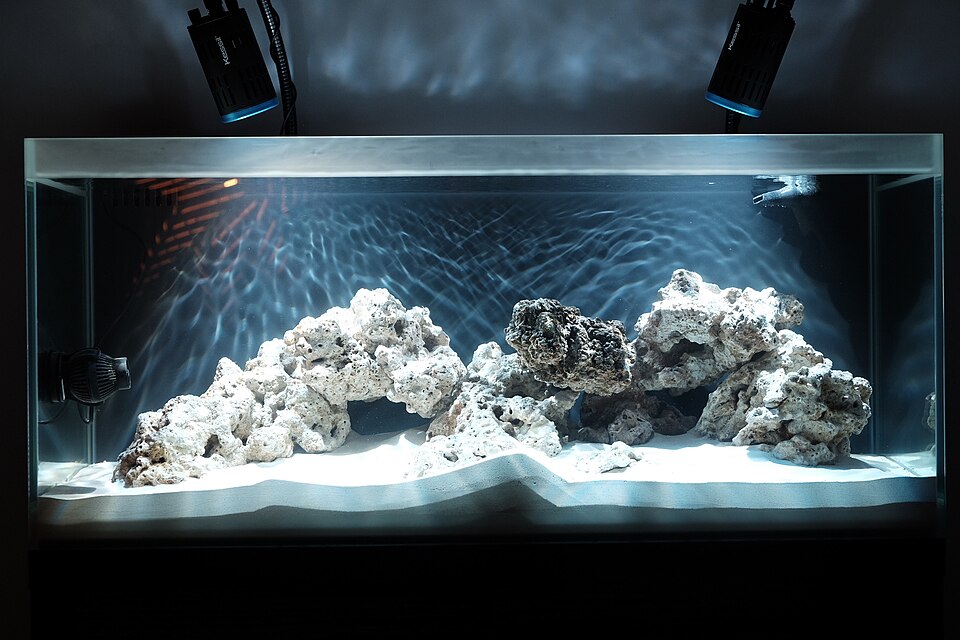
Photo: kerinin - Wikimedia Commons, CC BY-SA 2.0
One Footprint, Three Tanks
Aqueon builds three tanks on the identical 48 1/2 x 18 1/2 inch base. Only the height changes:
| Tank | Height | Outside volume | Empty / full weight | Load per sq ft |
| 60 breeder | 16 in | about 62 gal | 43 / 543 lb | about 87 lb |
| 75 gallon | 21 1/8 in | about 82 gal | 98 / 785 lb | about 126 lb |
| 90 gallon | 25 1/8 in | about 98 gal | 135 / 1,050 lb | about 169 lb |
Dimensions and weights from the Aqueon critical dimensions chart; outside volume (L x W x H / 231) and load on the 6.2 square foot footprint are our calculations. Real water in a set-up 90 is lower than the outside volume, usually around 80-85 gallons after glass, substrate and decor.
What the Extra 4 Inches Change
- Glass and weight: taller water pushes harder on the seams, so the 90 uses heavier glass: 135 lb empty against 98 lb for the 75. Moving it takes three or four people.
- Reach: at 25 inches deep you need a long-handled scraper, planting tongs and often a step stool. Many keepers cannot reach the bottom of a 90 without getting a shoulder wet.
- Light: plants on the bottom need a stronger light than in a 75; a light sized for a 21-inch tank leaves carpeting plants short.
- Fish that use height benefit: freshwater angelfish stand 8-10 inches tall with fins and like about 20 inches of water, so a 90 gives adult angels real room (see how big do angelfish get).
- Fish that use floor space gain nothing: corydoras, loaches and most cichlids care about the 48 x 18 inch bottom, which is the same as a 75.
Floor Load and Stands
At about 1,050 lb on 6.2 square feet, a 90 puts roughly 169 lb on each square foot, more than four times the 40 lb per square foot that US homes are designed for across a room. Place it near a load-bearing wall, across floor joists, on a stand rated for at least the full weight. Because the footprint matches the 75, many stands are sold for both; the label rating, not the size, is what matters. Heavier cases are worked through in 300 gallon fish tank.
What Fits in a 90 Gallon
Around 80-85 gallons of water suits a large planted community with tall plants and a big school of tetras, a group of angelfish or discus, a single adult oscar (a pair needs 125 gallons, per our oscar fish tank setup guide), or a group of medium South American cichlids. For a delhezi bichir the 48 x 18 base is enough; the larger Senegal needs a 24-inch-deep tank, as shown in bichir tank size. Count stock with the same method as in how many fish in a 55 gallon tank.
Should You Buy the 75 or the 90?
Choose the 90 if you keep tall fish or tall plants, and do not mind deeper maintenance. Choose the 75 if your fish live near the bottom, you want easier reach, or the floor is a concern: it is 265 lb lighter full. If you want more swimming length rather than height, skip both and look at a 6-foot tank in 125 gallon tank dimensions. Shorter options on the same base are in 75 gallon tank dimensions and 60 gallon tank dimensions.