Corydoras Catfish: Types, Group Size and Care
Published: 2026-10-28 · FishyKart Blog
Corydoras are small armoured catfish from South America, and few aquarium fish are as easy to recognise: a group of them sifts the bottom with whisker-like barbels, then one suddenly darts to the surface for a gulp of air. Traditionally grouped in the genus Corydoras (family Callichthyidae), with well over 150 described species, they are being split by scientists into several genera, so some species now also appear under names such as Hoplisoma or Gastrodermus; stores still sell them all as corydoras. Most stay between 1.5 and 3 inches, are often reported to live 5 years or more with good care, and do best in groups of 6 or more in water around 72-79°F.
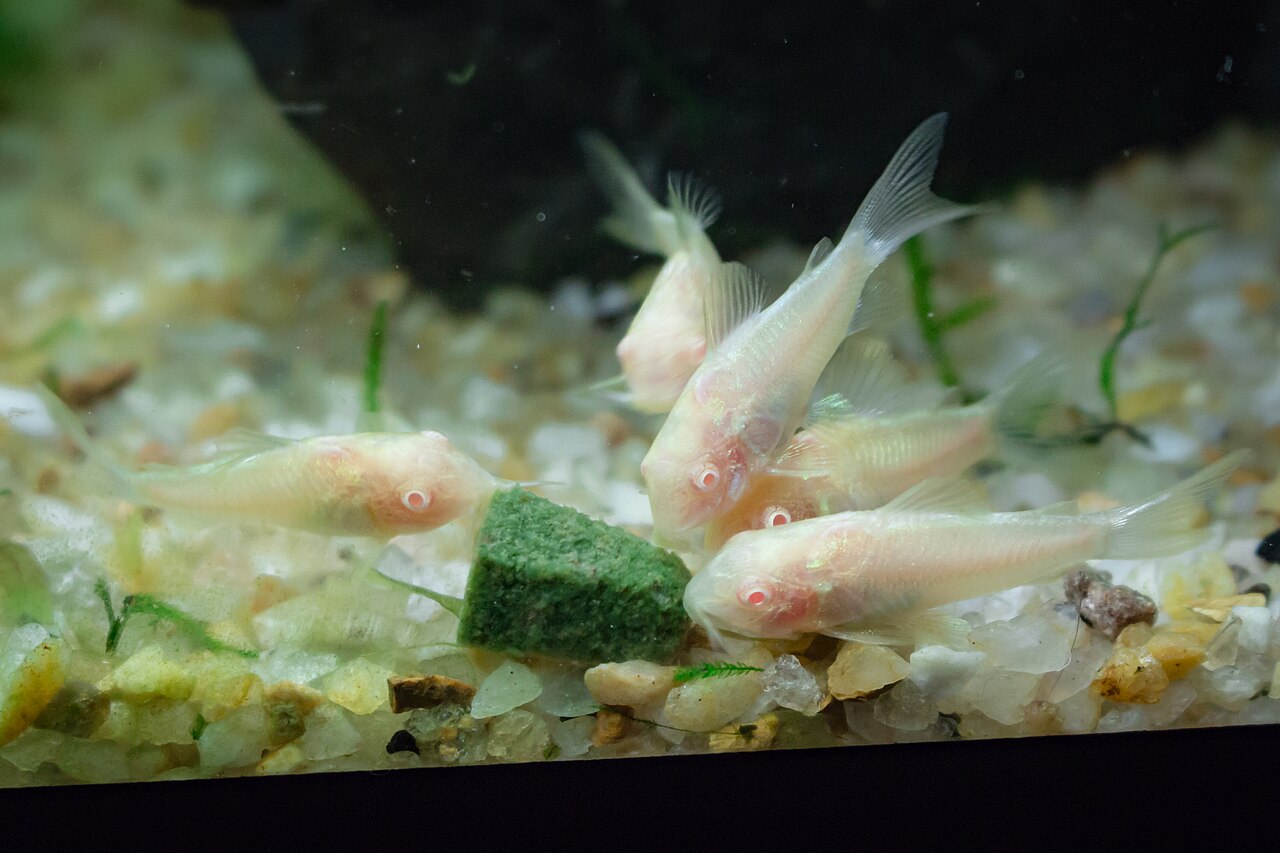
Photo: Gabriel Resende Veiga - Wikimedia Commons, CC BY-SA 4.0
| Parameter | Value |
| Genus | Corydoras in the broad sense (family Callichthyidae) |
| Origin | South America |
| Adult size | 1.5-3 in for most species; pygmy types about 1 in |
| Lifespan | Often reported as 5+ years |
| Group size | 6 or more of one species |
| Temperature | 72-79°F (22-26°C); some species prefer cooler or warmer |
| pH | 6.0-7.8 |
| Minimum tank | 20 gallons for most species; 10 gallons for pygmy types |
| Substrate | Fine sand or smooth gravel |
The Corydoras People Actually Buy
Most US stores carry the same handful of species, and they are not interchangeable in size or temperature needs.
- Bronze corydoras (C. aeneus): hardy, about 2.5 in, also sold as albino and "green" forms
- Panda corydoras (C. panda): black eye patches, smaller and fond of cooler water; see our panda cory guide
- Peppered corydoras (C. paleatus): mottled grey, tolerates cooler tanks than most
- Sterbai corydoras (C. sterbai): spotted with orange fins, prefers warmer water, a good match for discus keepers
- Pygmy and dwarf species (C. pygmaeus, C. habrosus, C. hastatus): about 1 in, suited to nano tanks
Different species will mix, but each one schools mainly with its own kind, so buy six of one rather than one of six.
Why the Bottom of the Tank Matters Most
Corydoras spend almost their whole day on the substrate, pushing their barbels into it to find food. Sharp or coarse gravel can wear those barbels down and open the way to infection, which is why sand is the safest choice. Keep the bottom clean: uneaten food and waste rotting in the substrate raise ammonia and nitrite right where corydoras feed. A light gravel vacuum during weekly water changes does more for them than any additive.
Feeding: They Are Not a Clean-Up Crew
The most common corydoras mistake is buying them to "clean the tank" and never feeding them. Leftover flakes rarely reach the bottom in useful amounts. Give sinking pellets or wafers once a day, add frozen or live foods such as bloodworms or brine shrimp a few times a week, and feed after lights-out if fast midwater fish steal everything first.
Air Gulping, Spines and Other Quirks
Corydoras have a modified gut that absorbs oxygen from swallowed air, so a quick sprint to the surface and back is normal behaviour. Frequent, frantic trips are not: they point to low oxygen or poor water quality. Corydoras also carry sharp, locking spines in their dorsal and pectoral fins. Net them gently, since the spines tangle in mesh, and never pick one up with bare hands.
Tank Mates
- Good: neon tetras, rasboras, otocinclus, kuhli loaches, amano shrimp and peaceful gouramis
- Avoid: large cichlids and fish big enough to swallow them, as well as fin-nippers that harass slow bottom dwellers
Bronze, pepper and sterbai types are in stock as pepper corydoras, sterbai corydoras and panda corydoras.