Kuhli Loach Tank Size - How Much Gallon Per Group
Published: 2026-10-23 · FishyKart Blog
Kuhli Loach (Pangio kuhlii) tank size is really a floor-space question, not a water-volume one: this eel-shaped bottom dweller spends nearly all its time sifting sand at the substrate level, so a shallow 20-gallon long tank houses a group more comfortably than a tall 20-gallon of identical volume. The baseline most experienced keepers converge on is 20 gallons for 5-6 Kuhli Loaches, scaling to 29-40 gallons for groups of 6-10.
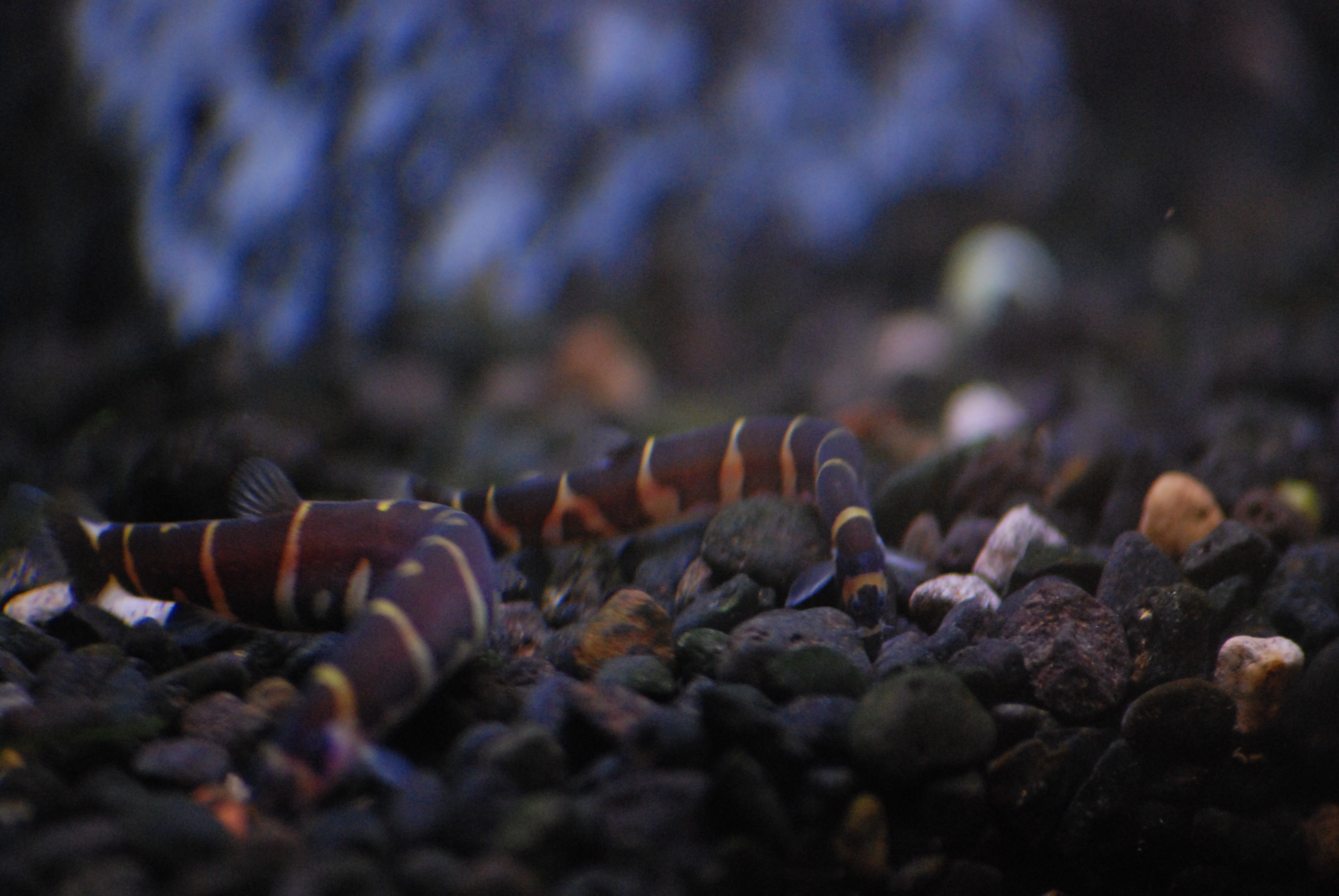
Photo: Linton Tuleja - Wikimedia Commons, CC BY-SA 3.0
| Parameter | Value |
| Minimum tank size | 20 gallons (long/wide footprint preferred) |
| Group size | 5-6 minimum, never fewer than 3-4 |
| Tank for 8-10 loaches | 29-40 gallons |
| Substrate | Fine sand, no sharp gravel |
| Footprint priority | Floor area over tank height |
Why Floor Space, Not Volume, Sets the Limit
Kuhli Loach rarely swims through open water in the upper half of a tank - it forages by touch along the substrate, sliding between roots and driftwood. Two tanks holding the same 20 gallons but shaped differently (a tall cube vs. a low, long rectangle) are not equivalent for this species: the long tank hands the group more usable sand, while the cube wastes most of its volume on water column the loaches never occupy. When sizing a tank for Kuhli Loach, footprint in square inches matters more than the gallon number on the box.
Group Size Drives the Minimum
A lone Kuhli Loach spends most of its time buried in substrate or wedged behind decor, essentially invisible. The species only relaxes into visible daytime foraging once kept in a group of 5 or more - confidence in numbers, not tank size alone, is what brings them out. That group-size requirement is the real reason a 10-gallon tank undersells this fish: it's not that 10 gallons of water is unsafe, it's that 10 gallons rarely has enough floor area for 5-6 loaches to spread out and forage without constant contact.
Scaling Up for Larger Groups
Add roughly 4-5 gallons of floor-area-matched tank per additional pair of Kuhli Loaches once past the 20-gallon/6-loach baseline. A 29-gallon tank comfortably stretches to 7-8 loaches; a 40-gallon breeder (36 x 18 inches of floor space) supports 8-10. Beyond 10 loaches, prioritize a wider footprint over more depth - the same logic that makes a 20-long outperform a 20-tall applies at every scale.
Substrate Effectively Changes Usable Space
Kuhli Loach has no protective scales on its underside, so coarse or sharp gravel causes abrasion wounds and, indirectly, shrinks the tank's usable area - the group avoids rough patches and crowds into whatever soft sand is available. Fine sand across the full floor turns the entire footprint into usable space; gravel turns it into isolated safe zones, which is functionally a smaller tank even at the same gallon count.
Buy Kuhli Loach Online
FishyKart stocks healthy Kuhli Loach for community and bottom-dweller setups sized correctly from day one.
Shop Kuhli Loach