Swim Bladder Disease in Fish: Signs, Causes and Treatment
Published: 2026-11-28 · FishyKart Blog
Swim bladder disease is not one illness but a buoyancy problem: a fish that floats at the surface, sinks to the bottom or swims tilted because its swim bladder is not holding the right amount of gas. Fish vet Jessie Sanders (DVM, DABVP Fish Practice) calls poor water quality one of the most common and overlooked causes, so the first step is always a water test, not a medicine.
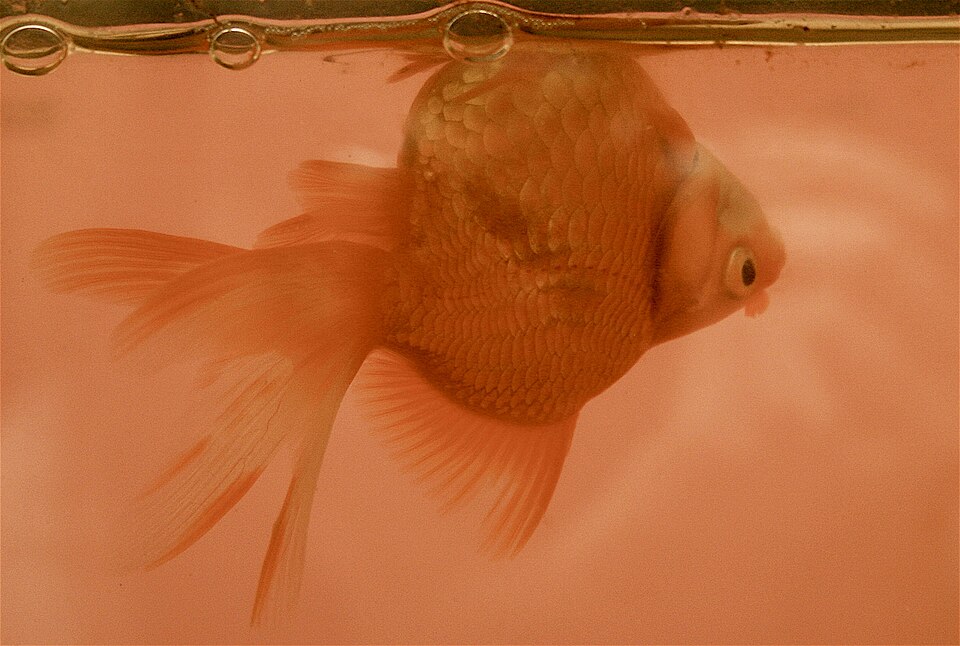
Photo: Humanfeather / Michelle Jo - Wikimedia Commons, CC BY 3.0. A goldfish that cannot keep itself upright: the classic look of a positive buoyancy problem.
Floating or Sinking? Read the Sign First
A healthy fish is neutrally buoyant: it hangs in the water at any depth without effort. A fish with a swim bladder disorder loses that balance in one of two directions, and the direction tells you what to watch for.
| What you see | Type | Main risk | What helps |
|---|---|---|---|
| Stuck at the surface, struggles to swim down, may flip upside down or onto its side | Positive buoyancy (too much gas) | Skin above the waterline dries and gets sore | Clean, stable water; do not cover the tank to push the fish down |
| Lies on the bottom, struggles to rise, rests on its belly or side | Negative buoyancy (too little gas) | Scrapes and sores from the substrate | Smooth substrate, very clean tank, easy access to food |
| Swims head-down, tail-down or in spirals, belly looks full | Either, often after feeding | Gut swelling pressing on the bladder | Less food, sinking food for gulping fish |
Based on PetMD, Swim Bladder Disease in Fish (Jessie Sanders, DVM, updated September 2023) and Chewy, Swim Bladder Disease in Fish (April 2025).
What the Swim Bladder Does
The swim bladder is a gas-filled sac under the spine that lets a fish float at a chosen depth without swimming all the time. Fish fill it in one of two ways, and this matters for treatment:
- Gulpers (physostomous fish): goldfish, koi, carp and catfish have a duct from the gut to the bladder and top it up by gulping air at the surface. Air swallowed while eating floating food can end up in the bladder.
- Gas-gland fish (physoclistous): cichlids and perch-like fish move gas in and out through a network of blood vessels, so swallowed air plays less of a role and infection, organ problems or injury are worth checking.
Common Causes
Because so many problems end in the same floating or sinking, swim bladder disease is a sign to investigate, not a diagnosis. The usual causes, roughly in the order to check them:
- Water quality. Ammonia, nitrite and unstable conditions stress the fish and disrupt normal body function; PetMD's fish vet calls it one of the most common and overlooked causes. See ammonia in a fish tank for safe levels and fixes.
- Feeding. Too much food, or the wrong food for the species, swells the gut and can block it; the swollen gut presses on the bladder.
- Temperature swings. A heater that fails or sticks on, or water that is always too warm or too cold, can trigger buoyancy problems.
- Infection and parasites. Bacterial, viral and parasitic infections can affect the bladder itself or nearby organs; Chewy calls secondary bacterial infection one of the most common causes.
- Body shape and injury. PetMD notes fancy goldfish with rounded bodies and curved spines are especially prone, and rough handling, shipping or fights can injure the bladder.
What to Do, Step by Step
- Test the water today. Ammonia and nitrite should read 0, and the temperature should be steady within your species' range. If anything is off, do a partial water change with dechlorinated water at the same temperature and find the cause (overstocking, overfeeding, a dirty or stopped filter).
- Check the heater and thermometer. A fish in a tank that swings several degrees a day will not settle until the temperature does.
- Cut back on food. Feed smaller amounts. For goldfish and other gulpers, PetMD suggests switching to sinking or neutrally buoyant food so the fish swallows less air; it helps in mild cases but not in all.
- Make the tank easy on the fish. For a sinker: smooth substrate such as glass stones and an extra clean tank. For a floater: keep the water clean and well oxygenated; PetMD warns not to cover the tank to force the fish underwater, because it lowers oxygen.
- Watch for other signs. Red streaks, ulcers, raised scales, cloudy eyes or rapid weight loss point to infection or organ disease. Raised scales with a swollen body is dropsy, which is more serious.
- Call an aquatic vet if it does not improve. Vets diagnose swim bladder problems with X-rays, which show the bladder's size, shape and position. The American Association of Fish Veterinarians and the World Aquatic Veterinary Medical Association can help you find one.
Chewy notes that secondary bacterial infection is a common cause and that a broad-spectrum antibiotic can be tried when water and feeding fixes fail. Use medicine as a later step and follow the label or your vet; dosing antibiotics into a tank with bad water treats the symptom and leaves the cause.
What Not to Do
- Do not strap on floats or weights. PetMD warns that devices can damage the skin and protective slime coat; use them only if a vet sets them up.
- Do not cover the tank to force a floater down. PetMD warns it lowers oxygen levels.
- Do not rely on home remedies alone. Popular fixes such as fasting or feeding peas only make sense when overeating or constipation is the cause; they do nothing when the cause is water, infection or injury.
Swim Bladder Problems in Goldfish and Bettas
Goldfish are the fish most often affected. Fancy varieties such as orandas, ryukins and black moors have short, round bodies that squeeze the bladder, and as gulpers they swallow air with floating flakes. Soaked or sinking food, smaller meals and a large, well-filtered tank reduce the risk; see goldfish care.
Bettas that float after a heavy meal are often simply overfed. Feed a betta small portions; our betta feeding guide has amounts. A betta that keeps floating with ragged fins or a swollen body needs a closer look for fin rot or infection.
Recovery and Prevention
When the cause is temporary, such as a feeding or water problem, many fish recover once it is fixed, and Chewy notes that fast treatment improves the chance of full recovery. When it is permanent, such as a deformed spine or an old injury, the fish can still live well with clean, stable water and adjusted feeding. To prevent it:
- Keep ammonia and nitrite at 0 with a cycled filter and regular partial water changes.
- Feed the right food for the species in small amounts; skip a day now and then for heavy eaters.
- Keep the temperature steady with a reliable heater and a thermometer you check.
- Choose a tank big enough for the fish and peaceful tank mates, so fights and stress do not injure it.
- Quarantine new fish before adding them to the main tank.