Ammonia in Fish Tank: Safe Level, Signs and How to Lower It
Published: 2026-11-18 · FishyKart Blog
The safe level of ammonia in a fish tank is 0 ppm. Fish excrete ammonia through their gills, and in a cycled tank bacteria in the filter convert it to nitrite and then nitrate as fast as it appears, so any reading above zero means that balance has broken. How dangerous a reading is depends on pH and temperature: only the un-ionized form, NH3, is highly toxic, and its share rises about tenfold for every one-point rise in pH. At 77 F (25 C), 1 ppm of total ammonia is roughly ten times more toxic at pH 8 than at pH 7.
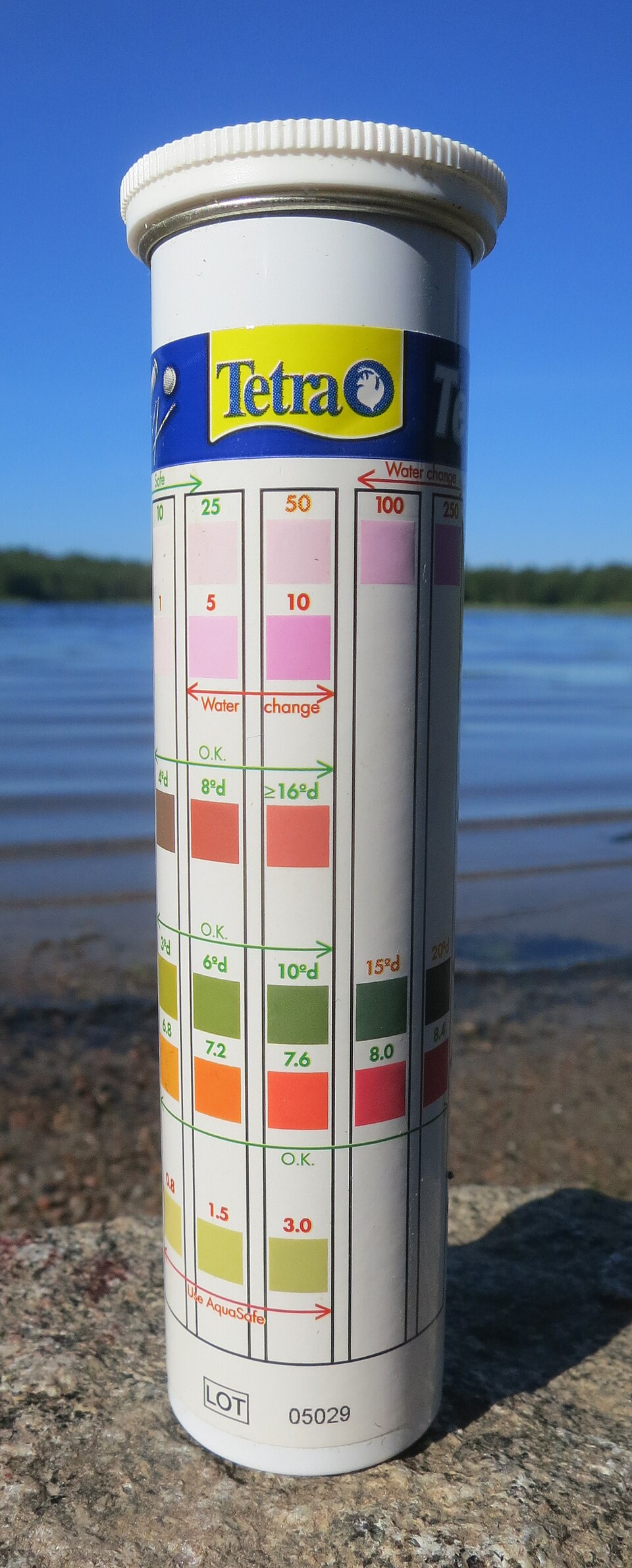
Photo: R. Henrik Nilsson - Wikimedia Commons, CC BY 4.0
What Your Test Kit Actually Measures
Hobby test kits read total ammonia nitrogen: the toxic NH3 plus the much less harmful ammonium ion, NH4+. According to the University of Florida IFAS extension, un-ionized ammonia is about 100 times more toxic to fish than ammonium, and it starts to harm fish at concentrations as low as 0.05 mg/L. Which form dominates depends on the water, so the same test result can be harmless in one tank and dangerous in another.
Toxic Share of Ammonia by pH and Temperature
| pH | 68 F (20 C) | 77 F (25 C) | 82 F (28 C) |
| 6.5 | 0.13% | 0.18% | 0.22% |
| 7.0 | 0.39% | 0.56% | 0.69% |
| 7.5 | 1.24% | 1.76% | 2.16% |
| 8.0 | 3.81% | 5.37% | 6.54% |
| 8.5 | 11.1% | 15.2% | 18.1% |
Share of total ammonia present as toxic NH3, our calculation with the standard Emerson et al. (1975) equation for fresh water. What it means in practice: at 77 F and pH 8, about 0.9 ppm of total ammonia already reaches the 0.05 mg/L level where harm begins; at pH 7 it takes about 9 ppm. Hard, alkaline water, common for African cichlids and in many US cities, gives far less margin than soft water. Check your tap water's hardness and pH in aquarium water hardness by city.
Signs of Ammonia Poisoning
UF IFAS notes that even low ammonia stresses fish and damages gills, and fish exposed over time get more bacterial infections and grow poorly. Watch for:
- gasping at the surface or hanging near the filter outflow;
- red, inflamed or dark gills;
- lethargy, clamped fins, sitting on the bottom;
- loss of appetite;
- red streaks in fins or body in more severe cases.
Gasping at the top can also mean low oxygen or heat; see why fish swim at the top of the tank. A test kit tells you which it is.
What Causes Ammonia Spikes
- An uncycled tank: the bacteria that remove ammonia take weeks to grow. Adding fish on day one is the classic cause; see how to cycle a fish tank.
- Overfeeding: uneaten food rots into ammonia.
- Overstocking: more fish than the filter's bacteria can handle.
- A dead fish or snail hidden behind decor.
- Over-cleaning: rinsing filter media under tap water or replacing it all at once kills the bacteria.
- Medication: some antibiotics harm filter bacteria.
How to Lower Ammonia, Step by Step
- Change 25-50% of the water now, with dechlorinated water matched to the tank temperature. For very high readings, repeat daily rather than changing everything at once.
- Add a conditioner that binds ammonia, which makes it temporarily less toxic while bacteria catch up. It does not remove ammonia from the test reading.
- Stop feeding for a day, then feed lightly.
- Find the source: dead fish, rotting food, a filter that stopped.
- Do not lower pH suddenly to make ammonia less toxic; fast pH swings stress fish further.
- Test daily until ammonia reads 0 ppm for several days.
Routine weekly water changes keep ammonia and nitrate from building in the first place; the method is in how to clean a fish tank, and milky water after a spike is covered in cloudy aquarium water.