About & Origin
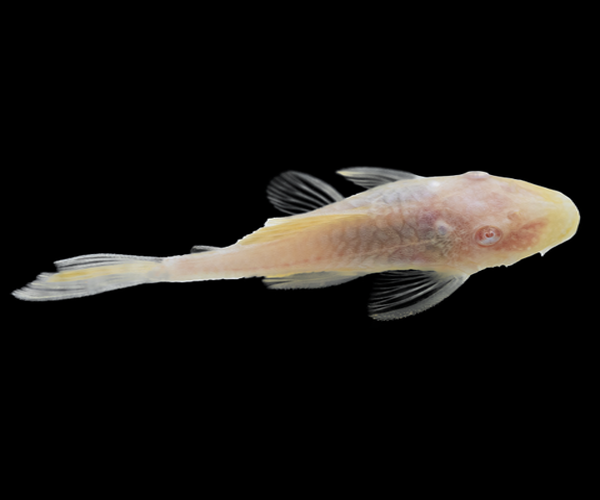
The Albino Bristlenose is a catfish — a colour form of the same Ancistrus species kept as the standard Bristlenose Catfish, distinguished by its pale yellow-pink body and red eyes rather than any difference in behaviour or origin. Its wild ancestors come from river systems across the Amazon and Orinoco basins of South America, where it clings to submerged rocks and wood with a sucker-disc mouth, grazing algae and biofilm.
As with the standard form, mature males develop the branching, tentacle-like bristles on the snout that give the species its name, while females remain smooth-headed -- an easy, reliable way to sex this fish.
It shares the same modest adult size (typically 12–15cm) as other Bristlenose forms, keeping it genuinely appropriate for long-term life in a standard home aquarium, unlike many larger pleco species that eventually outgrow most tanks.
The albino trait itself is a simple recessive mutation that removes dark pigment, so albino fry can appear in a batch bred from two carrier parents even when both look normally coloured. Because of this, albino Bristlenose are widely bred in the hobby and readily available, rather than being a rare or delicate strain -- their husbandry, growth rate, and temperament track the standard brown-and-cream Bristlenose almost exactly, aside from being somewhat more visible against dark substrate and correspondingly a little more exposed to bright light, which can cause mild stress or pigment stress over long exposure.
In the wild, Ancistrus species are found clinging to submerged wood and rock in both fast, oxygen-rich stretches and slower backwaters, which is part of why they tolerate a fairly broad range of home aquarium conditions. They are almost entirely peaceful toward other fish, reserving any real aggression for their own kind -- particularly males competing over a breeding cave.
Requirements
Bristlenose Catfish are hardy and beginner-friendly, with a short list of things worth getting right.
Driftwood: provide a piece of aquarium-safe driftwood -- it's rasped on for fibre and is genuinely beneficial to digestion, not just decorative.
Hiding spots: caves, wood crevices, or dense planting give this somewhat shy, mostly nocturnal fish somewhere to retreat during the day.
Tank size: comfortable from around 60–75cm/24–30 inches upward for a single fish or pair.
Diet: algae wafers and blanched vegetables (courgette, cucumber, spinach) as a staple once tank algae alone isn't enough, plus occasional sinking protein.
Breeding note: males guard eggs in caves and can become territorial toward other males during breeding -- worth knowing if keeping more than one.
Tankmates and stocking: peaceful toward essentially every other community fish, making it one of the easiest bottom-dweller choices to add to an established tank. If keeping several Bristlenose together, provide more than one cave or wood hide than there are fish, since a single dominant male will otherwise claim the best shelter and chase off rivals, especially once breeding condition sets in.
Growth and lifespan: a young Bristlenose bought small will typically reach its full 12–15cm size within 12–18 months given adequate feeding, and can live 5 years or more in a well-kept tank -- worth planning tank size around the adult, not the juvenile you're buying.
Filtration: a standard, properly cycled filter is sufficient; no special flow requirements beyond what a typical community tank already runs, though this species does appreciate the extra oxygenation a slightly stronger filter outflow provides.
Substrate: sand or fine gravel is kindest on the barbels and belly during long grazing sessions, though this species tolerates standard aquarium gravel without issue.
Compatibility

Water & Care Conditions
Bristlenose Catfish are tolerant of a fairly wide range of community-tank conditions.
- pH: 6.5–7.5
- Hardness: soft to moderately hard, roughly 5–15 dGH
- Temperature: 23–27°C (73–81°F)
- Oxygenation: appreciates decent water movement and oxygenation but is not especially demanding compared to fast-river species
One of the more forgiving catfish on water chemistry -- consistent, clean water and a piece of driftwood matter more than hitting an exact number.
Because Bristlenose are bottom-dwellers that spend a lot of time grazing rather than swimming in open water, gravel or sand kept clean of excess waste matters more for them than it does for mid-water fish -- ammonia and nitrite spikes from an overdue substrate clean hit slower-moving bottom fish first. A weekly partial water change is usually enough once the tank is established; avoid copper-based medications in the tank, as this and most other scaleless/armoured catfish are more sensitive to copper than typical scaled community fish.
Albino individuals in particular can show mild colour fading or increased skittishness under very bright, unshaded lighting, since the lack of dark pigment offers no natural UV protection -- floating plants, driftwood cover, or simply keeping tank lighting moderate rather than aquascaping-intensity is usually enough to keep them comfortable and active during the day rather than hiding constantly.
Watch general body condition rather than just colour as your main health indicator: a healthy Bristlenose has a rounded, slightly domed belly (not sunken) and actively grazes glass and decor after lights-out. A persistently sunken abdomen alongside visible ribs usually means the fish isn't getting enough to eat beyond whatever algae the tank produces naturally, and needs supplemental algae wafers or blanched vegetables added to its diet regularly, not just occasionally.