About & Origin
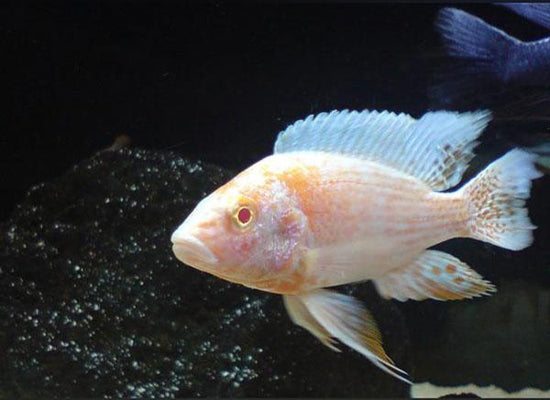
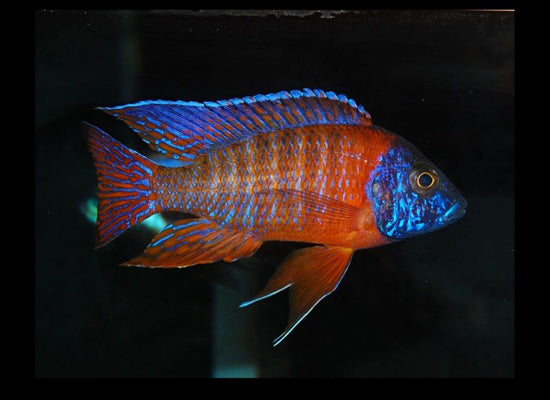
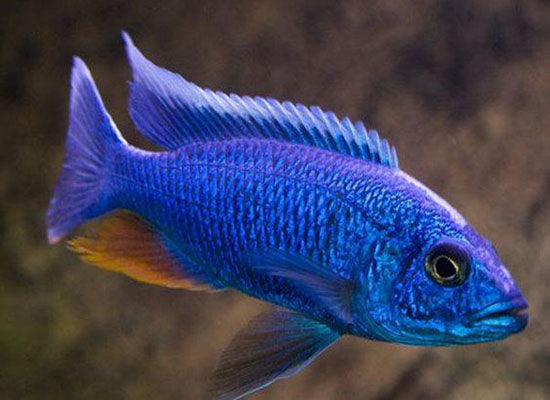
Peacock cichlids (Aulonocara species) are prized above almost any other Malawi cichlid for their colour — males in particular develop electric blues, oranges, and yellows as they mature. This albino form trades the usual pigmentation for a soft white-to-pink body, often with a faint ghost of the underlying pattern still visible, and red eyes.
In the wild, Aulonocara species patrol the sandy, intermediate zones between open water and rocky reef along Lake Malawi's shoreline, using enlarged sensory pores on the head (a lateral-line adaptation shared with many predatory bottom feeders) to detect movement of small invertebrates buried in the sand — hence the group's nickname, "peacock" for looks and, informally, "sand-sifting cichlid" for behaviour.
Peacocks are noticeably calmer than the notoriously combative Malawi mbuna group (Pseudotropheus, Melanochromis, and relatives), which makes them one of the more approachable entry points into keeping African rift lake cichlids.
Like other Aulonocara, this is a maternal mouthbrooder: after spawning over open sand or flat rock, the female gathers the fertilized eggs into her mouth and carries them for roughly three weeks before releasing free-swimming fry, feeding little or nothing herself during that time. A harem arrangement of one male to several females is the standard, stable social setup in the hobby — it spreads the male's attention and breeding activity across multiple females rather than concentrating stress on one.
Albino peacocks are a selectively-bred colour form rather than a wild population, and because the underlying pigment genes are recessive, breeding an albino to a normally-coloured Aulonocara will generally produce normally-coloured offspring carrying the albino gene rather than a 50/50 split — worth knowing if a buyer is hoping to keep the colour line going.
Requirements
A 200+ litre (55+ US gallon) tank suits a small group; keep one male per tank unless the aquarium is considerably larger, since males will compete for territory and females.
Temperament: semi-aggressive but calmer than mbuna — best mixed with other peaceful-to-semi-aggressive Malawi species of similar size rather than the more pugnacious mbuna, which will outcompete and bully peacocks for food and space.
Diet: a quality cichlid pellet formulated for carnivorous/omnivorous African cichlids, plus occasional frozen brine shrimp or mysis; peacocks are more predatory than herbivorous mbuna and don't need the vegetable-heavy diet those species do. Overfeeding rich, high-protein foods is a common cause of digestive trouble in Malawi cichlids generally, so little and often beats one large daily feeding.
Décor: rockwork with open sand for foraging and sightlines broken up to reduce aggression between rival males. Building the rockwork into several distinct piles rather than one continuous ridge gives subordinate males somewhere to retreat to and noticeably reduces the amount of chasing in a mixed-male setup.
Group composition: stocking two to three females per male, and avoiding single-male-single-female pairings in anything but a very large tank, keeps aggression toward any one female more manageable — a lone female can be relentlessly pursued by an amorous male with nowhere else to direct his attention.
Filtration: because Malawi cichlids are heavy waste producers relative to their size, filtration rated well above the tank's nominal volume avoids the cloudy water and creeping nitrates that undersized filters commonly cause in this kind of setup — this is worth budgeting for at the planning stage rather than upgrading to later.
Substrate depth: a few centimetres of fine sand is enough for natural foraging behaviour without becoming difficult to keep properly clean; too deep a sand bed can trap detritus and develop anaerobic pockets if it isn't regularly disturbed.
Compatibility
Water & Care Conditions
These parameters follow the natural chemistry of Lake Malawi's Rift Valley water — they aren't flexible in the way softer-water community fish can be:
- pH: 7.8–8.6 (Lake Malawi is naturally hard and alkaline — this is not optional, low-pH water stresses these fish over time)
- Water hardness: 10–20 dGH (200–350 ppm); many keepers add crushed coral or aragonite sand to the substrate/filter to hold pH and hardness up long-term
- Temperature: 24–28°C (75–82°F)
- Oxygenation: strong surface agitation and filtration — Malawi cichlids are messy, heavily-stocked-tank fish that need robust biological filtration and large, regular water changes
- Ammonia/nitrite: zero at all times in a mature tank — stress from poor water quality is a common trigger for Malawi bloat, which progresses quickly and is far easier to prevent than treat
- Water changes: weekly changes of 25-30% with hardness/temperature-matched water hold parameters steady, which matters more for rift lake cichlids than for most community fish since they've evolved in a remarkably stable natural environment
Test kits for pH, ammonia, nitrite, and nitrate are worth running weekly while a tank is still cycling and maturing, then monthly once stable, since buffering material like crushed coral gradually loses effectiveness and can let pH drift down without any obvious visual warning sign until fish begin to show stress.
Watch for the early signs of Malawi bloat — appetite loss, laboured breathing, pale stringy faeces, and abdominal swelling — since it's much easier to head off early with a water change and a short fast than to treat once advanced. New water used for changes should be matched to tank temperature and, ideally, hardness before it goes in, rather than added straight from a typically softer tap supply, to avoid repeated swings in chemistry that stress rift lake fish more than most community species.