Customer Reviews
About & Origin
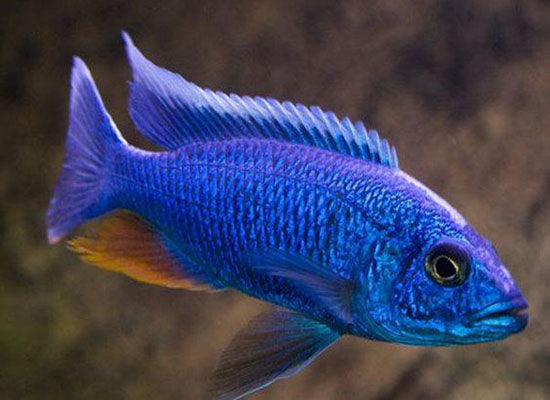
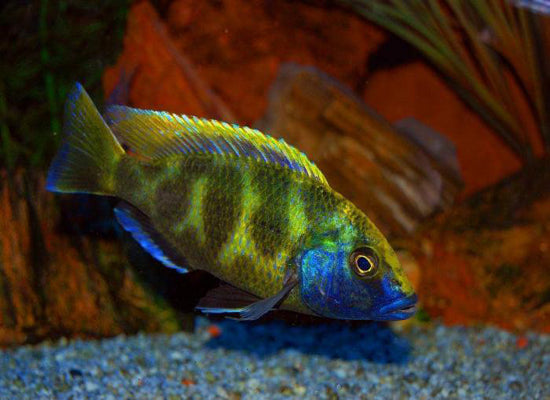
The Electric Blue Cichlid sold in the trade is almost always Sciaenochromis fryeri (sometimes still labelled by its older name, S. ahli), a hap-group cichlid from Lake Malawi prized for the saturated, almost neon blue that mature males develop over their entire body. Females and juveniles are a much plainer silvery-grey, so the electric-blue colouring this fish is named for is really a male-only, adult trait.
In the wild it's a mildly predatory species patrolling the intermediate rock/sand zones of the lake, feeding on smaller fish and invertebrates — it's noticeably more predatory than the algae-grazing mbuna group, closer in habits to a typical Malawi hap.
It's one of the most popular "showpiece" Malawi cichlids specifically because that blue colour is so vivid and unusual among freshwater fish generally, not just cichlids.
Like other Lake Malawi haps, it's a maternal mouthbrooder — after spawning, the female collects fertilized eggs into her mouth and carries them for roughly three weeks, releasing free-swimming fry once they're developed. Full adult colour intensity typically takes a year or more to develop fully, and can vary noticeably with diet, water quality, and how settled/confident the individual fish is in its tank.
Because the deep blue colouring is what makes this fish desirable, buyers should be aware that a stressed, poorly-fed, or juvenile specimen can look disappointingly plain silvery-grey — this is normal and not a sign of a wrong or unhealthy fish, the colour genuinely develops with age, confidence, and a good diet rather than being fixed from a young age. A well-kept adult can live eight to ten years or more, making this a genuine long-term stocking decision worth planning tank size and tankmates around from the start.
Requirements
Unlike the Aulonocara peacocks on this site, the Electric Blue Cichlid is a hap (Sciaenochromis fryeri) and noticeably more assertive -- expect real territorial behaviour from mature males, so give it 200+ litres minimum and avoid combining multiple electric blue males in anything but a large tank. It's more predatory too: a protein-heavy cichlid pellet or occasional frozen shrimp suits it better than mbuna-style vegetable flake. Otherwise, standard Malawi setup applies -- rockwork split into several piles rather than one ridge, open sand for foraging, one male to three-plus females, and filtration rated above the tank's stated volume given how much waste these fish produce.
Growth and adult size: males reach around 13-15cm, noticeably larger and more robust than most Aulonocara peacocks -- plan tank size around the adult male rather than the smaller juvenile typically sold.
Tankmates: best paired with similarly large, similarly assertive Malawi haps rather than small or delicate species -- pairing it with fish it can intimidate or outcompete for food leads to a lopsided, stressful tank dynamic for the smaller fish.
Sourcing: as one of the most popular and widely bred Malawi cichlids, quality varies between suppliers -- look for a deep, saturated blue rather than a washed-out or patchy individual, which often indicates stress or poor water conditions at the source.
Compatibility
Water & Care Conditions
Same Rift Valley chemistry as other Malawi cichlids: pH 7.8-8.6, hardness 10-20 dGH, 24-28C, strong filtration and surface agitation, zero ammonia/nitrite. Malawi bloat (appetite loss, laboured breathing, swollen abdomen) is the main risk and is usually stress-driven rather than specific to this species. Because males are more territorial than a typical peacock, err toward more rockwork and more space than the minimum, rather than less -- crowding this species causes real aggression, not just chasing.
Weekly water changes of 20-25% and consistent, hard/alkaline water are non-negotiable for long-term Malawi health -- this species genuinely doesn't tolerate soft, acidic, or unstable water conditions the way many South American or Southeast Asian fish comfortably do, and sustained exposure to the wrong chemistry is a genuinely common underlying cause of bloat and other stress-linked illness in this species.
Given stable, correctly-buffered water and a properly sized tank, Electric Blue Cichlids are genuinely hardy and can live 8-10 years or more, with colour intensity and territorial confidence both improving as the fish matures into adulthood over its first couple of years. Avoid copper-based medications entirely, as with all cichlids, and quarantine new stock for a genuine 2-3 weeks before introducing it to an established display tank.