About & Origin
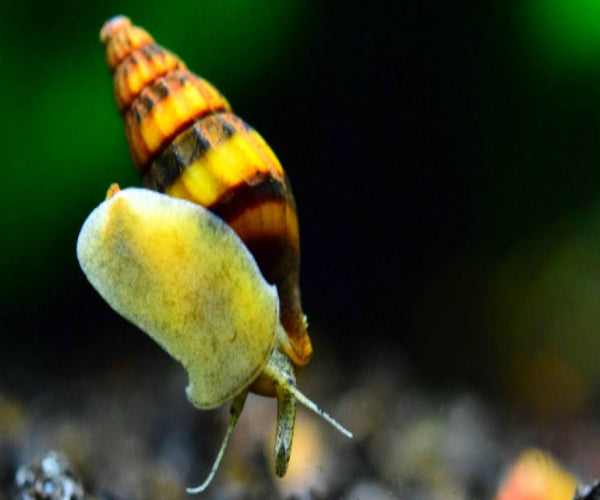
The assassin snail (Clea helena, also called Anentome helena) is a small, strikingly striped predatory snail native to freshwater streams and rivers of Southeast Asia, particularly Indonesia and Malaysia. Unlike almost every other aquarium snail, it is not a peaceful algae/detritus grazer -- it is a hunter, and is kept specifically to prey on nuisance snails (like pest bladder or Malaysian trumpet snail population booms).
It spends much of its time buried in the substrate, emerging to actively track down and consume other snails, as well as scavenging leftover meaty food. A single assassin snail can work through a real pest-snail infestation over a few weeks; it will not, however, coexist peacefully with snails you actually want to keep.
Its common and scientific names both point directly at this hunting behaviour -- "helena" and "assassin" both reference its role as a predator rather than a scavenger, and the yellow-and-black-striped shell is itself a form of camouflage against sandy substrate, breaking up its outline while it lies in wait partially buried. Unlike apple or nerite snails, which are almost entirely inactive during the day, assassin snails are more likely to be seen moving across open substrate at any hour once they detect prey nearby, using chemical cues in the water to home in on other snails from a distance.
In the wild it inhabits slow, sediment-rich streams and irrigation channels across Southeast Asia, where snail prey is abundant -- a niche that maps almost perfectly onto the pest-snail problem many planted and heavily-fed home aquariums develop, which is exactly why it became popular in the hobby specifically as a targeted biological control rather than a general-purpose cleanup animal.
Requirements
Assassin snails are easy to keep but need to be stocked with intent, not as a random community addition.
What it will eat: other snails, including ones you may want to keep (algae-eating nerites, apple snails, etc.) -- do not house it with snail species you want to preserve. It's an excellent, targeted solution for an unwanted pest-snail bloom, and largely leaves fish and shrimp alone.
Substrate: it likes to burrow, so a soft sand or fine gravel substrate suits it better than sharp, coarse gravel.
Feeding once pest snails run out: if there aren't enough snails left to hunt, it will happily take sinking meaty foods (bloodworm, shrimp pellets) as a substitute.
How many to buy: for an active pest-snail bloom, a small group (3–6 for a typical community tank) will work through the population noticeably faster than a single individual, since each one hunts independently across its own patch of substrate. Once the pest population is cleared, assassin snails will breed slowly themselves (they lay small, hard, transparent egg capsules singly rather than in clusters), naturally settling to a low, self-limiting population that roughly tracks available prey and supplemental feeding.
Handling and introduction: like other snails, acclimate slowly to avoid shocking it with a sudden change in water chemistry, and don't be alarmed if it disappears into the substrate for days at a time after introduction -- this is normal settling-in behaviour, not illness.
Realistic expectations: an assassin snail won't instantly wipe out a large pest-snail population overnight -- it hunts at its own pace, and a severe infestation is best tackled alongside reducing the root cause (usually overfeeding, which is what fuels most pest-snail booms in the first place).
Compatibility
Water & Care Conditions
Assassin snails are adaptable but do best in stable, moderately mineralised water:
- pH: 7.0–8.0
- Hardness: moderately hard, roughly 8–20 dGH; some calcium availability supports shell health
- Temperature: 22–27°C (72–81°F)
- Oxygenation: not demanding, comfortable in typical community tank flow
As with all snails, avoid copper-based medications in the tank -- copper is toxic to snails and shrimp at doses safe for fish.
Because it spends so much time buried, a soft substrate kept reasonably clean underneath matters more for this species than for surface-dwelling snails -- a substrate that's gone anaerobic and sour (recognisable by a rotten-egg smell when disturbed) is worth addressing with a gentle stir and partial water change, since it burrows directly into that layer. Shell condition should still be checked periodically the same way as any snail: a smooth, intact shell with the natural yellow-brown banding indicates adequate calcium and stable water; pitting or thinning points to water that's too soft or too acidic.
This species tolerates a broader range of established, mature tank conditions than many fish, and rarely needs special accommodation beyond what a typical planted or community tank already provides -- its main sensitivity is more about food availability (needing something to hunt or eat) than water chemistry precision.
Growth is slow and steady rather than rapid -- expect a young assassin snail to take the better part of a year to reach its full adult length of around 2–2.5cm, and correspondingly a slow, stable metabolism means it doesn't need frequent feeding once established; a tank with even a modest ongoing pest-snail supply or occasional protein supplement will keep it in good, healthy condition indefinitely. Sudden temperature swings are the most common real-world stressor for this species, more so than any single water-chemistry number, so a stable heater and a consistent maintenance schedule matter more than chasing an exact pH figure.