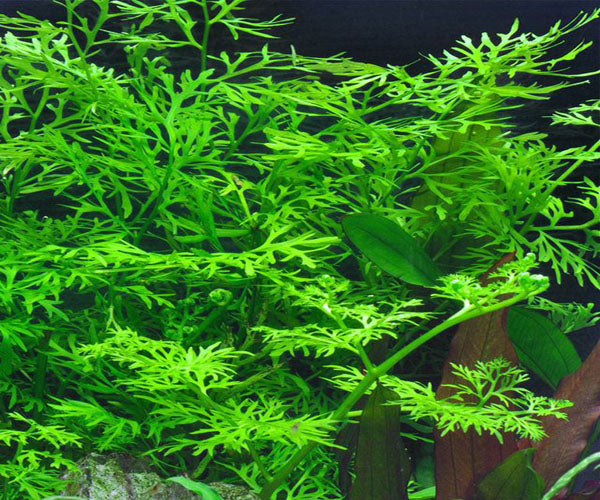
About & Origin
Water sprite (Ceratopteris thalictroides) is a fast-growing aquatic fern found across tropical and subtropical wetlands, marshes, and slow-moving waterways throughout Asia, Africa, and beyond — it's one of the most widespread aquatic ferns in the world. It's been a staple of the aquarium hobby for generations.
Its lacy, feathery, finely divided fronds give it a soft, airy look very different from the broad-leaved plants in most tanks. It's genuinely versatile: it can be planted in substrate as a rooted background/midground plant, or left to float freely at the surface, where it forms a loose, trailing mass of roots and fronds. Either way it grows quickly and readily produces small plantlets on its fronds that drop off and grow into new plants on their own.
Because it's so undemanding and fast-growing, it's frequently recommended as one of the best true beginner plants in the hobby.
As a true fern rather than a flowering plant, water sprite reproduces differently from most aquarium plants — instead of flowers and seeds, it produces spores on its fertile fronds and, more visibly to aquarium keepers, tiny plantlets that sprout directly along the margins of mature leaves. Each of these plantlets is a genetic clone of the parent, complete with its own small root system by the time it detaches, which is why a single healthy plant can seed an entire tank with offspring in a matter of weeks without any deliberate propagation effort.
Ceratopteris thalictroides shows real dimorphism between its submersed and emersed leaf forms, much like several other amphibious aquarium plants: fully underwater fronds are finely divided and lacy, maximising surface area for nutrient uptake, while fronds that reach the surface or grow emersed become noticeably broader and less deeply cut, better suited to standing in open air. Growers sometimes see both forms on the same floating plant simultaneously — feathery underwater growth trailing below broader leaves sitting flat on the surface.
Requirements
Water sprite is about as low-maintenance as aquatic plants get, and grows well in almost any freshwater setup.
Light: low to moderate light is enough; it doesn't need intense lighting to thrive, though more light means faster growth.
CO2: not required — it does perfectly well in a non-CO2, low-tech tank.
Planted or floating: can be rooted in substrate (where it will still send some roots into the water column) or simply left to float; floating growth tends to be faster and is a popular way to grow it as a natural nitrate-export and fry-shelter plant.
Propagation: new plantlets form along the edges of mature fronds and detach on their own — expect a single starter plant to multiply steadily if left mostly undisturbed.
Maintenance: its main downside is exactly its biggest strength — fast growth means it needs regular thinning to avoid shading out everything below it, especially when left floating.
Root rot risk if rooted: when planted in substrate, the crown of the plant (where the fronds emerge) should sit at or just above the substrate surface rather than being buried, since a buried crown is prone to rotting — this is a similar principle to not burying an Anubias rhizome, though water sprite is generally more forgiving of the occasional mistake.
Nutrient export: because it grows so quickly and pulls nutrients directly from the water column when floating, a patch of water sprite is a genuinely effective, low-effort way to help control nitrates and phosphates between water changes in a busier or more heavily stocked tank.
Thinning: rather than trimming individual fronds, most keepers simply pull whole plants (including the naturally forming plantlets) once the mass gets too dense, giving away or composting the excess — there's rarely a shortage once it gets going.
Compatibility
Water & Care Conditions
Water sprite tolerates a very wide range of freshwater conditions, which is a big part of why it's such a reliable beginner plant:
- pH: 6.0–7.5
- Hardness: soft to moderately hard water, roughly 2–15 dGH
- Light: low to moderate; tolerates a wide range without complaint
- Temperature: 20–28°C (68–82°F)
- Oxygenation: as a fast grower it's a strong daytime oxygenator itself, and does well with normal community-tank water movement
It's genuinely hard to go wrong with water sprite outside these ranges too — growth just slows down rather than the plant struggling outright, which is exactly why it's such a common first plant.
Its wide distribution across tropical and subtropical wetlands worldwide means it's naturally adapted to cope with everything from soft blackwater conditions to harder, more alkaline water, which is a big part of why it settles into almost any established freshwater tank without special adjustment. New plantlets and freshly planted specimens can look a little pale or delicate for their first week or two, but this typically resolves on its own as roots establish and growth resumes at its normal fast pace.
Because it's such a heavy user of dissolved nutrients, a tank relying on a large mass of water sprite for nitrate control may need slightly more frequent liquid fertiliser dosing than expected to avoid other, less nutrient-hungry plants in the same tank going short — a rare case where a "beginner plant" can actually outcompete its neighbours if left completely unchecked.
Water movement matters more for the floating form than the rooted one: too much surface agitation from a powerful filter outflow will constantly push loose floating mats into corners or under the surface, so a calmer area of the tank, or a floating ring/barrier, helps keep a floating patch looking tidy.