About & Origin
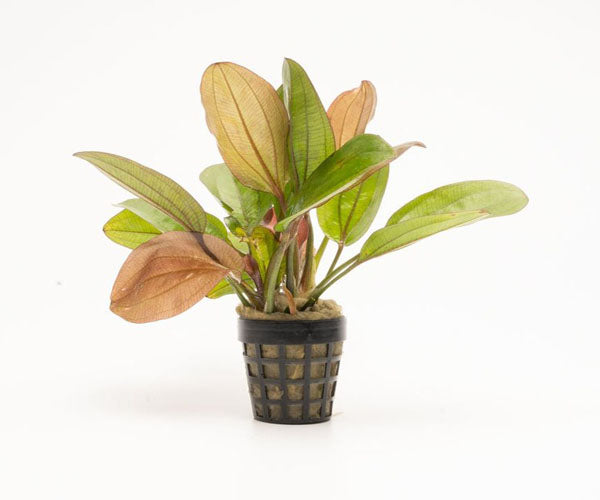
Echinodorus "Red Flame" is a cultivated hybrid sword plant, selectively bred (rather than a wild species) by German aquatic-plant breeder Hans Barth in the 1990s for its striking colouration. Like other Echinodorus cultivars, it was developed from South American sword plant parent species prized for their form and colour.
It forms a dense rosette of broad, wavy-edged leaves that emerge with red-orange mottling and streaking against a green background — a distinctive look among sword plants, most of which are solid green. The exact intensity of the red colouring varies with growing conditions, particularly light.
At a moderate height of around 30cm with a dense rosette of many leaves, it makes an eye-catching mid-to-large centrepiece without being quite as sprawling as some of the largest Echinodorus varieties.
As a man-made hybrid rather than a naturally occurring species, Red Flame doesn't have a "wild habitat" in the way most other plants on this site do -- its parentage draws on South American sword plant genetics selected specifically for colour rather than any single native environment. Because it's propagated vegetatively (by runners and division) rather than reliably from seed, individual plants from the same source are essentially clones, meaning colour and growth habit stay consistent from specimen to specimen.
Requirements
Red Flame needs the same fundamentals as other large swords, plus a bit more attention to light for its colour to really show.
Light: moderate to high lighting brings out the strongest red-orange mottling; in lower light the plant grows fine but tends to stay greener with less contrast.
Substrate: a heavy root feeder, like all Echinodorus — a nutrient-rich substrate or root tabs are worth the investment for both size and colour intensity.
CO2: not required but speeds growth and can help deepen colouration alongside good light and root nutrients.
Tank size: at a mature ~30cm with a dense rosette, it needs a reasonably sized tank to have room to fill out properly.
Placement: works well as a colour-accent centrepiece against a green backdrop of other plants, where its mottled foliage stands out clearly.
Trimming: remove older, fading leaves at the base as needed rather than cutting the whole rosette back -- new growth continuously emerges from the crown, and the newest leaves typically show the most vivid colouring.
Propagation: mature plants send out runners that develop into new plantlets, which can be separated and replanted once they've grown their own root system, gradually building a colour-matched colony from a single starter plant.
Compatibility
Water & Care Conditions
Echinodorus Red Flame grows best, with strongest colour, within:
- pH: 6.5–7.5
- Hardness: soft to moderately hard water, roughly 3–15 dGH
- Light: moderate to high for best colour development
- Temperature: 22–28°C (72–82°F)
- Nutrients: root-level feeding is important for both size and the intensity of its red mottling
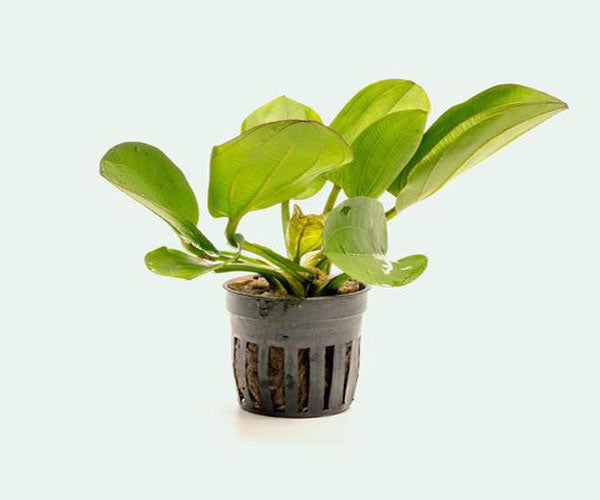
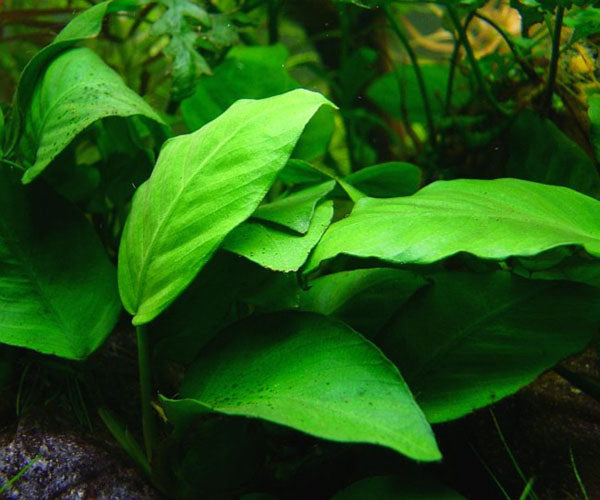
Outside these ranges it typically survives but loses colour intensity, growing more uniformly green with less of the mottled red-orange pattern it's grown for.
Weekly water changes and stable temperature support consistent growth and colour retention over time -- since this is a cultivated hybrid grown specifically for its appearance, inconsistent care shows up visually (as fading colour, less contrast, duller leaves) well before the plant's basic underlying health is actually threatened, making leaf colour a genuinely useful, easy-to-spot early indicator of overall tank health.
Root-level nutrition matters more than water-column dosing for this species, the same as other Echinodorus -- a nutrient-rich substrate or regular root tabs make a visibly bigger difference to leaf size and colour intensity than adjusting water parameters alone. Given consistent light, root feeding, and stable water, a young plant typically reaches its full display-quality colour and rosette size within just a few months of consistently good, steady growth.