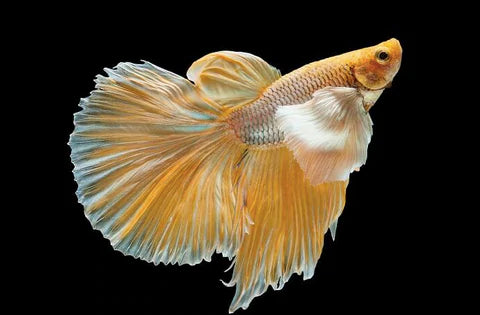
Betta fish, also known as Siamese fighting fish, are very common with beginner aquarists. They are small and colorful fish with striking personalities.
They have been cross-bred over years creating the most amazing colorations and tail variations.
They do not require a lot of maintenance and their physiology and behavior is quite captivating and amazing.
This fish can learn to recognize their owners, and they also create bubble nests. Betta fish have an organ known as the labyrinth organ which allows them to breathe air as their gills cannot always get enough oxygen from the surrounding waters.
About & Origin
This is a gold-coloured variety of the Betta (Betta splendens), native to the slow-moving rice paddies, ditches, and floodplains of Thailand, Cambodia, Vietnam, and Laos. The wild form is fairly muted in colour; the bright, metallic gold seen in this variety is the product of generations of selective breeding by betta breeders, mostly concentrated in Thailand.
Like every other betta, it's a labyrinth fish, with a specialised organ letting it breathe air directly from the surface — an adaptation to the shallow, still, often oxygen-poor wetland water of its native range — and males retain the same strongly territorial, solitary nature that gives the species its common name.
This describes a gold-toned colour strain of Betta splendens, achieved through generations of selective breeding for metallic gold pigmentation rather than a distinct species or wild colour form.
Like all bettas, it descends from wild labyrinth fish native to the shallow rice paddies and slow floodplain waters of Thailand, and shares the same fundamental biology, temperament, and care needs as any other betta colour or fin-type variety.
The gold betta is a colour strain of Betta splendens bred for a metallic yellow-gold body and fins rather than the more common reds, blues, and multicolour patterns. Like all betta colour and fin varieties it is entirely a product of selective breeding within the same species, native originally to the shallow rice paddies, floodplains, and slow-moving waters of Thailand and neighbouring Southeast Asia.
As with all betta colour strains, breeders continually refine and stabilise new shades, so slight variation between individual fish sold under the same "gold" label is normal.
Gold-strain bettas are among the less commonly seen colour forms compared to reds and blues, making them a sought-after choice for keepers wanting something a little different.
Requirements
Keep singly, or as the sole betta in a community tank — never with another male betta, which will result in fighting.
Its long fins are vulnerable to nipping, so slow, calm, non-aggressive tankmates are essential, and it does better in gentle flow than strong current.
Feeding is easy — a good quality betta pellet as a staple, with occasional live or frozen treats for variety and colour.
One male per tank — highly territorial toward other male bettas, best kept alone or with carefully selected, peaceful, fin-safe tankmates rather than a general community mix.
A betta-specific pellet as the dietary staple, being primarily carnivorous, with occasional live or frozen foods like bloodworm or brine shrimp for variety and conditioning.
A tank of at least 20 litres with a heater and gentle filtration gives this fish a genuinely healthy long-term home.
As with every betta, this fish must be kept alone — one male per tank, no other bettas, and careful selection of any tankmates to avoid triggering aggression or fin damage. A heated, filtered tank of at least 15–20 litres with gentle flow suits it far better than the small unheated bowls bettas are sometimes mistakenly sold with.
A varied diet of quality betta pellets plus occasional live or frozen bloodworm/brine shrimp helps maintain vivid gold colouration and overall condition, and small, regular feedings suit its small stomach better than one large daily feeding.
Regular partial water changes of around 25-30% weekly, combined with stable temperature and gentle filtration, keep this fish healthy and its gold colouring vivid over the long term. Avoid sudden temperature swings, which stress bettas more than most community fish.
Avoid sudden water changes of large volume at once, which can shock a betta more than a series of smaller, gentler changes.
Compatibility

Water & Care Conditions
Standard betta care via its labyrinth organ's tolerance for still water:
- pH: 6.0–7.5
- Salinity / hardness: freshwater only, soft to moderately hard water
- Temperature: 24–28°C (75–82°F) — a stable heater is essential
- Light: moderate, with floating plant cover appreciated
- Oxygenation: tolerant of still, low-oxygen water; prefers calm water over strong flow
- Colour care: stable water quality and a varied, high-protein diet help maintain vivid gold colouration over time; stressed or poorly fed bettas often dull noticeably
- Housing: one male per tank always — bettas will fight other bettas, often fatally, if housed together undivided
- Diet: quality betta pellets as a staple, with occasional live/frozen foods for colour and condition
- Longevity: typically lives 2-4 years, occasionally longer with excellent care
- Tank position: spends most time in the upper-to-middle water column near the surface for air access
- Filtration: gentle flow is best; strong current can tire a betta's long fins and labyrinth-breathing routine
As a labyrinth fish it supplements gill breathing with atmospheric air, tolerating lower oxygen levels and stiller water better than most fish — though this doesn't reduce the real need for clean, well-filtered water.
Gentle flow and smooth decor without sharp edges help protect this species' long, delicate fins from damage.
Unlike most tropical fish, this fish genuinely needs a tight-fitting lid with an air gap underneath, not to prevent jumping alone but because it periodically surfaces to gulp air through its labyrinth organ, and a fully sealed lid with no airspace can leave the air it breathes stale and humid.
A heater is essential despite the labyrinth organ's tolerance for lower oxygen -- bettas are true tropical fish and become lethargic, prone to illness, and short-lived in unheated, too-cool water, contrary to the common misconception that they can live in a small unheated bowl.