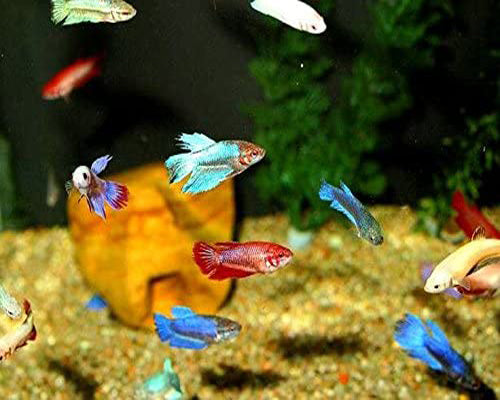
About & Origin
This listing is a fully grown adult female Betta (Betta splendens), native to the slow-moving rice paddies, ditches, and floodplains of Thailand, Cambodia, Vietnam, and Laos. Buying at adult size means the fish's colour, fin shape, and temperament are already fully settled and visible, rather than still developing as with a younger fish.
Females are generally more modestly coloured and shorter-finned than males, but share the same hardiness and the same labyrinth organ that lets the species breathe air directly from the surface — an adaptation to shallow, still, often low-oxygen water in the wild.
Unlike males, which are strictly one-per-tank, females are more socially flexible and can sometimes be kept in carefully managed groups.
Female bettas (Betta splendens) have shorter fins and a less dramatic colour than males, but share the same wild origin in the shallow rice paddies and floodplain waters of Thailand, and the same labyrinth organ allowing them to breathe atmospheric air.
Unlike males, adult females can, under the right conditions, be kept together in a group known as a "sorority" — though this requires a reasonably large, well-planted tank with plenty of visual breaks and careful monitoring, since females still establish a pecking order and can be aggressive toward each other, especially in cramped conditions.
Female bettas (Betta splendens) are noticeably smaller-finned and less flamboyantly coloured than males in most strains, but are far more socially tolerant — several females can often be housed together in a "sorority" of five or more in a sufficiently large, well-decorated tank, something never attempted with males. This adult-size listing means a mature fish rather than a young juvenile still growing into its full colour and pattern.
Requirements
An adult female can be kept singly in a peaceful community, or as part of a carefully introduced group ("sorority") of 4 to 6 or more in a sufficiently large, well-planted tank — this needs planning, as a pecking order will still form even among females.
As with all bettas, avoid fin-nipping tankmates and strong water flow, which its fins handle poorly.
Feeding is easy — a good quality betta pellet as the staple diet, with occasional live or frozen treats.
If keeping multiple females together, a sorority of 5 or more (never just 2-3, which concentrates aggression on one fish) in a well-planted tank with sightline breaks is the safer approach, alongside close monitoring for bullying.
A betta-specific pellet as the dietary staple, being primarily carnivorous, with occasional live or frozen bloodworm or brine shrimp for variety.
A tank of at least 20 litres with a heater and gentle filtration is recommended, larger still if keeping a sorority group.
A female-only sorority needs a reasonably large tank (generally 75+ litres) with plenty of visual cover and hiding spots to diffuse the pecking-order squabbles that develop among females, and should ideally be introduced together as a group rather than adding individuals one at a time to an established hierarchy. A single female alone is equally content and considerably simpler to keep.
A varied diet of quality betta pellets plus occasional live or frozen bloodworm/brine shrimp suits females just as it does males, and regular small feedings are better tolerated than one large feeding.
Whether housed singly or in a sorority, stable cycled filtration and a heated tank of adequate size matter more to long-term health than any single decor choice.
Compatibility

Water & Care Conditions
Tolerant of still, low-oxygen water thanks to its labyrinth organ:
- pH: 6.0–7.5
- Salinity / hardness: freshwater only, soft to moderately hard water
- Temperature: 24–28°C (75–82°F) — a stable heater is essential
- Light: moderate, with floating plant cover appreciated
- Oxygenation: tolerant of still, low-oxygen water; prefers calm water over strong flow
- Sorority keeping: if housing multiple females, a larger tank (75L+) with dense cover meaningfully reduces squabbling compared to a small bare tank
- Introduction order: introducing a female sorority as a group all at once, rather than one at a time, tends to go more smoothly
- Diet: quality betta pellets as a staple, with occasional live/frozen foods for variety
- Longevity: typically lives 2-4 years with good, stable care
- Tank position: spends most time in the upper-to-middle water column near the surface
- Filtration: gentle flow suits bettas best, whether housed singly or in a sorority
As a labyrinth fish, females share males' ability to breathe atmospheric air at the surface and tolerate lower dissolved oxygen than most fish.
Gentle flow suits this species well; unlike males, fin damage from current is less of a concern given females' shorter fins, but calm water is still preferable.
Unlike most tropical fish, females genuinely needs a tight-fitting lid with an air gap underneath, not to prevent jumping alone but because it periodically surfaces to gulp air through its labyrinth organ, and a fully sealed lid with no airspace can leave the air it breathes stale and humid.
A heater is essential despite the labyrinth organ's tolerance for lower oxygen -- bettas are true tropical fish and become lethargic, prone to illness, and short-lived in unheated, too-cool water, contrary to the common misconception that they can live in a small unheated bowl.