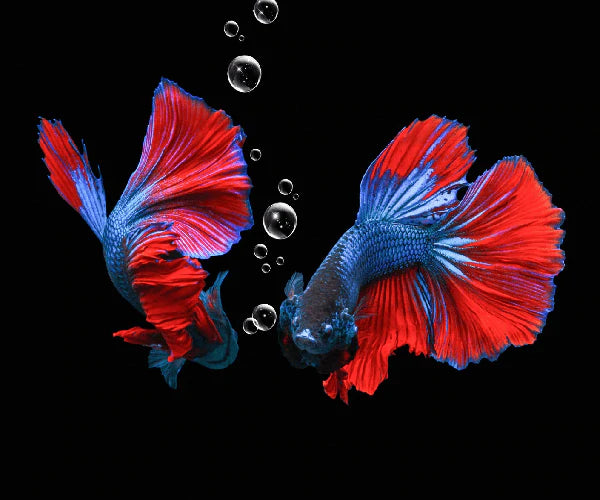
About & Origin
The Betta (Betta splendens) is native to the slow-moving rice paddies, ditches, and floodplains of Thailand, Cambodia, Vietnam, and Laos. This listing bundles a female betta together with complementary items — the fish itself is the same species and biology as any other betta on this site, just packaged as a starter combo.
Females are generally more modestly finned and coloured than males, and share the species' labyrinth organ, letting them breathe surface air directly — an adaptation to the shallow, still, often low-oxygen wetland water where the species evolved.
Unlike males, which must be kept strictly alone, females are more socially flexible and can sometimes be housed in carefully managed groups.
This listing is for a female Betta splendens, which has notably shorter fins and less vivid colour than the more commonly marketed males, but shares the species' wild origin in Thailand's shallow rice paddies and floodplain waters, and its distinctive labyrinth breathing organ.
Female bettas are sometimes sold as part of combo packages (with tanks, plants, or other accessories) as a beginner-friendly starter option, since they're generally considered somewhat calmer and more tolerant of tankmates than males, though they're still capable of real aggression.
Female bettas (Betta splendens) have shorter fins and more muted colours than males, but are notably more sociable and can often be kept in small groups ("sororities") of five or more, unlike males which must always be housed alone. Native to Thailand's shallow rice paddies and slow-moving waterways, they retain the same labyrinth-organ air-breathing adaptation as males.
Whatever combo items accompany this listing, the fish itself is the same species and biology as any other female betta in the trade.
Requirements
A single female works well in a peaceful community tank; a group ("sorority") of 4 to 6 or more females can also work in a large enough, well-planted tank, introduced carefully since a pecking order will still form.
As with any betta, avoid fin-nipping tankmates and strong current — both are poorly tolerated by its fins.
Feeding is easy — a good quality betta pellet as the staple, with occasional live or frozen treats for variety.
Can potentially be kept in a "sorority" group of 5 or more females in a large, heavily planted tank with visual breaks, though this requires more space and careful monitoring than housing a single female.
A betta-specific pellet as the dietary staple, since bettas are primarily carnivorous, with occasional live or frozen bloodworm or brine shrimp for variety.
A tank of at least 20 litres with a heater and gentle filtration is recommended regardless of any bundled accessories.
Whatever hardware or extras this combo includes, the underlying fish care stays the same: a heated, filtered tank of at least 15-20 litres per fish (more if housing a sorority group), stable water quality, and — if keeping multiple females — enough cover and space to diffuse normal pecking-order behaviour without it escalating into real injury.
A varied diet of quality betta pellets plus occasional live or frozen bloodworm/brine shrimp keeps a female (or sorority group) in good condition, with small regular feedings preferred over one large daily feeding.
Regular partial water changes of around 25-30% weekly keep water quality stable, which matters more to betta health than almost any other single factor. A reliable heater avoiding sudden temperature swings is important, since bettas are more sensitive to fluctuation than many community fish.
Compatibility

Water & Care Conditions
Tolerant of still, low-oxygen water thanks to its labyrinth organ:
- pH: 6.0–7.5
- Salinity / hardness: freshwater only, soft to moderately hard water
- Temperature: 24–28°C (75–82°F) — a stable heater is essential
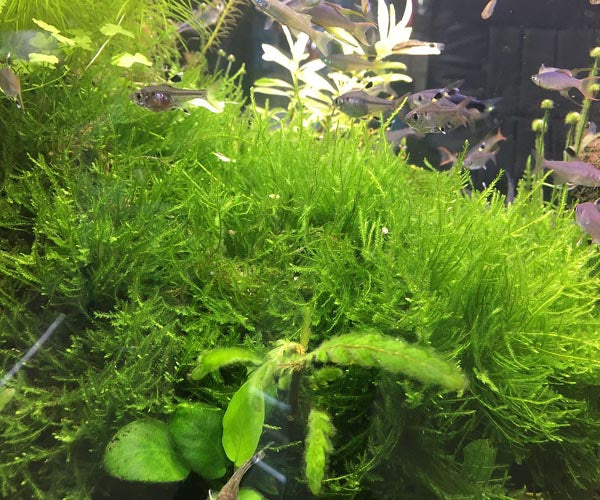
- Light: moderate, with floating plant cover appreciated
- Oxygenation: tolerant of still, low-oxygen water; prefers calm water over strong flow
- Sorority note: if this combo is intended for multiple females together, more space and cover reduces squabbling versus a small bare tank
- Water quality: stable, cycled conditions matter more to long-term betta health than any single exact parameter
- Diet: quality betta pellets as a staple, with occasional live/frozen foods
- Longevity: typically lives 2-4 years with good, stable care
- Tank position: spends most time in the upper-to-middle water column near the surface
- Filtration: gentle flow is best for bettas, avoiding strong current that tires their fins
- Substrate: soft, rounded substrate or sand is gentler on trailing fins than sharp gravel
As a labyrinth fish, it can breathe atmospheric air at the surface, tolerating lower dissolved oxygen and stiller water better than most community fish.
Gentle to moderate flow suits this species; extremely strong current isn't necessary and can stress the fish.
Unlike most tropical fish, females genuinely needs a tight-fitting lid with an air gap underneath, not to prevent jumping alone but because it periodically surfaces to gulp air through its labyrinth organ, and a fully sealed lid with no airspace can leave the air it breathes stale and humid.
A heater is essential despite the labyrinth organ's tolerance for lower oxygen -- bettas are true tropical fish and become lethargic, prone to illness, and short-lived in unheated, too-cool water, contrary to the common misconception that they can live in a small unheated bowl.