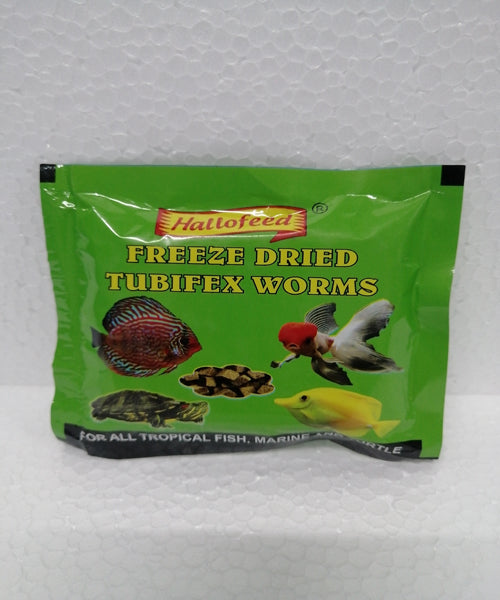
About
This is a 10 gram packet of freeze-dried tubifex worms — small aquatic annelid worms preserved through freeze-drying, a process that removes moisture at low temperature under vacuum rather than through heat, which helps retain more of the worms' natural nutrient, colour, and flavour profile compared to simple air- or oven-drying.
Because freeze-drying works at low temperature, it avoids the protein degradation that heat-based drying can cause, so freeze-dried tubifex generally keeps more of its original texture and remains highly palatable to fish — often more so than a heat-dried equivalent, which is part of why it commands a premium over plain dried worms.
Like other tubifex products, they're a high-protein, high-palatability food, widely used as a treat or conditioning food to encourage growth, colour, and breeding readiness, or simply to tempt fish that are reluctant to eat a plain flake or pellet diet. The 10 gram packet size is a modest, trial-friendly portion — enough for regular occasional feeding in a small to medium home aquarium for a good while without the food sitting opened for so long that it loses freshness.
Freeze-drying also has the practical benefit of being shelf-stable at room temperature while avoiding some of the contamination concerns historically associated with live tubifex sourced from polluted sediment in urban waterways, a well-documented source of parasites and bacteria in the live-food trade.
Most fish across a wide range of species respond strongly to it, from small tetras and barbs up through larger cichlids and catfish, because the scent profile closely mimics live prey even though the moisture has been removed. This makes it a useful tool beyond simple variety feeding — it's commonly reached for specifically when a fish has stopped eating normally, whether from stress, illness recovery, or settling into a new tank, since a food this palatable can sometimes restart feeding when a plain flake or pellet is being ignored.
Requirements
Feed as an occasional treat or supplement, a few times a week, rather than as a nutritionally complete everyday diet — it's rich in protein and fat but not a balanced staple on its own, and shouldn't replace a proper daily food long-term.
A small pinch is usually enough per feeding; freeze-dried worms are lightweight and can seem like "more food" by volume than they actually are in caloric terms, but overfeeding rich foods still fouls water quickly regardless of how little it weighs.
Some fish do better if the worms are pre-soaked for a minute before feeding, which softens them and reduces the risk of them expanding after being swallowed — freeze-dried food in particular can rehydrate and swell somewhat once inside a fish's digestive tract if fed completely dry in large amounts, which is worth avoiding especially with smaller-bodied species.
Once the packet is opened, treat it less like a shelf-stable pantry item and more like a food that's actively degrading with air exposure — reseal it tightly after each use and don't leave it open on a counter, since freeze-dried food's porous texture actually absorbs ambient humidity faster than a denser dried product would.
It's a good option for spot-feeding a specific fish that isn't getting enough at normal group feeding time, since a small pinch dropped near a shy or slower individual tends to draw its attention effectively without needing to overfeed the whole tank to compensate. Used this way it functions as much as a feeding-management tool as a straightforward supplement.
Beyond fish, it's also a food various freshwater shrimp and some scavenging invertebrates will readily take, so if your tank includes a mixed community of fish and shrimp or snails, expect competition for it and consider whether targeted feeding is worth the effort versus simply broadcasting a small amount across the tank.
Compatibility

Feeding Guidelines
As a rich treat rather than a complete diet, moderate portions and proper storage matter most, and the freeze-dried format is somewhat more moisture-sensitive than plain dried food:
- Frequency: 2–3 times per week as a treat/supplement, not daily
- Portion: a small pinch per feeding — calorie-dense for its volume, easy to overfeed by accident
- Pre-soaking: optional but helpful for smaller-mouthed fish, softening the worms and reducing post-feeding expansion in the gut
- Leftovers: remove anything uneaten after a couple of minutes rather than letting it sink and decompose
- Storage: airtight, cool, dry place away from humidity, resealed promptly after each use since the freeze-dried texture is porous and absorbs moisture readily
- Signs of spoilage: discard if it smells off, clumps with moisture, loses its typical texture, or shows mould
- Rotate with other foods: use alongside a staple diet and other treats rather than as the fish's only variety food
- Reluctant eaters: a small offering can help re-start feeding in a stressed, sick, or newly-settled fish thanks to its strong scent, more reliably than a plain flake in that situation
- Spot-feeding: useful for targeting a specific shy or slow individual without overfeeding the rest of the tank
- Packet size: the 10 gram size is meant for regular but modest use — buy a size matched to your feeding frequency rather than letting a large packet sit half-used for months
- Shrimp and inverts: if your tank has dwarf shrimp or snails alongside fish, expect them to compete for it too — broadcast feeding may be simpler than trying to target fish only
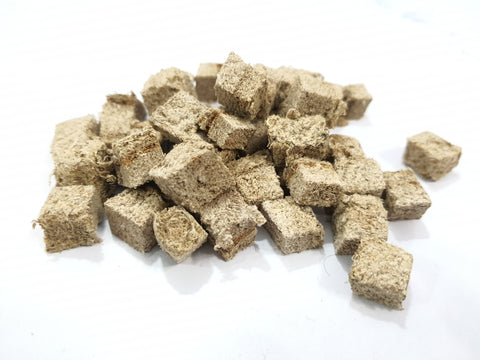
- Freshness check: good freeze-dried tubifex should look loosely clumped and dry, with a strong but not rancid smell — texture that feels sticky or compressed is a sign moisture has gotten in