About & Origin
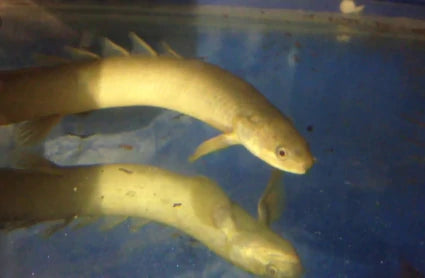
The Green Senegal Bichir is the natural, wild-type coloration of Polypterus senegalus — an olive-green, eel-like, armor-scaled fish that is one of the most ancient lineages kept in the aquarium hobby, its body plan essentially unchanged for hundreds of millions of years. Senegal Bichirs are widely distributed across Africa, found in slow-moving shallow waters including swamps, marshes, lakes, estuaries, and small tributaries.
Bichirs are true living fossils — snake-like, armor-plated predators with paired lung-like breathing organs that let them survive in oxygen-poor water by gulping air directly at the surface, an adaptation shared with their prehistoric ancestors. They hunt mostly by smell and touch rather than sight, using sensitive nostrils and a keen sense of smell to find food after dark.
The Green Senegal Bichir sold at this size (around 3 inches) is a juvenile — an easy size to start with, but one that will grow considerably, so it's worth planning its permanent home in advance. Look closely and you'll notice the paired pectoral fins are unusually large and fleshy compared to a typical fish's — bichirs use them almost like primitive limbs, "walking" along the substrate and occasionally across damp surfaces outside the water for short stretches, a trait that has made them a subject of real scientific interest into how early vertebrates may have first moved onto land. The olive-green, mottled wild-type coloring is genuine camouflage in its natural habitat, breaking up its outline against muddy, plant-choked shallows.
Taxonomically, bichirs sit in their own ancient order, Polypteriformes, distinct from every other bony fish family kept in aquariums — they retain primitive features like ganoid scales (thick, enamel-like, and diamond-shaped rather than the thin overlapping scales of modern fish) and a spiracle behind each eye used for breathing. Given reasonable care, a Senegal Bichir is also a genuinely long-lived aquarium fish, commonly reaching 10–15 years and sometimes 20+, so buying one is a long-term commitment rather than a short-lived novelty purchase.
fishykart.com ships healthy, actively-feeding juveniles, not fish pulled straight off a long-haul wholesale shipment.
Requirements
Because this is the wild-type colour form rather than a selectively bred variant, the Green Senegal is arguably the hardiest and most naturally resilient option of the bichir colour strains — its normal pigmentation gives it full protective coloring against bright light and better camouflage instincts than pale or patterned lab-bred forms, which can make it settle into a new tank with slightly less stress than an albino sibling.
Containment: a tight-fitting lid with only a small gap for air access is not optional. Polypterus senegalus is a proven escape artist that can squeeze through surprisingly small gaps and survive out of water far longer than most fish thanks to its lung-like breathing organ — long enough that an escapee is rarely found in time.
Substrate and snout care: soft sand lets this fish root and forage naturally with its sensitive, barbel-like snout; sharp gravel will abrade it over months of digging behaviour and is one of the more common avoidable injuries in captive bichirs.
Space planning: sold small at roughly 3 inches, but a wild-type Green Senegal reaches the same 25–35cm adult length as any Polypterus senegalus strain, so a 90-gallon-plus long, low-footprint tank needs to be the eventual plan from day one, not an afterthought once it outgrows a starter tank.
Diet and temperament: a strict carnivore and nocturnal ambush predator — sinking pellets, frozen bloodworm, or live food, and it will treat any tankmate small enough to fit in its mouth as a meal rather than a companion.
Lighting and hides: as a smell-and-touch hunter that's naturally more active after dark, this fish appreciates subdued lighting and plenty of daytime cover — driftwood, rockwork, or dense planting it can retreat into. It's common for a newly introduced Green Senegal to stay hidden and skip a meal or two in its first days; that's normal settling-in behaviour rather than a sign of illness, provided the fish still looks alert and holds a healthy resting posture.
Compatibility

Water & Care Conditions
Green Senegal Bichirs tolerate a genuinely wide parameter range once established, which is part of why the wild-type form has stayed a hobby staple for decades:
- pH: 6.5–7.5, tolerating a broader 6.0–8.0 without issue
- Hardness: soft to moderately hard freshwater
- Temperature: 24–28°C (75–82°F)
- Oxygenation: less critical directly since this species breathes atmospheric air at the surface, but strong biological filtration still matters — a heavy-feeding predatory fish this size produces real waste regardless of how it gets its oxygen
The one non-negotiable: a sealed tank or one with no air gap above the waterline is a genuine suffocation risk, not just an escape risk, since this fish must surface periodically to breathe. Juveniles are noticeably more sensitive to ammonia and nitrite spikes than the hardy adults they grow into, so introduce this fish to a fully cycled tank rather than a brand-new setup.
Growth is steady rather than explosive — expect several centimetres of growth per year under good feeding, tapering off as the fish approaches its adult length over 2–3 years. A weekly 20–25% water change is a sensible baseline given the bioload, adjusted upward if nitrate readings climb between changes. Because it retains full wild-type pigmentation, this colour form is somewhat less light-sensitive than the albino strain and doesn't need quite as much shading, though it still appreciates subdued lighting and cover to retreat into during the day as a naturally nocturnal hunter. Keep an eye on its fleshy, limb-like pectoral fins for any sign of fraying or clamping, which can be an early indicator of poor water quality well before other symptoms show — otherwise, a well-kept Green Senegal is one of the more trouble-free predatory fish in the hobby once its basic containment and space needs are met.