About & Origin
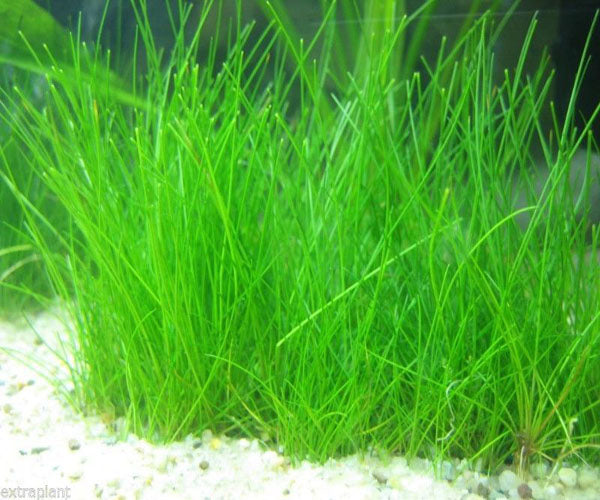
Dwarf hairgrass, Eleocharis parvula, is a carpeting aquarium plant — a small, grass-like sedge found growing naturally in shallow fresh and brackish wetlands across a very wide range — parts of North America, Europe, and Asia — rooting in soft mud along pond and marsh margins.
In the aquarium it's grown for one purpose above all: a true green "lawn" across the foreground of a tank. Each plant is a single thin blade only a few centimetres tall, but a healthy planting spreads by runners under the substrate to fill in as a dense, uniform carpet rather than staying as separate tufts.
It's one of the shortest of the commonly available hairgrass species, which is exactly what makes it usable as a genuine low-growing carpet rather than a taller meadow-style grass.
Botanically it's a sedge rather than a true grass, part of the same family as many wetland "spike rush" species. In the wild it often grows semi-emersed, tolerating both fully submerged conditions and periods where the water level drops and exposes it to open air — a resilience that carries over into how forgiving it can be of fluctuating aquarium conditions once established.
Because it spreads by underground runners rather than seed in cultivation, a single small starter portion is genuinely enough to eventually fill an entire foreground — it just takes consistent conditions and some patience.
Dwarf hairgrass is often confused with, and sold alongside, taller hairgrass varieties like Eleocharis acicularis (common dwarf hairgrass, noticeably taller) and giant hairgrass (Eleocharis montevidensis), which can reach well over 15cm and is used as a background "meadow" plant rather than a foreground carpet. Eleocharis parvula specifically stays low, usually under 5–8cm even in ideal conditions, which is the whole reason it's chosen for true carpet-style aquascapes rather than the taller lawn look.
Requirements
Dwarf hairgrass is a plant where the setup matters more than the plant itself — the same species can either carpet beautifully or struggle to survive, depending on conditions.
Light: it needs moderate to high light to spread outward as a low mat rather than grow tall and thin reaching for the surface.
CO2: not strictly mandatory, but supplemental CO2 is what usually separates a thin, patchy planting from a thick, true carpet. In a low-tech tank it will survive but spread much more slowly.
Substrate: needs a nutrient-rich, fine-grained substrate it can root into and spread runners through — coarse gravel makes it harder for the fine roots to establish.
Planting: separate the portion into very small tufts (just a few blades each) and plant them a couple of centimetres apart across the foreground; it fills in the gaps over the following weeks as runners spread sideways. Trimming the tops periodically encourages it to thicken and spread rather than just grow taller.
The "melt" phase: like many carpeting plants, hairgrass very commonly yellows and dies back partially within the first one to three weeks after planting, as it sheds the emersed-grown leaves it arrived with and pushes out new submerged-adapted growth. This is normal and not a sign the planting has failed — resist the urge to remove it during this stage, keep conditions stable, and new runners typically appear from the base within a few weeks.
Algae risk during establishment: because a freshly-planted carpet is thin and slow-growing at first, it's especially vulnerable to being smothered by hair algae or diatoms competing for the same light before the grass fills in. Trimming any algae-covered blades promptly and avoiding excess light/nutrients during the first month or two of establishment gives the carpet a better chance to win that race.
Flow: gentle to moderate water movement across the substrate surface helps distribute CO2 and nutrients evenly across a carpet planting, since a stagnant corner will visibly carpet more slowly and unevenly than an area with better circulation.
Compatibility
Water & Care Conditions
Dwarf hairgrass tolerates a fairly wide range, but carpets most reliably within these conditions:
- pH: 6.0–7.5
- Hardness: soft to moderately hard, roughly 2–15 dGH
- Temperature: 20–28°C (68–82°F)
- Light: moderate to high, ideally with CO2 supplementation for a true dense carpet
Under low light without CO2 it usually survives but grows sparse and upright instead of carpeting, and can gradually thin out over time.
If running pressurised CO2 (recommended for a genuine dense carpet), target roughly 20–30ppm alongside strong lighting — the combination of high light and CO2 is what drives lateral runner growth rather than upward blade growth. Regular trimming is itself a care requirement here, not just cosmetic maintenance: mowing the carpet down every couple of weeks with scissors once it's established encourages it to thicken sideways rather than simply getting taller, much like mowing a lawn does. A thin layer of root-tab or substrate fertiliser under the planting area, topped up periodically, supports the runner network as it spreads, since most of this plant's growth happens underground and out of sight. Weekly partial water changes (20–30%) help keep nutrient and CO2 levels consistent, which matters more for a carpeting plant than for most stem plants since uneven conditions tend to show up as patchy, uneven carpet growth rather than an even mat.
Watch for signs conditions need adjusting: blades that stay noticeably longer than a few centimetres and lean toward the light are usually asking for more intensity; a carpet that stalls in the same patchy state for months without filling in is more often a CO2 or nutrient shortfall than a light problem, since the runner network needs both energy and raw material to keep spreading outward. Brown or fading patches on individual blades are typically old growth naturally dying back as newer blades take over, and can simply be trimmed away rather than treated as a health problem.