About & Origin
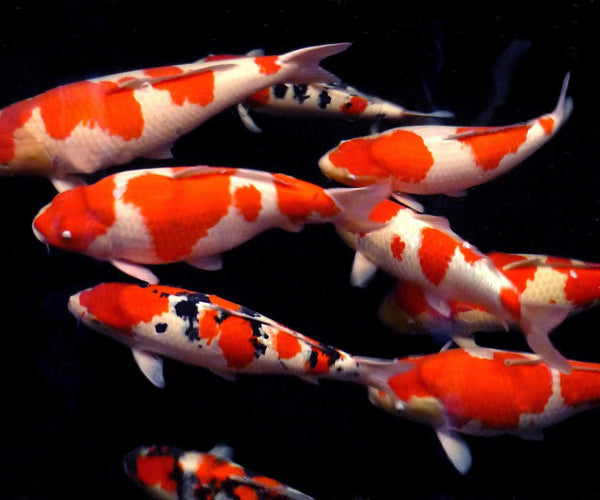
Koi are a large, ornamental coldwater pond fish — a domesticated variety of the common carp (Cyprinus carpio), developed in Japan over the past two centuries (building on earlier Chinese carp-breeding traditions) for their vivid, painterly colour patterns. 'Japanese koi' specifically usually signals lineage from, or breeding in the style of, Japan's historic koi-breeding regions, prized for pattern quality and colour depth.
In the wild, common carp are a hardy, coldwater river and lake fish found across temperate Europe and Asia, and koi have inherited that same coldwater hardiness and long lifespan -- well-kept koi routinely live several decades.
Koi are also famously large: what's sold small as a juvenile 'tank' koi is the very beginning of a fish that, given the space, keeps growing for years.
Named pattern categories are a serious, centuries-old classification system in koi breeding, and even a casual buyer benefits from knowing the basics: Kohaku (white body with red pattern), Taisho Sanshoku/Sanke (white with red and black), Showa Sanshoku (black body with red and white), and dozens of other recognised varieties each have their own bloodlines, breeding history, and judging standards at koi shows worldwide, particularly in Japan. Pattern, colour balance, and body conformation are all judged criteria, and top show-quality koi from renowned Japanese breeders can sell for extraordinary sums -- a genuinely different market from the young, unclassified "pond koi" typically sold for a home setup.
Koi are also remarkably intelligent and social for a fish: well-settled individuals learn to recognise their keeper, will often approach at feeding time, and can even be trained to feed from the hand -- a big part of why koi-keeping has such a devoted following well beyond simple ornamental value.
Because koi are simply an ornamental strain of common carp rather than a distinct species, they're also capable of interbreeding with wild or feral carp populations if they ever escape into open waterways -- another reason, alongside general ecological responsibility, that koi should only ever be kept in a properly contained pond or tank and never released into the wild.
Requirements
This is fundamentally a pond fish, not an indoor aquarium fish, once past the juvenile stage. A young koi can live temporarily in a large indoor tank, but adults commonly reach 40-90cm and need hundreds to thousands of litres of space, ideally an outdoor pond with strong filtration -- keeping koi long-term in a standard home aquarium is not realistic or fair to the fish.
Koi are coldwater fish and do not need, and generally do poorly with, tropical heating -- they're comfortable across a wide seasonal temperature range and are one of the few ornamental fish suited to unheated outdoor ponds in temperate climates.
They're messy, enthusiastic omnivores, eating floating or sinking koi pellets, blanched vegetables, and virtually anything else offered -- overfeeding rather than underfeeding is the usual risk, given how food-motivated koi are.
Seasonal feeding matters for coldwater fish kept outdoors: as water temperature drops in cooler months, a koi's metabolism slows dramatically, and feeding should be reduced and eventually stopped in cold weather -- feeding a torpid, cold-slowed fish a full warm-season diet can cause serious digestive problems, since it can no longer properly process that much food.
Pond depth and volume matter as much as surface area for long-term koi keeping: a pond needs enough depth (generally at least 90cm-1.2m in temperate climates) to avoid freezing solid in winter and to give the fish room to shelter from summer heat and predators such as herons, alongside enough total volume to dilute and process the substantial waste a group of large koi produces.
A young koi kept temporarily indoors while a pond is being planned or built should still be given as large a tank as practical, strong filtration, and a clear, realistic timeline for the move outdoors -- treating an indoor tank as anything but a short-term stepping stone for this species sets both the fish and the keeper up for problems as it grows.
Compatibility
Water & Care Conditions
As a coldwater carp, koi have very different needs from tropical fish, most importantly around temperature and long-term space:
- pH: 7.0–8.5
- Water hardness: moderately hard to hard, 8–25 dGH
- Temperature: 10–24°C (50–75°F) -- a true coldwater fish, no heater needed or wanted
- Oxygenation: high -- ponds/tanks need strong aeration and filtration to handle a koi's substantial waste output
- Seasonal care: feeding should scale down and stop as water temperature drops in cooler months, matching the fish's naturally slowed cold-weather metabolism rather than a fixed year-round schedule
- Water changes: large, regular partial water changes and strong biological filtration are essential given the substantial bioload of even a few adult koi
- Predator protection: outdoor ponds need real thought given to keeping out herons, cats, and other predators, alongside adequate depth for the fish to retreat to safety
- Longevity: well-kept koi commonly live several decades, with some documented individuals living far longer -- this is a genuinely multi-generational commitment for the right keeper, not a short-lived ornamental fish
- Common issues: parasites, fungal infections, and ulcers are the most frequently seen health problems, most linked back to poor water quality, overcrowding, or temperature stress rather than the fish being inherently delicate
- Lighting: outdoor ponds get natural daylight; indoor temporary housing doesn't need anything specialised beyond standard aquarium lighting
- Handling: koi have a protective slime coat that's easily damaged by rough netting or dry handling -- always handle with wet hands or a soft net, and return the fish to water as quickly as possible
- Substrate & decor: ponds typically use smooth, easily cleaned bases rather than deep gravel; heavy planting is best kept in protected pots, since koi will dig and graze on unprotected pond plants