About & Origin
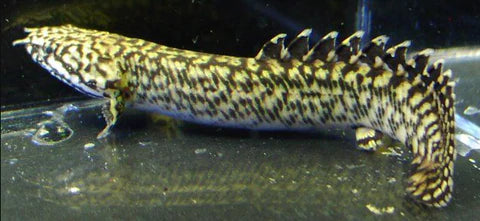
The Leopard Senegal Bichir is a primitive, elongated freshwater fish — a color variant of Polypterus senegalus with bold dark spotting across the body, giving it its name. Like all Senegal Bichirs, it's one of the most ancient fish lineages in the aquarium hobby, essentially unchanged for hundreds of millions of years. Senegal Bichirs are widely distributed across Africa, found in slow-moving shallow waters including swamps, marshes, lakes, estuaries, and small tributaries.
Bichirs are true living fossils — snake-like, armor-plated predators with paired lung-like breathing organs that let them survive in oxygen-poor water by gulping air directly at the surface, an adaptation shared with their prehistoric ancestors. They hunt mostly by smell and touch rather than sight, using sensitive nostrils and a keen sense of smell to find food after dark.
The Leopard Senegal Bichir sold at this size (around 3 inches) is a juvenile — an easy size to start with, but one that will grow considerably, so it's worth planning its permanent home in advance. Look closely and you'll notice the paired pectoral fins are unusually large and fleshy compared to a typical fish's — bichirs use them almost like primitive limbs, "walking" along the substrate and occasionally across damp surfaces outside the water for short stretches, a trait that has made them a subject of real scientific interest into how early vertebrates may have first moved onto land. The dark leopard-style spotting is a selectively line-bred pattern trait, distinct from the plain olive wild type and the pale albino form also sold under this species.
Taxonomically, bichirs sit in their own ancient order, Polypteriformes, distinct from every other bony fish family kept in aquariums — they retain primitive features like ganoid scales (thick, enamel-like, and diamond-shaped rather than the thin overlapping scales of modern fish) and a spiracle behind each eye used for breathing. Given reasonable care, a Senegal Bichir is also a genuinely long-lived aquarium fish, commonly reaching 10–15 years and sometimes 20+, so buying one is a long-term commitment rather than a short-lived novelty purchase.
fishykart.com ships healthy, actively-feeding juveniles, not fish pulled straight off a long-haul wholesale shipment.
Requirements
The bold dark spotting is purely cosmetic and doesn't change this fish's needs from any other Senegal bichir, but it does make individual fish easier to tell apart in a group — useful if you're keeping more than one and want to track feeding or growth per fish.
Containment first: a secure, well-fitted lid with only a small air gap is essential. This species surfaces regularly to gulp air through a lung-like breathing organ, and a poorly-sealed tank invites both escape and, in the worst case, a fish stranded and dried out outside the water.
Substrate: soft sand rather than gravel — the leopard's rooting, barbel-sensitive snout is just as prone to abrasion injury as any other bichir's if kept over sharp substrate.
Long-term space: sold at a manageable 3 inches, but this pattern doesn't stay small — plan for a 90-gallon-plus long, low tank by the time it reaches its adult 25–35cm length, generally over two to three years of steady growth. A long, low footprint suits this fish better than a tall one, since it spends most of its time cruising near the bottom rather than using vertical space.
Feeding: a strict carnivore and nocturnal ambush predator that hunts by smell and touch after dark — sinking pellets, frozen bloodworm, or live food, and it will treat any tankmate small enough to fit in its mouth as prey rather than company.
Cover and lighting: subdued lighting and daytime hiding spots (driftwood, rockwork, dense planting) suit its naturally nocturnal habits well. Don't be surprised if a freshly introduced Leopard Senegal stays tucked away and skips its first meal or two — that's typical settling-in shyness rather than a health problem, so long as the fish otherwise looks bright-eyed and holds a normal posture.
Compatibility

Water & Care Conditions
The Leopard Senegal shares the same wide tolerance range as any Polypterus senegalus, one of the reasons the species as a whole has remained a durable hobby fixture despite its prehistoric, undomesticated origins:
- pH: 6.5–7.5, though it copes fine with a broader 6.0–8.0
- Hardness: soft to moderately hard freshwater
- Temperature: 24–28°C (75–82°F)
- Oxygenation: less urgent than for a typical fish since it breathes air directly at the surface, but strong biological filtration still matters given how much a predator this size eventually eats and excretes
The single hard rule regardless of colour pattern: an airtight tank or one without an air gap above the waterline can genuinely suffocate this fish, since it must reach the surface periodically to breathe — good water chemistry doesn't substitute for that access. Juveniles handle ammonia and nitrite spikes noticeably worse than the tough adults they become, so introduce this fish to an already-cycled tank rather than a freshly set-up one.
Expect gradual, steady growth toward its adult size over two to three years rather than a sudden size jump, with the spotted pattern typically becoming more defined and contrasty as the fish matures. Weekly water changes of roughly 20–25% are a reasonable baseline given the bioload of a predatory fish this size, increased if nitrate readings creep up between changes. As with all bichirs, expect initial shyness after introduction — a period of not feeding in the first few days is normal rather than a health concern, as long as the fish otherwise looks alert and holds a normal resting posture. Its fleshy pectoral "limbs" are worth checking periodically for fraying or clamping, since they can show early signs of poor water quality before other symptoms appear — beyond that, a settled Leopard Senegal is a genuinely low-maintenance, long-lived predator once its space and containment needs are met.