About & Origin
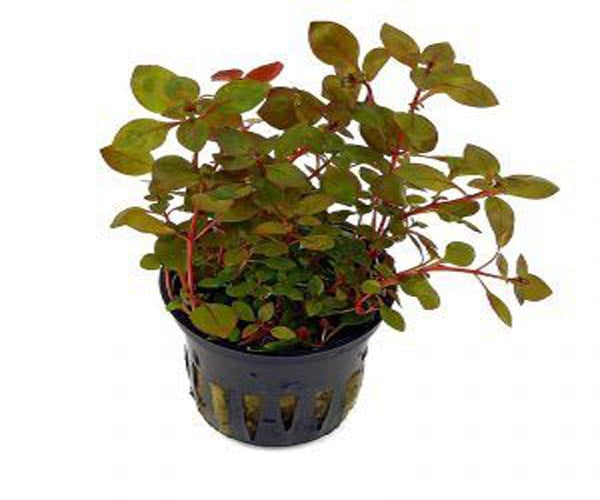
Ludwigia sp. "Mini Super Red" is a compact aquarium stem plant prized for its vivid red-to-pink foliage. It belongs to the wider Ludwigia genus, a group of wetland and marginal plants found across tropical and subtropical regions of the Americas, Africa and Asia, many of which have been adapted to fully submerged aquarium life. "Mini Super Red" itself is a hobby cultivar rather than a plant collected straight from the wild — a compact, more intensely coloured selection bred specifically for the aquascaping trade, where its small leaf size and dense growth make it a favourite for foreground and midground colour accents.
In good conditions it forms a low, bushy stand of small rounded leaves that shift from green toward deep red and pink the more light (and, optionally, CO2) it receives. Because it stays compact rather than shooting straight up like many stem plants, it's commonly planted in groups toward the front half of the tank rather than as a tall background hedge.
It's frequently confused with (and sold alongside) other small red-leaved stem plants such as Rotala rotundifolia and Ludwigia "Mini Super Red" itself is sometimes mislabelled under closely related trade names, so leaf shape is the easiest way to tell it apart: this cultivar has distinctly rounder, more oval leaves than the narrower, more pointed leaves of most Rotala species. In an aquascape it's often used the way a landscaper would use a low flowering shrub — planted in a dense cluster to create a solid block of warm colour that contrasts against the surrounding greens, rather than as an isolated accent stem. Because the colour intensity is so directly tied to light and nutrient availability, experienced aquascapers also use it as a rough visual gauge of a tank's overall light and fertilizer dosing — if it starts drifting back toward plain green, that's often the first visible sign that light or micronutrients have dropped.
Requirements
This plant is genuinely beginner-friendly for a red stem plant, which is part of why it's so widely grown.
Light: medium-to-high lighting is what actually drives the red colouration — under weak light it will grow but stay mostly green. It does not strictly require CO2 injection to survive, but supplemental CO2 and regular micronutrient/iron dosing noticeably deepens the red and speeds up growth.
Substrate: plant it in a nutrient-rich substrate (or dose root tabs under a plain substrate) — like most Ludwigia it roots into the substrate and feeds through both roots and leaves.
Placement & trimming: best planted in small groups rather than singly, spaced with room to bush out. Regularly pinch or trim the growing tips to keep it dense and low rather than leggy — cuttings root easily and can be replanted to fill out the group.
Propagation: straightforward stem-cutting propagation — trim a healthy top section and replant it directly into the substrate. A single starter portion will readily bulk up into a full group within a few weeks under decent light, since every cutting you take can be replanted rather than discarded.
Fertilizer: as a red-leaved plant it's a relatively heavy consumer of iron and other micronutrients specifically (these are what drive the anthocyanin pigments responsible for the red colour), so a liquid micronutrient/iron fertilizer dosed on a regular schedule — alongside root tabs for the macro-nutrients it pulls from the substrate — will noticeably outperform a plain, unfertilized setup even under otherwise identical light.
Common mistakes: the two most common reasons this plant fails to colour up are simply too little light and CO2/nutrient swings — an inconsistent dosing schedule tends to produce patchy, uneven colouration rather than the solid, deep red a stable routine produces. It's also sensitive to being shaded out by faster-growing neighbours, so keep an eye on surrounding plants overtopping it.
Compatibility
Water & Care Conditions
Tolerant of a range of conditions, but these ranges give the best growth and colour:
- pH: 6.0–7.0
- Water hardness: soft to moderately hard, general community-tank hardness is fine
- Temperature: 20–28°C (68–82°F)
- Light: medium to high — this is the main driver of red colouration, more so than any single water parameter
- CO2: not required to keep the plant alive, but supplemental CO2 and iron/micronutrient dosing produce noticeably faster growth and deeper red colour
- Water flow: moderate flow through the group helps prevent detritus and algae building up between the densely packed stems
- Nutrient dosing: a regular liquid iron/micronutrient dose is far more important to this plant's appearance than to a typical green stem plant, since iron uptake is directly tied to red pigment production
- Photoperiod: a consistent 8-10 hour lighting schedule, kept on a timer, gives steadier colour and growth than an irregular schedule
In low light without extra nutrients the plant will still grow but tends to stay greener and grow more sparsely, with longer gaps between leaves as it stretches toward whatever light is available rather than staying compact. Sudden drops in CO2 or nutrient dosing (for example after a long gap between fertilizer doses) can also cause a temporary pause in new red growth, with fresh leaves emerging green before colouring up again once dosing resumes — this is a normal recovery pattern, not a sign the plant is dying. Because the plant responds so visibly and quickly to changes in its care routine, it also doubles as an easy early-warning indicator for the rest of a planted tank: if it starts losing colour or growing leggy, it's often worth checking overall light intensity and fertilizer dosing before assuming anything is specifically wrong with this one plant.