About & Origin
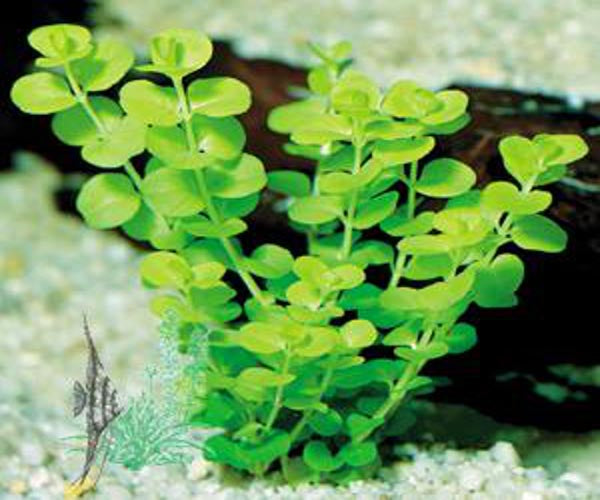
Lysimachia nummularia is a versatile aquatic and paludarium plant — widely known outside the aquarium world as Creeping Jenny or Moneywort — native to damp meadows, ditches and streambanks across Europe and parts of western Asia, where it naturally sprawls along wet soil as a low, creeping ground cover. Its round, coin-shaped leaves (the "nummularia" in its name literally references coins) give it a distinctive look that's easy to recognise once you've seen it.
In its native form it's an amphibious plant, equally happy growing emersed with its leaves above water as it is fully submerged — which is exactly why it's popular in both paludariums/riparariums (grown emersed along the waterline) and standard aquariums (grown fully submerged as a stem plant). Submerged, its growth habit shifts to a more upright stem with pairs of rounded green leaves running along it.
Outside the fishkeeping world it's actually a well-known (and in some regions invasive) outdoor groundcover and pond-margin plant, sold in garden centres as "Creeping Jenny" for boggy garden beds and container water gardens — the aquarium form sold here is exactly the same species, just grown and shipped for submerged aquarium use rather than as an outdoor perennial. That dual identity is part of why it's such a forgiving aquarium plant: a species that's naturally adapted to survive both fully flooded and only-occasionally-wet conditions in the wild tends to be far more tolerant of an aquarium's inevitable swings in water level, temperature and lighting than a plant that only ever evolved underwater.
Visually it's often used as a lower-effort, more temperature-tolerant substitute for other rounded-leaf stem plants, since it can hold its own in cooler unheated tanks where many typical tropical stem plants would struggle. Its compact leaf pairs also make it a useful mid-height plant for breaking up sightlines between a tall background hedge and a low foreground carpet in an aquascape layout.
Requirements
One of the more forgiving stem plants, which is why it turns up in both simple community tanks and dedicated aquascapes.
Light: does fine under moderate lighting without CO2, but responds to higher light and CO2/fertilizer dosing with noticeably denser, faster growth.
Substrate: not fussy — it roots readily in ordinary planted-tank substrate and adapts to a wide range of hardness.
Placement: typically grown as a background or midground stem plant, planted in small groups; can also be grown emersed along a paludarium waterline if you keep part of it above the surface.
Trimming & propagation: a moderately fast grower — trim the tops regularly to keep it bushy rather than leggy, and replant the cuttings, which root easily.
Emersed growth: if you're running a paludarium or riparium setup, it will happily grow with its stems partly out of the water, producing slightly different, often more rounded foliage above the waterline and small yellow flowers — something it will not do fully submerged. This makes it a genuinely dual-purpose plant for anyone building a mixed aquatic/terrestrial display, not just a standard aquarium stem plant.
Fertilizing: it will grow on tap-water nutrients alone in a lightly stocked tank, but in a low-nutrient or heavily-planted tank it benefits from a standard all-in-one liquid fertilizer dosed a few times a week, especially where nitrate and potassium are concerned.
Compatibility with unheated tanks: because it tolerates cooler water better than most stem plants, it's a reasonable choice for goldfish tanks or unheated setups where more strictly tropical stem plants would decline over time — worth considering specifically for that use case if the rest of the tank runs on the cooler side.
Space: give it room to spread once established — a healthy group will fill out and can shade neighbouring low-light plants if left completely untrimmed for long stretches, so factor its eventual bushier footprint into initial spacing.
Compatibility
Water & Care Conditions
One of the most undemanding stem plants available — it tolerates a genuinely wide range of conditions:
- pH: 6.0–8.0, with 6.5–7.2 giving the healthiest growth
- Water hardness: adaptable across a wide range, roughly 4–16 dGH
- Temperature: 15–25°C (59–77°F) tolerated, with faster growth toward the warmer end — it's unusually cold-tolerant for an aquarium stem plant
- Light: moderate to high, 10–12 hours a day; grows fine without CO2 but rewards CO2 + nitrate/trace fertilizing with denser growth
- CO2: not required, but supplemental CO2 measurably speeds growth and produces tighter internode spacing (leaves packed closer together)
- Water changes: tolerant of the normal swings in a regular weekly water-change routine, one of the reasons it's a common recommendation for beginner planted tanks
- Water movement: not particular about flow, does fine in both gently and moderately circulated tanks
Its wide temperature and hardness tolerance makes it one of the easier stem plants to keep alongside almost any community fish setup. Unlike more demanding red or carpeting plants, it rarely shows dramatic visual distress signals when conditions aren't perfect — instead of melting or bleaching, it tends to simply slow its growth rate and space its leaves further apart along the stem, which makes it a genuinely low-stress choice for anyone still learning to read how their tank responds to changes in light, fertilizing or water chemistry. If growth does stall out completely, the most common causes are insufficient light reaching the lower/older portions of the stem (worth thinning surrounding plants) or a long-term nutrient deficiency rather than anything acutely wrong with the water itself.
Because it's genuinely one of the more forgiving stem plants sold, it's a reasonable pick for a first planted tank or for anyone who wants real greenery without committing to a demanding CO2/high-light setup — it simply grows slower and less densely rather than failing outright under lower-tech conditions.