About & Origin
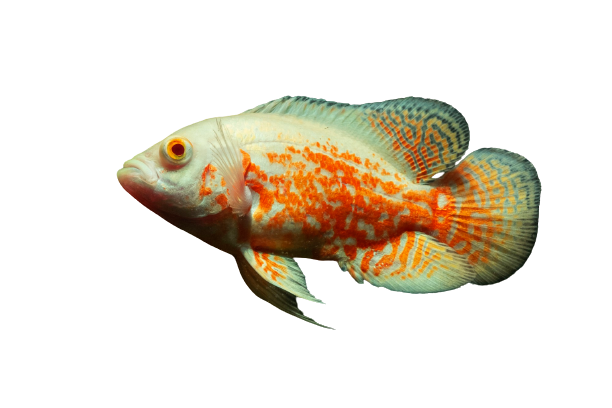
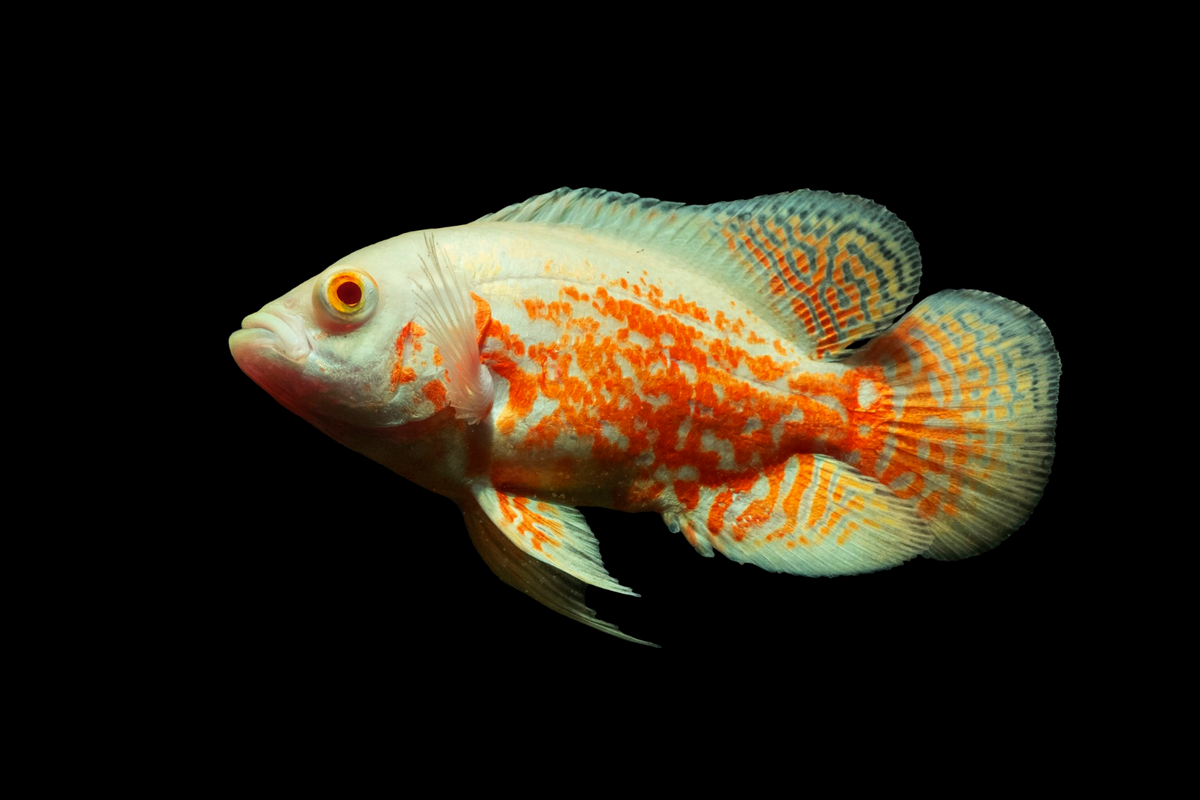
The oscar (Astronotus ocellatus) is a large South American cichlid from the slow-moving, often turbid waters of the Amazon, Rio Negro, and Paraná river basins. The mango-coloured (orange/yellow mottled) tiger oscar seen in this listing is a selectively bred colour form of the same wild species, not a different fish.
Oscars are famous in the hobby for their intelligence and personality -- they recognise their owner, learn to anticipate feeding time, and are often described as 'the dog of the aquarium world' for how interactive they become once settled in.
In the wild they're ambush predators, hanging in cover near submerged wood and vegetation before lunging at passing prey, a hunting style that carries straight over into tank behaviour: an established oscar will often "case" a new tankmate for days before deciding it's food, rather than attacking on sight.
They're also long-lived for an aquarium fish, commonly reaching 10-15 years or more with good care, and continue growing for the first few years of life -- a young oscar bought small will still need the full-size adult setup within a year or two, so it's worth planning tank space around the fish it will become rather than the size it's sold at.
Colour and pattern in oscars vary widely even within a single wild population, and decades of aquarium breeding have produced additional named forms -- tiger (mottled orange-and-black), red, albino, and long-fin variants among them -- all still the same species and sharing identical size, temperament, and water requirements regardless of colour. This variety, combined with the fish's outsized personality, is part of why oscars have stayed one of the most consistently popular large cichlids in the hobby for decades, despite the serious space commitment they demand.
Requirements
Oscars grow large -- commonly 30-35cm, occasionally more -- and a single adult needs at least 250-300 litres (65-75 gallons), with more for a pair or group. They also rearrange decor enthusiastically, uprooting plants and moving gravel, so hardscape needs to be secured and planting kept minimal or in pots; large, well-anchored driftwood and rock rather than delicate aquascaping suits them far better.
They're intelligent, food-driven predators that will eat any tankmate small enough to fit in their mouth, so companions need to be large and robust, not small community fish. Two oscars can coexist but may pair off aggressively toward others; stocking should be planned carefully, and a spare tank or divider is worth having in case a pairing turns aggressive rather than reproductive.
Diet is important to get right: a high-quality cichlid pellet as a staple (not a diet of feeder fish, which carries disease risk and poor nutrition), supplemented with prawn, earthworm, and other meaty protein for conditioning. Overfeeding is a common real mistake with this species -- oscars beg persistently and will eat far more than they need, and obesity together with a poor, feeder-fish-heavy diet is a leading cause of the "hole in the head" disease (head and lateral-line erosion) sometimes seen in the trade.
Filtration needs to be sized generously: oscars are large, messy eaters that produce a heavy bioload, and canister or sump filtration rated well above the tank's nominal volume is the norm rather than the exception for this species. A secure, heavy lid is also worth having -- oscars are strong enough to dislodge loosely fitted equipment and have been known to splash substantial amounts of water out of an open-topped tank.
Compatibility
Water & Care Conditions
Oscars are fairly adaptable to water chemistry, but their size and bioload make filtration the real limiting factor:
- pH: 6.0–8.0
- Water hardness: soft to moderately hard, 5–20 dGH
- Temperature: 23–27°C (74–81°F)
- Oxygenation: a large, heavy-bioload fish -- strong filtration and good oxygenation are essential, not optional
- Water changes: larger, more frequent partial water changes (25-30% weekly) than a small community tank needs, given the bioload; ammonia and nitrite should always read zero
- Common issues: "hole in the head" disease (head/lateral-line erosion, linked to poor diet and water quality) and ich are the two most commonly seen health problems, both largely preventable with a varied diet and consistent water quality
Given a large enough tank and consistent care, oscars are a genuinely long-term commitment rather than a starter fish, but they're also one of the more forgiving cichlids on exact water chemistry -- stability and cleanliness matter more to this species than hitting a precise number within the ranges above.
A well-cycled tank before introducing an oscar matters more than with most small community fish, given how quickly a large, food-driven predator can produce enough waste to spike ammonia in an uncycled or under-filtered setup. Test kits for ammonia, nitrite, and nitrate are worth keeping on hand permanently for this species rather than just during initial setup, since its size means water-quality problems can develop and become dangerous faster than in a lightly stocked community tank.
Aquascaping choices should account for how heavily an oscar disturbs its environment -- floating or loosely rooted plants will be uprooted, fine substrate gets rearranged into piles as the fish digs, and any decor needs to be either too heavy to move or securely wedged in place, since an oscar treats loose gravel and light ornaments as toys as much as territory markers.