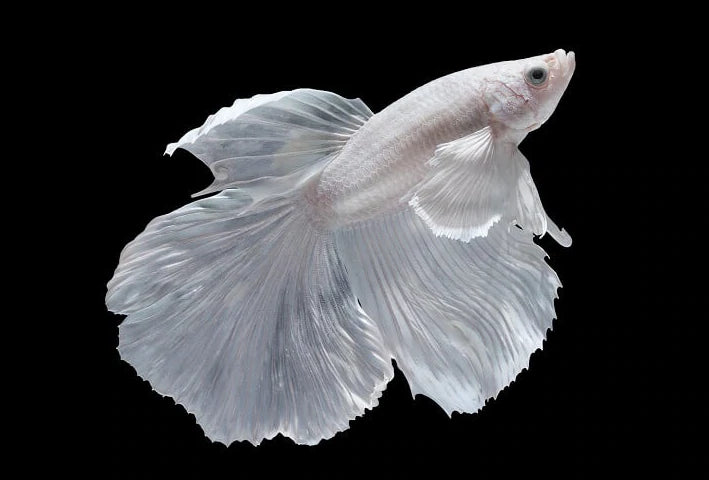
Betta fish, also known as Siamese fighting fish, are very common with beginner aquarists. They are small and colorful fish with striking personalities.
They have been cross-bred over years creating the most amazing colorations and tail variations.
They do not require a lot of maintenance and their physiology and behavior is quite captivating and amazing.
This fish can learn to recognize their owners, and they also create bubble nests. Betta fish have an organ known as the labyrinth organ which allows them to breathe air as their gills cannot always get enough oxygen from the surrounding waters.
There are different ways to classify Bettas by looking at the shape of their tails, their patterns and finally colors.
About & Origin
The Betta, or Siamese Fighting Fish, is a small, hardy freshwater fish prized for its dramatic fins and colour. This particular Betta (Betta splendens) variety is bred for a milky-white tail set against a contrasting body colour — a bi-colour pattern achieved through selective breeding rather than found in the wild. The species is native to the slow-moving rice paddies, ditches, and floodplains of Thailand, Cambodia, Vietnam, and Laos, where the wild ancestor is far more modestly coloured than any ornamental variety in the trade today.
Bi-colour patterns like a contrasting white tail are prized precisely for that contrast, and like all betta colour and pattern traits are the result of over a century of dedicated breeding, mostly concentrated in Thailand.
Biologically it's identical to any other betta — the same labyrinth organ for breathing surface air, and the same solitary, territorial nature in males.
This describes a betta with a milky-white tail, either as a solid "cellophane"/white-tail pattern or as part of a bi-colour body-and-fin combination — a trade description of colour pattern within Betta splendens rather than a distinct fin type.
As with all bettas, it descends from wild labyrinth fish native to the shallow rice paddies, floodplains, and slow drainage ditches of Thailand and neighbouring Southeast Asia.
This variety pairs a coloured or patterned body with a distinctly white or pale ("milk") tail and fins, a contrast pattern selectively bred within Betta splendens rather than a separate type of fish. Like all bettas it originates from Thailand's shallow rice paddies and slow-moving waterways, and carries the same labyrinth organ letting it gulp air at the surface.
As a selectively bred contrast pattern, the exact boundary and shade between the coloured body and white tail can vary somewhat between individual fish even within the same batch.
Requirements
Keep singly, or as the sole betta in a community — never with another male betta, which will result in fighting.
Its long fins are vulnerable to nipping, so tankmates must be genuinely calm and non-aggressive, and it does better in gentle flow than strong current.
Feeding is easy — a good quality betta pellet as a staple, with occasional live or frozen treats for variety.
One male per tank — territorial toward other male bettas, best kept alone or with carefully chosen, peaceful, fin-safe tankmates.
A betta-specific pellet as the dietary staple, since bettas are primarily carnivorous, with occasional live or frozen bloodworm or brine shrimp for variety.
A tank of at least 20 litres with a heater and gentle filtration is recommended for a genuinely healthy long-term home.
Pale/white fin sections can sometimes make early signs of fin rot or fungal issues easier to spot than on a solid dark-finned fish, which is a genuine practical advantage for monitoring health — any discolouration, ragged edges, or clamped fins are worth acting on quickly. One male per tank always; never house with another betta.
A varied diet of quality betta pellets plus occasional live or frozen bloodworm/brine shrimp keeps this fish in good condition, with small, regular feedings preferred over one large daily feeding given its small stomach.
Regular partial water changes of around 25-30% weekly and a reliable heater avoiding sudden temperature swings keep this fish healthy long-term. Bettas are more sensitive to fluctuating conditions than many community fish, so consistency matters more than chasing one perfect number.
Avoid sudden large-volume water changes, which can shock a betta more than smaller, gentler changes spread out over time.
Overall a low-maintenance betta variety once basic heated, filtered conditions are met.
Compatibility

Water & Care Conditions
Standard betta care via its labyrinth organ's tolerance for still water:
- pH: 6.0–7.5
- Salinity / hardness: freshwater only, soft to moderately hard water
- Temperature: 24–28°C (75–82°F) — a stable heater is essential
- Light: moderate, with floating plant cover appreciated
- Oxygenation: tolerant of still, low-oxygen water; prefers calm water over strong flow
- Health monitoring: pale fin sections make early fin-rot or fungal discolouration easier to spot than on solid dark fins — a genuine practical advantage for catching problems early
- Housing: one male per tank always; heated, filtered water of at least 15-20 litres is far better long-term than a small unheated bowl
- Diet: quality betta pellets as a staple, with occasional live/frozen foods for variety and condition
- Longevity: typically lives 2-4 years with good, stable care
- Tank position: spends most time in the upper-to-middle water column near the surface
- Filtration: gentle flow is best, avoiding strong current that can tire a betta's fins
As a labyrinth fish, it can breathe atmospheric air at the surface, tolerating lower dissolved oxygen and stiller water better than most community fish.
Gentle flow and smooth, snag-free decor help protect this species' fins from tearing or fatigue.
Unlike most tropical fish, this fish genuinely needs a tight-fitting lid with an air gap underneath, not to prevent jumping alone but because it periodically surfaces to gulp air through its labyrinth organ, and a fully sealed lid with no airspace can leave the air it breathes stale and humid.
A heater is essential despite the labyrinth organ's tolerance for lower oxygen -- bettas are true tropical fish and become lethargic, prone to illness, and short-lived in unheated, too-cool water, contrary to the common misconception that they can live in a small unheated bowl.